On 10 April 1814, Easter Day, Wellington attacked Marshal Soult's army entrenched at Toulouse. At heavy cost the Allies took the heights of Calvinet, and Soult evacuated the city the following evening. But the battle had been fought for nothing: Napoleon had abdicated a few days earlier, and the news reached Toulouse only on the 12th.
Forces at play
Outcome: Disputed outcome: Toulouse taken, Soult's army intact

France
- Soult
- Clausel
- Reille
- Harispe
About 42,000 men
Casualties: 2,700 to 3,200 men

United Kingdom · Spain · Portugal
- Wellington
- Beresford
- Freire
- Picton
About 49,000 men, including 9,500 Spaniards
Casualties: 4,500 to 5,500 men, nearly 2,000 of them Spanish
Flags: FDRMRZUSA, CC BY-SA 4.0, Wikimedia Commons
Battle coordinates
Toulouse
Coordinates 43.6045° N · 1.4440° E
Battle narrative
From Spain to the South of France
By the end of 1813 the British, Portuguese and Spanish army of the Marquess of Wellington had driven the French out of Spain and crossed the Pyrenees. Marshal Soult, commanding the imperial army in the South-West, fell back step by step. Beaten at Orthez at the end of February 1814, he had to choose between covering Bordeaux and covering Toulouse; he withdrew towards Toulouse, which was easier to supply. On 12 March Bordeaux opened its gates to the British without a fight, and the royalists there proclaimed Louis XVIII.
Soult reached Toulouse on 24 March. He put the city in a state of defence, although part of the population, royalist or weary of war, was not well disposed towards him. The news from the north was bad: the Allies were marching on Paris.
A city between two rivers
Toulouse was protected on the west by the Garonne; on the far bank, the fortified suburb of Saint-Cyprien covered the city. To the north the Languedoc Canal formed a continuous ditch, whose bridges — the Ponts-Jumeaux, the Pont des Minimes and the Pont Matabiau — were covered by earthworks. To the east, between the city and the small river Hers, stretched the heights of Calvinet, or Mont-Rave, which Soult had studded with redoubts. About 42,000 French held these positions; Wellington had about 49,000 men, 9,500 of them Spanish.
Wellington had to cross to the right bank of the Garonne. On 4 April his engineers threw a pontoon bridge across north of the city; but after some 19,000 men had crossed, the flood carried the bridge away and cut them off for three days. Soult did not seize the chance to attack them. On 8 April the British hussars seized the bridge of La Croix-d'Orade over the Hers.
10 April, Easter Sunday
Wellington attacked on 10 April, Easter Day. In the west, General Hill made a diversion against Saint-Cyprien. In the north, Picton's division, ordered to make mere demonstrations, launched a real attack on the Ponts-Jumeaux and was repulsed with significant losses. The main effort was to fall on the heights of Calvinet: Freire's two Spanish divisions were to attack their northern end, while Marshal Beresford, with two Anglo-Portuguese divisions, marched along the Hers to take them from the south.
But Beresford got bogged down in the sodden fields. Thinking he heard the signal to attack, Freire launched his Spaniards too early: they climbed the slope, were counter-attacked and fell back; rallied under Wellington's eyes, they attacked a second time and were thrown back again with heavy losses.
The redoubts of Calvinet
Beresford at last reached his start line south of the heights. Taupin's division came down to meet him but deployed badly: caught by artillery fire and by Congreve rockets, a new weapon, it broke, and General Taupin was killed. The Anglo-Portuguese climbed the slope, took the Sypière redoubt, then worked their way north along the heights. The redoubts were taken and retaken. General Harispe, who was defending them, fell badly wounded, and the French abandoned the Calvinet redoubt to entrench a little further back, on the knoll of Sacarin and as far as the Pont des Demoiselles.
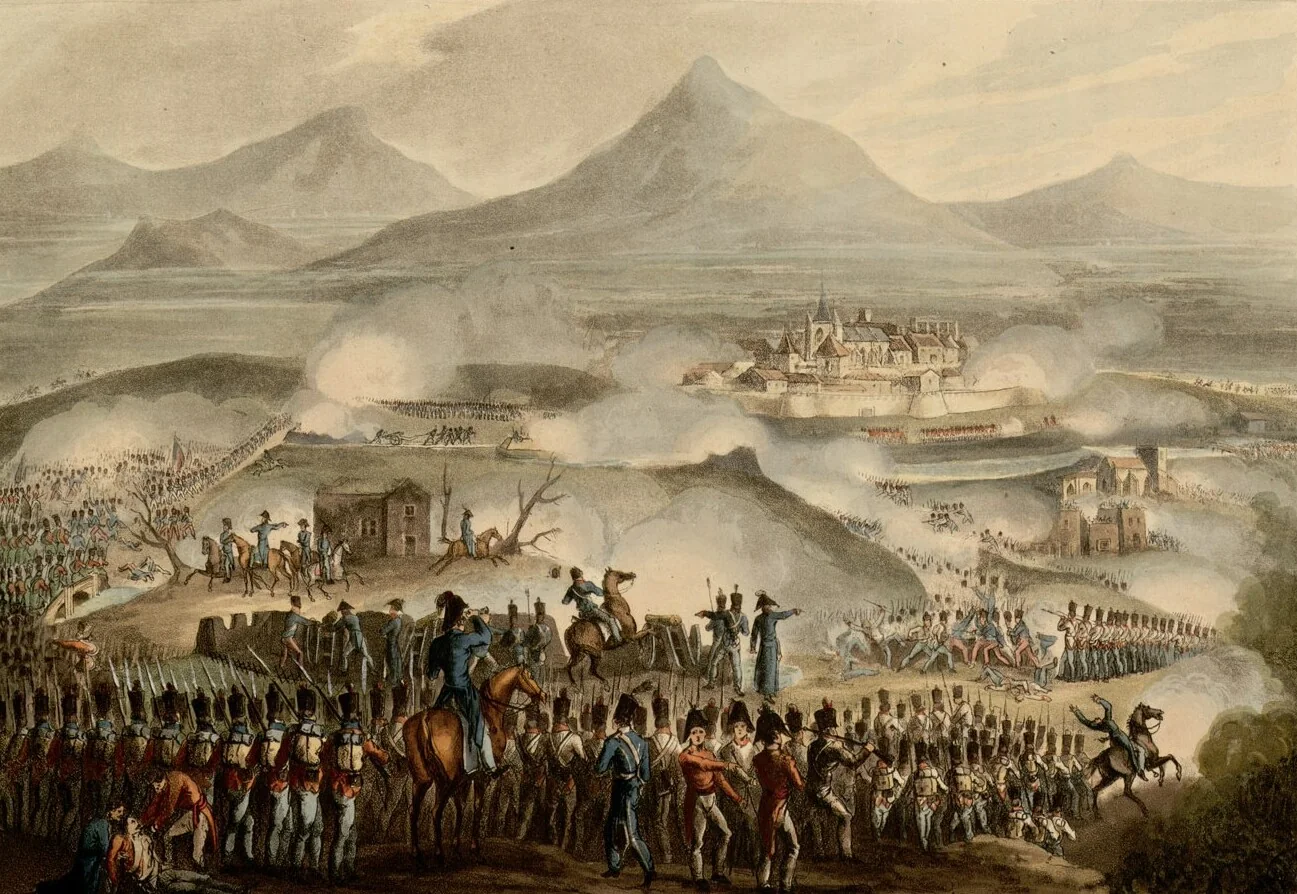
By nightfall the Allies held the heights, but the French line was not broken, and Wellington, short of ammunition, could not exploit his advantage. The Allies had lost 4,500 to 5,500 men, nearly 2,000 of them Spanish; the French 2,700 to 3,200.
The evacuation of Toulouse
On 11 April the two armies remained face to face. But the British cavalry was threatening the Carcassonne road, by which Soult hoped to join Marshal Suchet's army. That same evening, at about 9 p.m., Soult evacuated the city in good order along that road, leaving some 1,600 wounded behind in the city. On the morning of the 12th the municipal authorities handed Toulouse over to the Allies, and Wellington was cheered there by the royalists.
A battle fought after the war had ended
That very afternoon of the 12th, Wellington learned that Napoleon had abdicated: the official couriers had left Paris on the night of 7 April, too late to prevent the battle. Soult at first refused to believe news coming from the enemy; he signed the armistice only on 17 April, after receiving a dispatch from Berthier. Both sides claimed victory: the British because Toulouse had fallen, the French because Soult's army, having inflicted heavier losses than it suffered, had withdrawn intact. In Toulouse an obelisk inaugurated in 1839, the Rue du Dix-Avril and the Rue 1814 commemorate the battle.
Go further
Recommended books to dig deeper (affiliate links)

Napoleon the Great
Andrew Roberts · 2014
A monumental biography drawing on Napoleon’s 33,000 surviving letters, admiring but rigorous.
See on Amazon
Napoléon ou le mythe du sauveur
Jean Tulard · 1977
The book that reshaped how the man is read: how France gave itself a saviour, and what it cost.
See on Amazon
Nouvelle histoire du Premier Empire
Thierry Lentz · 2002-2010
Four reference volumes on institutions, diplomacy and collapse: the scholarly synthesis of the subject.
See on AmazonAs an Amazon Associate, this site earns from qualifying purchases.
Support the encyclopedia
Napoleon Empire is an independent project. Your contribution helps grow the content and keep the site running.
DonateSecure payment on the platform you choose.