Origins and creation
The Guard's musical tradition traces back to the Consular Guard, where every elite infantry regiment gathered, as early as Year VIII (1799-1800), its own drum corps and wind band, distinct from the fighting troops. When the Consular Guard became imperial in 1804, these formations grew with it, gaining in strength and prestige as the new regime asserted its splendour.
A decree of 1802 set the establishment of the 1st Foot Chasseurs regiment, providing a band of thirty-five soldier-musicians, officers included. The Foot Grenadiers, at the head of the Old Guard, maintained an even larger formation, gathering around forty-eight players under a sergeant-major — a figure far above that of ordinary line bands.
Organisation and strength
On the march, the "head of column" followed an unvarying protocol: bearded sappers, leather aprons and axes on their shoulders, opened the parade; then came the drum-major, the drum corps, and finally the band itself. This ceremony, repeated at the great reviews of the Carrousel and the Tuileries as much as on campaign, shaped the Guard's public image almost as much as its cavalry charges.
Every Guard regiment — grenadiers, chasseurs, then the Young Guard's fusiliers, tirailleurs and voltigeurs — maintained its own band, administratively distinct from the company drummers responsible for combat signals (charge, retreat, rally). The two functions, musical and martial, remained complementary but kept separate in the chain of command.
Uniform, instruments and recruitment
The band combined woodwinds — oboe, clarinets in C and F, bassoon, flute — with brass — trumpet, horn, bugle, trombone, serpent — and a "Turkish-style" percussion section then fashionable across European armies: side drum, bass drum, cymbals, Chinese hat (jingling johnny) and triangle, borrowed from Ottoman janissary bands through the eighteenth-century fashion for them.
Musicians' coats broke with the troop's dark blue: a legacy of the Egyptian campaign, they wore a sustained sky blue, trimmed with scarlet counter-epaulettes for the grenadiers and jonquil yellow for the voltigeurs, with function lace on collar and cuffs. Grenadier musicians wore the bearskin colback, voltigeur musicians the shako — an ornamental extravagance that culminated in the drum-major's uniform, laced with gold and topped with an imposing plume.
Deeds of arms
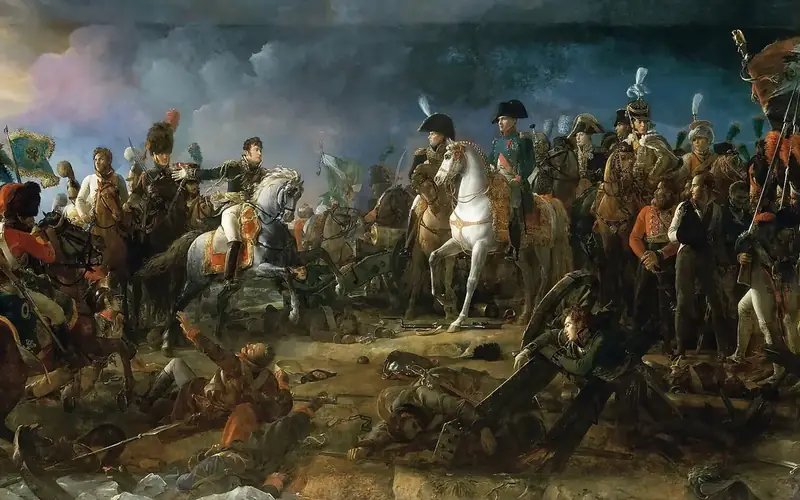
Jean-Nicolas Sénot (1761, Salins-les-Bains – 1837, Melun) embodies this function: drum-major of the 1st Foot Grenadiers of the Guard from Year VIII to 1814, he led his drum corps through every campaign of the Empire. At Austerlitz, on 2 December 1805, his drummers beat the charge with such force that several drumheads tore under the strain — an episode that survived in regimental memory.
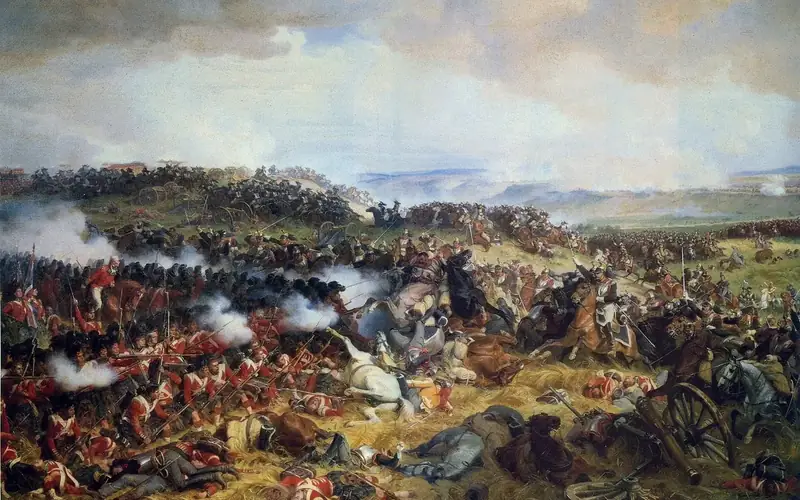
Recalled to service during the 1815 Belgian campaign, Sénot then commanded a battalion of the 2nd Foot Grenadiers at Waterloo on 18 June — a career that shows how the Guard's musical function did not exclude, on occasion, command of troops in the line.
Legacy and memory
Through their sumptuous dress and their virtuosity, the Guard's bands fixed, for painters and memoirists of the nineteenth century alike, the sound and image of the First Empire: rousing marches at the great reviews, drumrolls marking the great days of battle, the drum-major's gilded silhouette leading the bearskins.
Historical re-enactment associations still keep this repertoire and these uniforms alive today, notably around the memory of Waterloo, a reminder that the Grande Armée did not march only to cadenced step, but also to music.