Origins and creation
The horse grenadiers of the Guard inherited the Consular Guard horse grenadiers, already distinguished under the Consulate. On 18 May 1804 they entered the Imperial Guard establishment as an elite heavy cavalry regiment under colonel-general Bessières.
Their vocation was not skirmishing: it was the breakthrough charge, massive intervention when the enemy centre wavered or a threatened French line had to be restored. The unit cultivated an aesthetic of power — tall horses, dark uniforms, bearskins — that impressed allies and adversaries alike.
Across the campaigns the regiment remained relatively limited in strength compared with line cavalry, precisely to preserve recruiting quality and mounts.
Organisation and strength
The regiment was organised in squadrons. Strengths varied; orders of magnitude cited by historians often turn around one thousand to fifteen hundred sabres in normal periods, with falls after murderous campaigns. Exact figures depend on reviews and depots.
Bessières supervised Guard cavalry; in the field officers such as General Walther or Colonel (later General) Lepic appear in immediate command of the horse grenadiers. Lepic remains associated with the Eylau charge and the famous reply preserved by tradition: ‘Heads up! Canister is not shit!’
In the Guard hierarchy the horse grenadiers belonged unambiguously to the Old Guard. Their status equalled that of the horse chasseurs for prestige, with a more distinctly ‘heavy’ mission.
Uniform, arms and recruitment
The bearskin, dark blue coat with lapels, heavy cavalry boots and straight heavy-cavalry sabre composed the classic silhouette. Horses, often black or very dark in period descriptions, reinforced the effect of a homogeneous mass.
Recruitment required experienced troopers of suitable stature, able to master a heavy mount at the gallop under fire. Guard pay and privileges attracted the best from cuirassier and dragoon regiments, without automatic entry.
Training stressed charge cohesion: heavy cavalry that broke apart lost its advantage. The horse grenadiers drilled to hold alignment up to the shock.
Deeds of arms
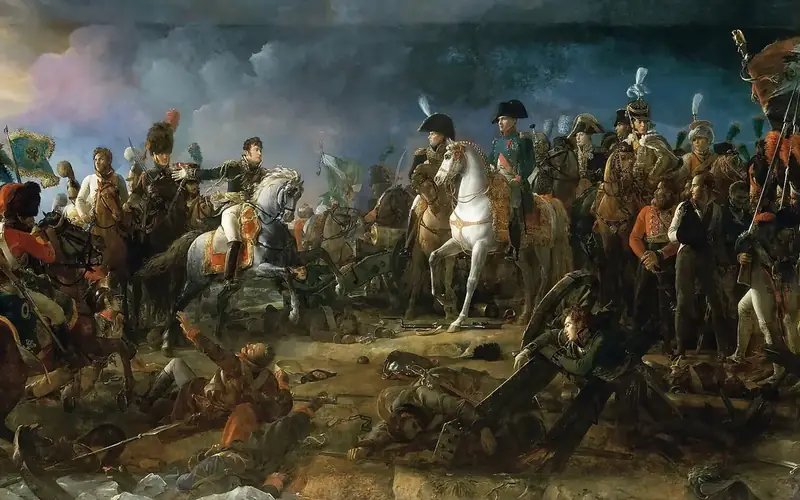
At Austerlitz Guard cavalry intervened to complete success when the Allied deployment broke. The horse grenadiers formed part of that mounted reserve Bessières held near the Emperor.
At Eylau on 8 February 1807, in the snowstorm, the great cavalry charge — in which Murat also committed the reserve — saw the horse grenadiers play a shock role. Tradition retains Lepic’s bearing under canister as a symbol of corps coolness.
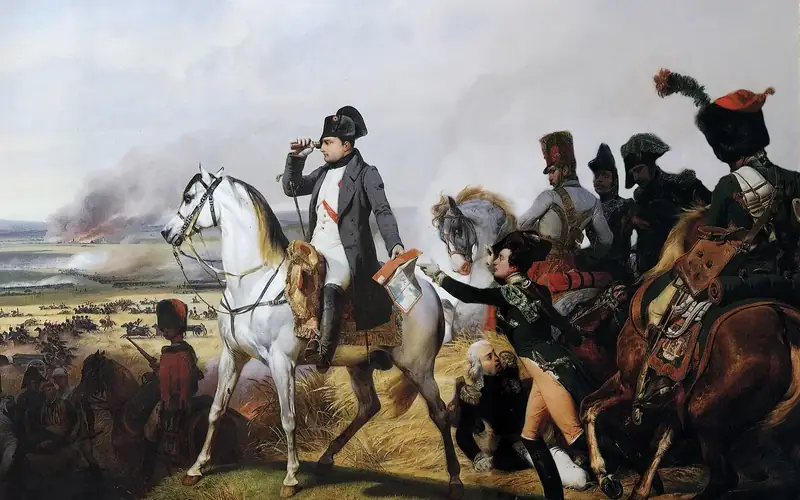
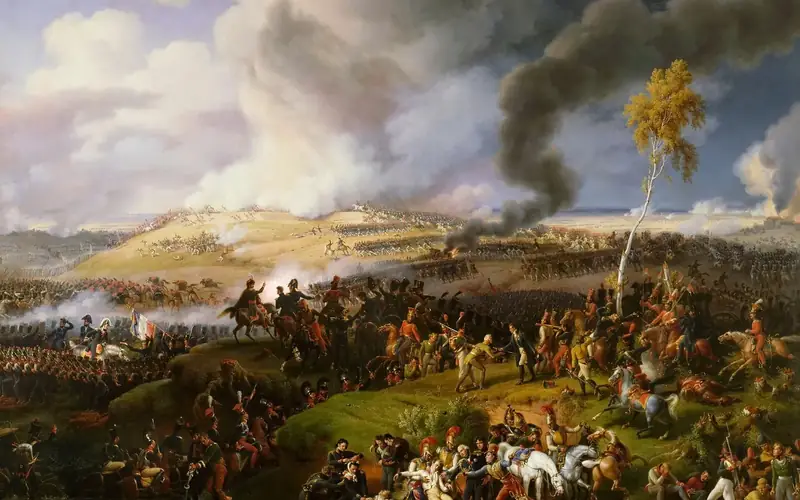
They were present in the Austrian (1809), Russian (1812) and German (1813) campaigns. Like all Guard cavalry they suffered the loss of horses in Russia: without mounts the finest unit became improvised infantry.
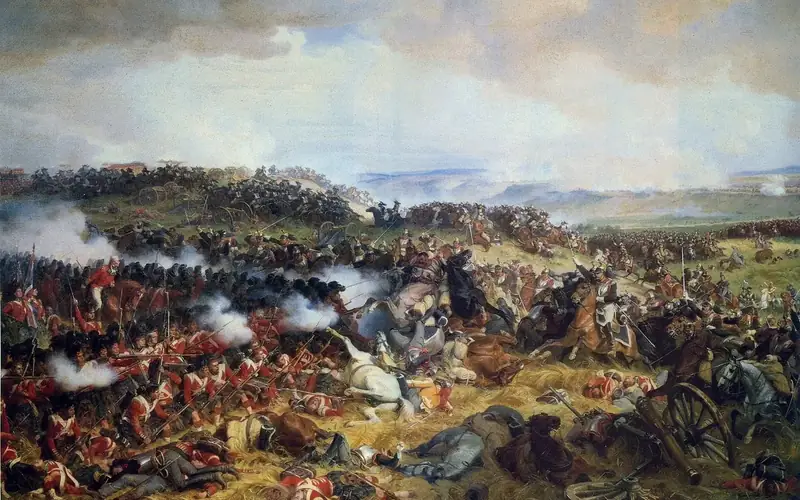
At Waterloo Guard cavalry charged repeatedly against Allied squares without achieving decisive rupture. The horse grenadiers paid the price of those repeated assaults against still firm infantry and murderous artillery.
Legacy and memory
In nineteenth-century painting and engraving the Guard horse grenadier embodies Napoleonic cavalry at its most solemn. Uniform museums still preserve coats and bearskins that fascinate the public.
Their memory merges with that of Bessières: a reserve cavalry, not a parade cavalry, whose value was measured by the moment chosen to give rein.