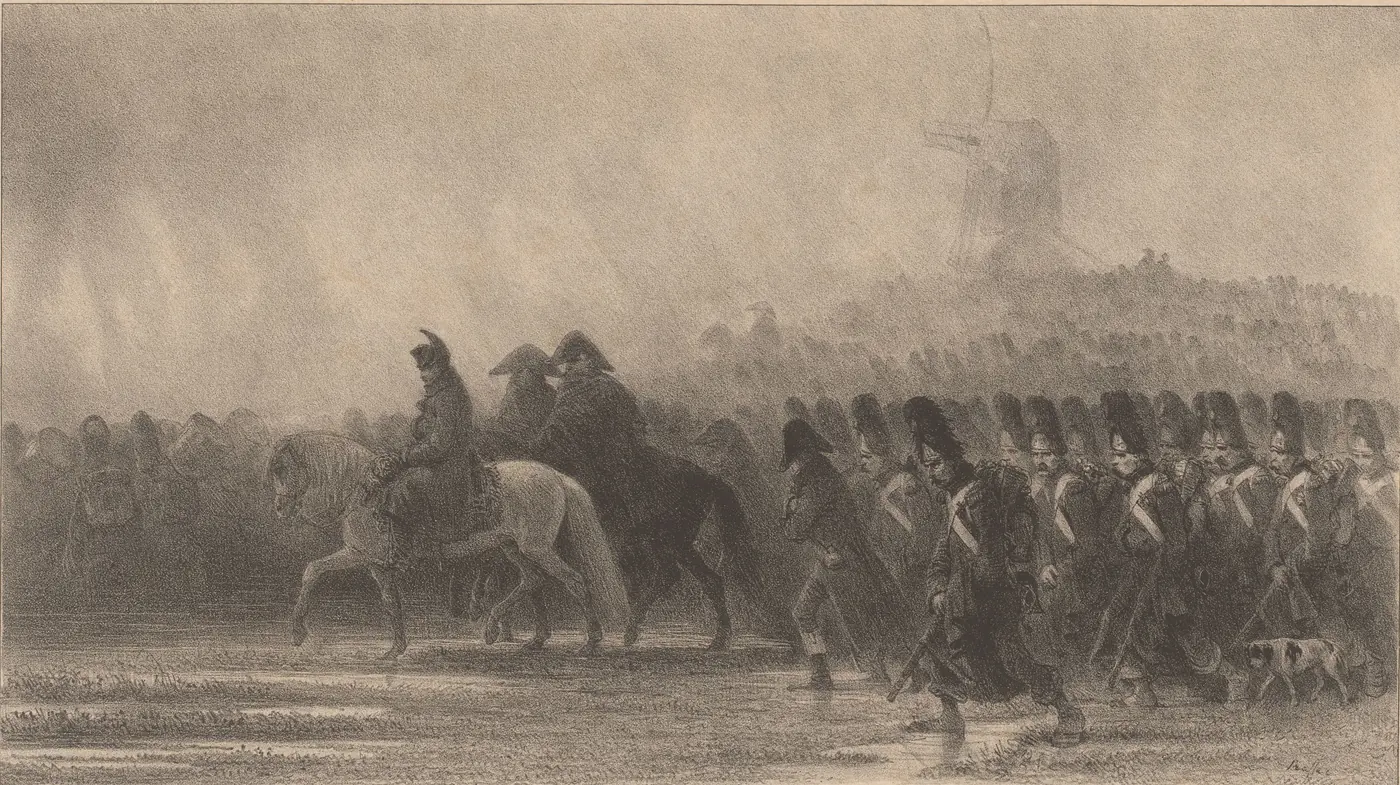
A tall black fur headdress inherited from the grenadiers of the seventeenth century, the bearskin cap gave the Old Guard a silhouette recognisable among all others, from Raffet's lithograph to the squares of Waterloo.
Origins and precedents
In the lithograph Auguste Raffet published in 1836, a column of grenadiers trudges through rain and mud behind a rider in a greatcoat. The eye catches the faces first, then what rises above them: tall black caps, packed together like a forest. No other piece of headgear of the First Empire says the Old Guard as quickly as this bearskin.
Its history begins well before Napoleon. In the seventeenth century, grenadiers, soldiers picked to throw grenades by hand, found it hard to handle their weapon in a broad-brimmed hat. The traditional explanation is that they adopted a brimless cap, more practical, which later grew taller and was covered in fur. Whether the tale is exact or simplified, the outcome is well known: by the following century, the fur cap marked the elite companies of the infantry all over Europe.
Birth of the imperial symbol
The Revolution did not abolish it. Grenadiers in the armies of the Republic kept their caps, and when the Consular Guard was organised at the end of 1799 around its foot grenadiers, it took the cap up again as a mark of distinction. In 1804 the Guard became imperial and the cap went with it, with nothing to invent: the object was already familiar and merely had to change masters.
The Guard's model is a tall headdress of black fur, wide enough to enclose the head and rising well above the forehead. On the front, a copper plate, whose design varied with the period and the model, catches the light. A red plume, a white cord ending in tassels, a tricolour cockade and a flap of red cloth hanging at the back complete the whole, which turns the infantryman into an almost architectural silhouette.
Official uses
The effect sought was as much psychological as military. The cap added to the stature of men already chosen for their height and gave the serried ranks the look of a wall. In combat it was of no use: it was heavy, it soaked up water, it feared rain more than it guarded against a sabre cut. But Napoleon's army knew the value of a uniform that impressed before a shot was fired.
It was therefore worn with care. On campaign the cap was readily covered with a cloth cover, and in ordinary service dress the bicorne replaced it. The fur was kept for days that mattered: reviews, entries into cities, ceremonies, and battle days when the Guard showed itself. That rarity counted for much in its prestige, since people are seldom moved by what they see every day.
In the army and in battle
It was not the privilege of the Guard's foot grenadiers alone. The Guard's foot chasseurs wore it too, with a plume distinguishing their arm, as did the mounted grenadiers, seen in fur caps at Eylau in the charge led by Lepic, and the sappers, who added a full beard, a leather apron and an axe. In the line infantry, grenadier companies still sported it at the start of the Empire, before the shako took over from about 1807.
To wear this cap was to belong to the most respected corps in the army. One entered it after several campaigns and long years of service, and the Guard enjoyed pay, rank and care that set it above the rest of the infantry. The men, in turn, knew they were watched. Their nickname of « grognards », the grumblers, comes from the liberty they allowed themselves to complain aloud, even in front of the Emperor, without ever faltering when it was time to march.
Propaganda and representation
It is this bond of affection that Raffet fixed in 1836, fifteen years after Napoleon's death, under a title that became proverbial: They grumbled, and yet they always followed him. Born in 1804, he had seen no campaigns, but he belonged to the generation of artists who, with Charlet and a few others, helped shape the figure of the old soldier of the Empire under the July Monarchy. In their images the bearskin works as an instantly recognisable sign.
The Russian campaign offered the harshest test. In 1812 the Old Guard followed the Emperor to Moscow, then took the road west with him, and when the army fell apart it remained one of the few corps to keep its ranks. At Krasnoi, in mid-November, its battalions still advanced in order among the Cossacks, which many witnesses remembered as much as the disorder around them.
Posterity and collections
On 18 June 1815, it was the Guard that was committed late in the day against the plateau of Mont-Saint-Jean. Its battalions climbed the slope under grapeshot, fell back, and then a few squares of the Old Guard covered the retreat around La Belle-Alliance. The famous phrase credited to Cambronne, « The Guard dies and does not surrender », is very probably legend, but like all legends it says what people wished to see.
The bearskin outlived the Empire. Napoleon III restored it in 1854 for the grenadiers of his own Imperial Guard, and several European armies made it a ceremonial attribute. In Britain, the 1st Regiment of Foot Guards received the title of Grenadier Guards in 1815, which tradition links to its stand against the Imperial Guard at Waterloo; British foot guards still wear the bearskin in front of the royal palaces, a custom that for them predates that victory.
Memory and debate
The cap is not an isolated symbol: its plate, its cords and its grenade echo the vocabulary of the French grenade, with which it shares an origin. Through it the regime staged a model of the soldier, the man of experience, disciplined and loyal. The image is flattering, and it has a reverse side: the Guard was precious, hence spared, and at the Moskova Napoleon refused to commit it despite his marshals' requests, a decision still debated.
For Empire Napoléon, the bearskin shows that a regime can set a symbol on its soldiers' heads as on its flags: it tells at a glance what the Emperor expected of his best men, and what they gave him in return. One need only glimpse its silhouette in the haze of a lithograph to understand why the Napoleonic legend recognised itself so readily there.
Go further
Recommended books to dig deeper (affiliate links)

Napoleon the Great
Andrew Roberts · 2014
A monumental biography drawing on Napoleon’s 33,000 surviving letters, admiring but rigorous.
See on Amazon
Napoléon ou le mythe du sauveur
Jean Tulard · 1977
The book that reshaped how the man is read: how France gave itself a saviour, and what it cost.
See on Amazon
Nouvelle histoire du Premier Empire
Thierry Lentz · 2002-2010
Four reference volumes on institutions, diplomacy and collapse: the scholarly synthesis of the subject.
See on AmazonAs an Amazon Associate, this site earns from qualifying purchases.
Support the encyclopedia
Napoleon Empire is an independent project. Your contribution helps grow the content and keep the site running.
DonateSecure payment on the platform you choose.