Origins and creation
By the end of November 1812 the cavalry of the Grande Armée had almost ceased to exist. Cold, lack of forage and forced marches had killed most of the horses; whole regiments, without mounts, were reduced to cadres. Many cavalry officers were walking, their men gone. A few, however, had saved their horses.
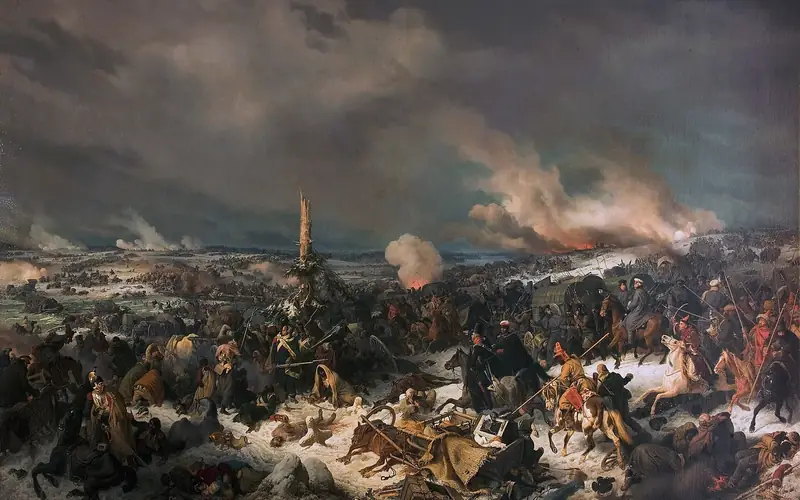
It was from these that an escort for the Emperor was formed around 23 November. The sources place the episode near the Bobr, perhaps at Borisov, on the eve of the crossing of the Berezina (26-29 November). No written order of creation has been found, and no overall nominal roll has come down to us: the papers of Berthier's staff may have been lost in the retreat. The formation may therefore have been made by word of mouth.
Organisation and strength
The 29th Bulletin of the Grande Armée, dated Molodechno on 3 December 1812, describes a unit of four companies of one hundred and fifty men, that is six hundred horsemen. Modern historians are more cautious: David Chandler, for instance, speaks of about five hundred. The bulletin's figure belongs as much to communication as to headcount, and is best read as an order of magnitude.
The unit's peculiarity lay in its inverted hierarchy. Only officers served in it: those below the rank of colonel rode as plain troopers, colonels performed the duties of non-commissioned officers, and generals those of captains. This voluntary demotion, which the bulletin stresses, speaks of the gravity of the moment as much as of the discipline of a body with no troops left to command.
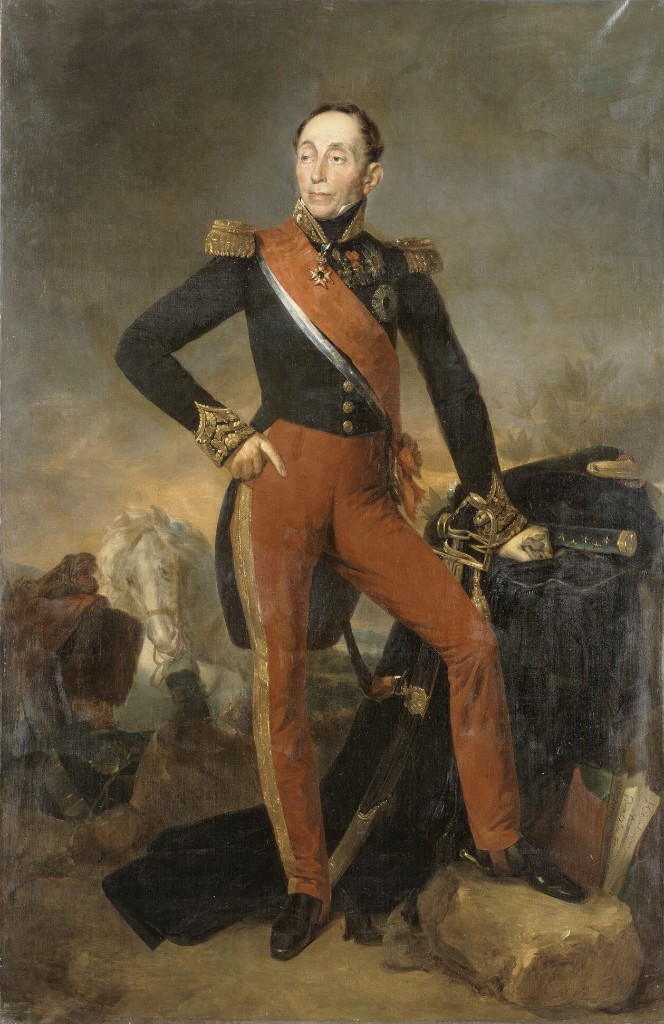
Command is generally attributed to Lieutenant General Emmanuel de Grouchy, under the orders of Murat, King of Naples, who then led the cavalry. Tradition names among the generals and senior officers involved La Tour-Maubourg, La Grange, Rambourgt, Fernig and Castellane; the lists, however, vary from one author to another, and some identifications remain uncertain.
Role and service
The mission was simple and unglamorous: never to lose sight of the Emperor. The bulletin puts it in its own way, noting that the squadron "did not lose sight of" Napoleon in his movements. It had no charge to lead and no position to hold; its role was that of a close guard, at a time when the mounted Guard itself was exhausted and the risk of a Cossack surprise on the imperial column was very real.
The squadron thus accompanied the headquarters through the crossing of the Berezina, then through the stages leading to Molodechno and Vilna. Napoleon left the army on 5 December to return to Paris, leaving command to Murat. The escort outlived his departure by only a few days.
A name that entered legend
The name "Sacred Squadron" comes from the 29th Bulletin itself, the first official text to let France glimpse the scale of the disaster. It evokes the ancient Sacred Band of Thebes, an elite corps famed for its loyalty: the learned allusion could flatter officers whom fate had reduced to the rank of troopers, and it placed the episode in the register of heroic sacrifice. The phrase would be applied again to other elite troops gathered in routs.
For Napoleon, who was then tending his image, the tale offered a consolation: that of an army whose leaders, generals included, agreed to serve as simple soldiers around their sovereign.
Dissolution and memory
According to the historiography, the Sacred Squadron was dissolved on 10 December 1812 at Kovno, after about seventeen days of existence, when the army recrossed the Niemen and the escort's purpose disappeared. Some of its members, like Castellane, left valuable memoirs of the campaign.
Brief and poorly documented, this troop with neither regiment nor colours has no feat of arms to its credit. It nonetheless holds a place apart in the memory of 1812, because it brought together in a single rank all that was most tragic about the retreat: a cavalry without horses, leaders without troops, and an emperor who, to cross Lithuania, relied on his own officers.