Origins: Swiss tradition in French service
Since the Old Regime Swiss cantons supplied infantry regiments to the French monarchy. That Helvetic mercenary tradition — Swiss Guards at Versailles, line regiments in campaign — survived Revolutionary upheavals in renewed forms.
On 31 December 1805 an imperial decree created four Swiss regiments in Imperial service: 1st, 2nd, 3rd and 4th Swiss Regiment. They joined allied and foreign troops completing the Grande Armée, with contracts, Swiss officers and cantonal identity preserved in recruiting.
The Swiss Confederation authorised this levy in a precise diplomatic framework: regiments served France but remained tied to home cantons by conventions fixing duration, pay and recall conditions.
Organisation of the four regiments
Each Swiss regiment organised on the French line infantry model: battalions, companies, regulatory staff. Officers were mostly Swiss; NCOs and soldiers recruited in cantons according to agreed quotas.
Theoretical strength approached an ordinary line regiment, but real figures fluctuated with campaigns, desertions and partial recalls. The four regiments were not always united: they were distributed among army corps as needed.
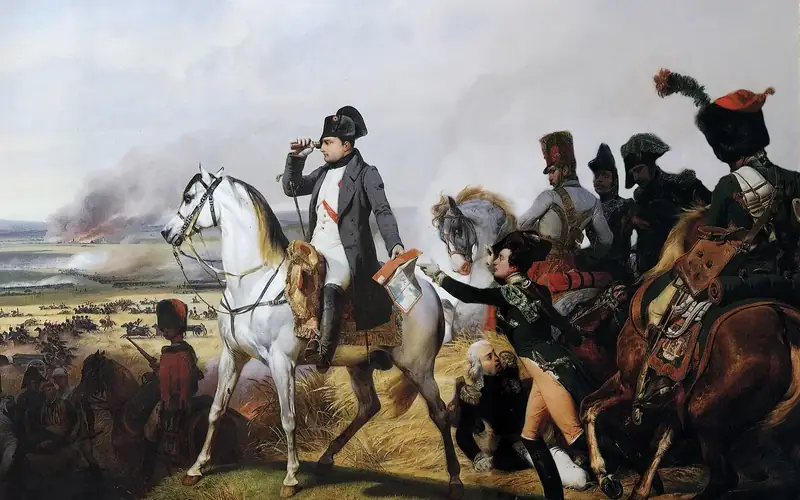
In 1809 elements of Swiss regiments served in Masséna's corps during the Austrian campaign. Their presence at Wagram (5–6 July) placed them at the heart of that campaign's greatest battle, on the plateau where the French army faced Archduke Charles.
Swiss reputation — discipline, steadiness under fire, contractual fidelity — preceded and accompanied these regiments throughout Imperial service.
Uniform and tactical role
Swiss regiments wore French line infantry uniform with specific distinctions: facing colours, headgear and regulatory insignia set by clothing decrees. Shako, blue coat and trousers visually tied them to the French army while keeping Helvetic marks.
Tactically they manoeuvred like ordinary line infantry: assault columns, squares against cavalry, sieges. Their role was not Imperial Guard elite, but reliable infantry valued by marshals for stability.
On campaign Swiss regiments suffered the same trials as French units: marches, disease, combat. Their fidelity to France rested on cantonal contracts as much as regimental esprit de corps.
Wagram and the Russian campaign
At Wagram in July 1809 Swiss regiments engaged in Masséna's disposition took part in decisive fighting against the Austrian army. It is the best-documented battle of their Imperial service — where their commitment is most clearly attested in Napoleonic great days.
In 1812 Swiss regiments did not take part in the Battle of Borodino: they served in Oudinot's II Corps, engaged on a sector distinct from the main disposition. They did fight at Polotsk (August 1812), where Oudinot faced Russian forces in Belarus, and during the retreat, notably near the Berezina in November.
These Russian engagements cost dearly: cold, combat losses and retreat trials reduced Swiss battalions to a fraction of departure strength. Survivors reaching Germany in winter 1812–1813 bore the mark of that catastrophic campaign.
In 1813–1814 the Swiss Confederation, facing the coalition and European pressure, progressively recalled its regiments. They did not fight at Waterloo (June 1815): dissolution of the military convention and recall of Helvetic contingents kept them out of the Hundred Days.
Legacy and end of service
Swiss regiments embodied the last great phase of Helvetic mercenary service to France. Their contractual fidelity contrasted with other allied troops' fate; cantonal recall marked the end of a secular tradition challenged by emerging national loyalties.
For Empire Napoléon this entry documents four numbered regiments, present at Wagram and in Russia (Polotsk, Berezina), but absent from Waterloo — a trajectory faithful both to the Empire and to Swiss Confederation constraints.