On 25 July 1799, a year after the destruction of his fleet in the same bay, Bonaparte crushed at Aboukir the Ottoman army that had landed to retake Egypt. Murat's charge, in which he captured Mustafa Pasha himself, decided the day; a month later Bonaparte left Egypt for France.
Forces at play
Outcome: Decisive French victory
French Republic
- Bonaparte
- Murat
- Lannes
- Lanusse
About 10,000 infantry and 1,000 cavalry
Casualties: About 220 killed and 600 wounded

Ottoman Empire · United Kingdom
- Mustafa Pacha
- Sidney Smith
15,000 to 18,000 men according to French estimates, 5,000 to 7,000 according to Sidney Smith
Casualties: From 8,000 to nearly 20,000 killed, drowned or captured according to the estimates
Battle coordinates
Aboukir
Coordonnées 31.3167°, 30.0667°
Battle narrative
Two battles of Aboukir
The name of Aboukir, a small peninsula east of Alexandria, refers to two battles. The first, fought at sea on 1 August 1798, was a defeat: Nelson's squadron destroyed the fleet that had carried the Army of the Orient, which was thereafter cut off from France. The second, on land, on 25 July 1799, was a victory for Bonaparte over an Ottoman army landed to retake Egypt. It is the subject of this page.
The Ottoman landing
Urged on by Britain, the Ottoman Empire had declared war on France. Two armies were to reconquer Egypt: one through Syria, the other by sea. Bonaparte had tried to forestall them in Syria, but had failed before Acre and returned to Cairo in June 1799. On 14 July a fleet of some sixty vessels, supported by the British, landed about 16,000 men at Aboukir under Mustafa Pasha, a veteran of the wars against Russia. The Ottomans overran a post of 300 French soldiers and took the fort, whose small garrison surrendered after a few days.
Mustafa Pasha did not march on Cairo. He had the peninsula fortified with two lines of entrenchments resting on the sea at each end, to force the French to attack him frontally without being able to outflank him. According to an often-quoted account, Murad Bey, who had joined him, warned him against the apparent ease of this first success.
Bonaparte's march
Bonaparte, who was then pursuing Murad Bey near Cairo, learned of the landing on 15 July from a report by Marmont, governor of Alexandria. He at once assembled his troops at Damanhur and, without waiting for Kléber's division, marched on Aboukir with about 10,000 infantry and 1,000 cavalry. He arrived before the peninsula on 24 July. The Ottoman numbers are disputed: 15,000 to 18,000 men according to French estimates, but only 5,000 to 7,000 at the time of the battle according to the British commodore Sidney Smith, who supported the Ottomans with his ships.
25 July: the first line
On the morning of the 25th Bonaparte attacked. Lanusse's division was on the left, Lannes's on the right, Murat's cavalry in the vanguard. In the west the Ottoman entrenchments were unfinished: Lanusse broke through them after fierce fighting, then swung round behind the first line. Panic spread among the defenders, who had nowhere to fall back to; many threw themselves into the sea to try to reach the ships, and most of them drowned.
Murat's charge
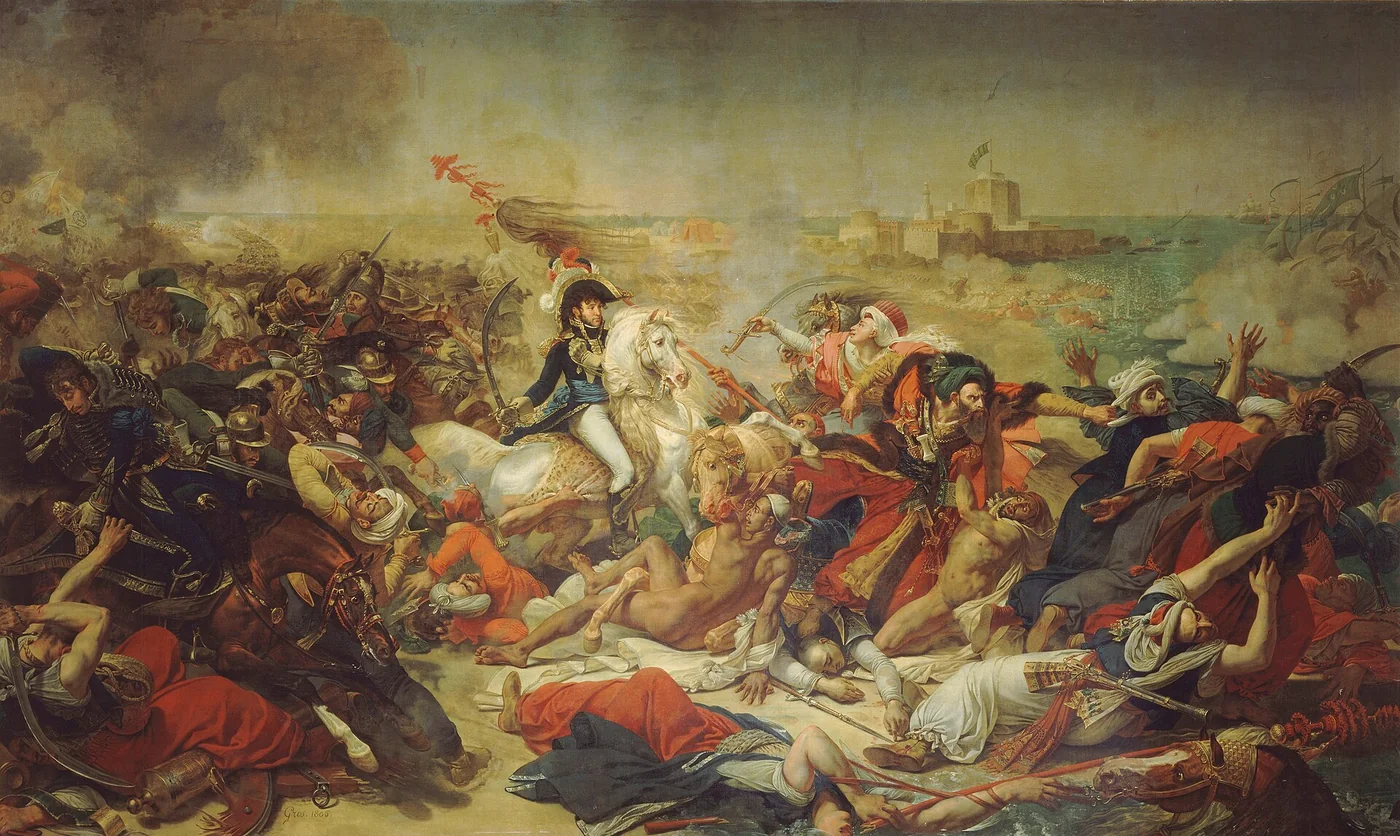
The attack on the second line, stronger and swept by Ottoman and British gunboats, was at first repulsed. Ottoman soldiers then came out of their entrenchments to cut off the heads of the fallen French, a custom whose effect Sidney Smith himself recorded: the French, outraged, at once returned to the attack. Bonaparte had placed his artillery so as to take the Ottoman right in flank; a gap opened in the line. Murat rushed into it with his cavalry and drove through to the enemy camp. In front of his tent Mustafa Pasha fired a pistol at him, wounding him in the jaw; with a sabre stroke Murat cut off fingers of the Pasha's right hand and took him prisoner. The rout became general, and thousands of Ottomans tried to escape by sea.
The fort of Aboukir
A few thousand survivors, among them the Pasha's son, took refuge in the fort of Aboukir, reinforced by British marines. Bonaparte left the conduct of the siege to Lannes; wounded while driving back a sortie, he was replaced by Menou. Bombarded day and night, short of food and reduced to drinking seawater, the besieged came out en masse on 2 August to surrender.
Outcome
The French lost about 220 killed and 600 wounded. Ottoman losses, enormous, are very variously estimated: the figures put forward range from some 8,000 to nearly 20,000 men killed, drowned or captured, estimates hard to reconcile with those of the army that had landed. The French took about a hundred colours and some thirty guns. Murat, whose charge had decided the day, was promoted to general of division that same evening, as was Lannes. Kléber, arriving that evening, is said to have told Bonaparte: "General, you are as great as the world, but the world is not great enough for you!"
The victory gave the Army of the Orient a few months' respite. But Bonaparte, who had learned from British newspapers of France's setbacks in Europe, decided to go home. On 23 August 1799 he secretly embarked on the frigate Muiron with Berthier, Murat and Lannes, leaving the command to Kléber. The Army of the Orient would capitulate in 1801. In Paris, the Rue d'Aboukir, named in 1865, commemorates the victory of 1799.
Go further
Recommended books to dig deeper (affiliate links)

Napoleon — A magisterial biography
An exhaustive biography of the Emperor, the fruit of rigorous research.
≈ £14.99 Napoleon's Army
Organization, tactics and daily life of the Grande Armée soldiers.
≈ £18.00 Austerlitz 1805
The detailed account of the Battle of the Three Emperors.
≈ £12.99As an Amazon Associate, this site earns from qualifying purchases.
Support the encyclopedia
Napoleon Empire is an independent project. Your contribution helps grow the content and keep the site running.
Donate