From 20 March to 21 May 1799 Bonaparte besieged Acre, the key to the road into Syria. Deprived of its siege artillery, captured at sea by the British, the Army of the Orient broke itself against a town supplied by Sidney Smith's ships. Decimated by the assaults and by plague, it had to return to Egypt: it was Bonaparte's first major setback.
Forces at play
Outcome: French failure

French Republic
- Bonaparte
- Kléber
- Lannes
- Caffarelli
- Bon
12,000 to 13,000 men according to the sources, at first without siege artillery
Casualties: 4,000 to 4,500 men killed, wounded or missing according to the sources


Ottoman Empire · United Kingdom
- Djezzar Pacha
- Sidney Smith
- Phélippeaux
- Haïm Farhi
A garrison of about 5,000 men at the outset, reinforced by sea, and two British ships of the line
Casualties: 2,000 to 2,300 men according to the sources
Battle coordinates
Siege of Acre
Coordinates 32.9281° N · 35.0818° E
Battle narrative
The Syrian expedition
Master of Egypt but cut off from France since the destruction of his fleet at Aboukir, Bonaparte turned in early 1799 towards Ottoman Syria. Acre, on the coast, commanded the route between Egypt and Syria; beyond it, Bonaparte hoped to raise the country against the Porte, and even to threaten British India. About 13,000 men entered Syria. After El-Arish and Gaza, Jaffa was taken by storm at the beginning of March: the town was given over to plunder, and several thousand prisoners, many of them Albanians, were executed on the beach on Bonaparte's orders. Known in Acre, this massacre probably stiffened the resistance of the defenders, many of whom were Albanians too.
Djezzar, Phélippeaux and Sidney Smith
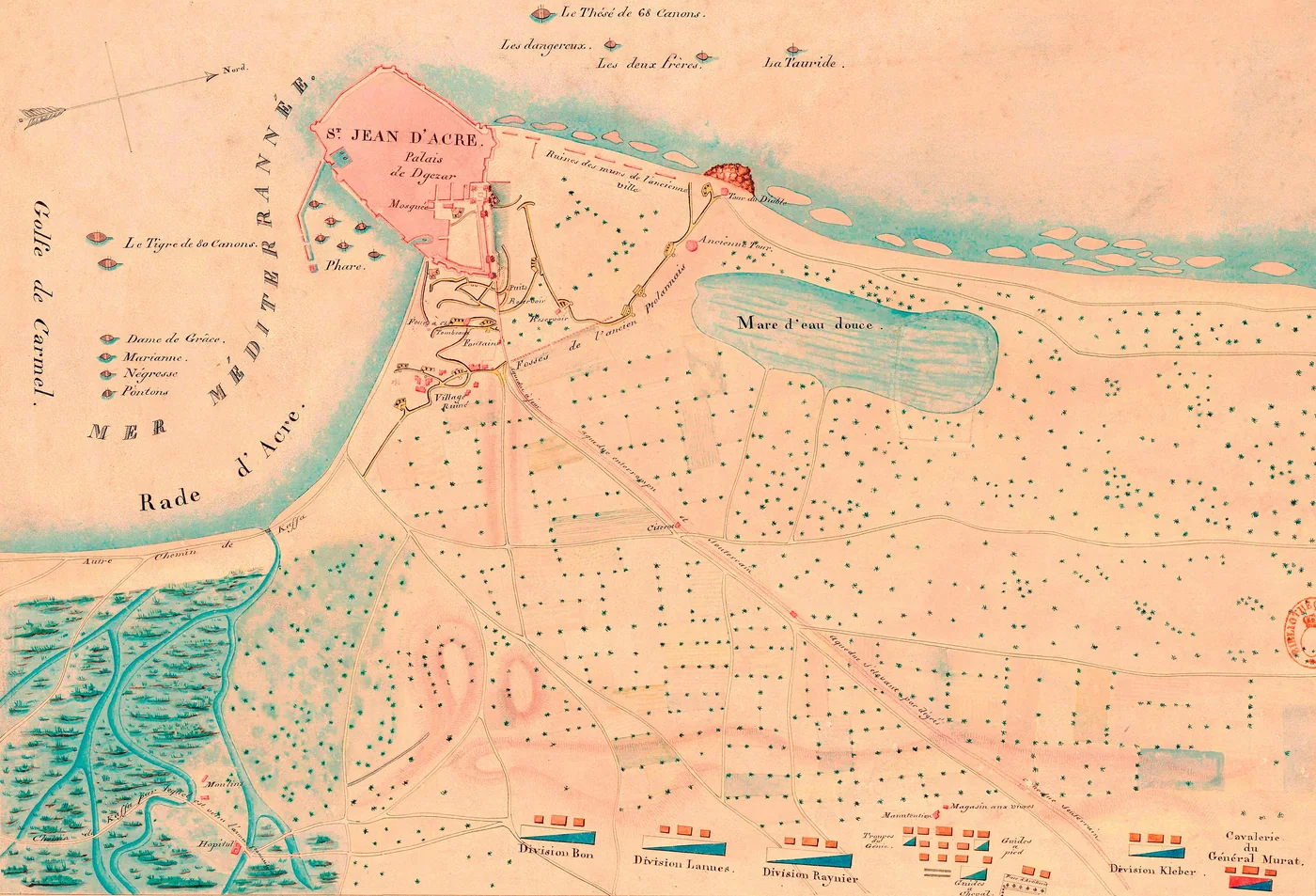
Acre is built on a tongue of land jutting out into the Mediterranean. Its master, the Ottoman governor Ahmed Djezzar Pasha, refused to surrender; his adviser Haim Farhi played a large part in organising the defence. Above all, the town received decisive support from the sea. The British commodore Sidney Smith anchored Tigre and Theseus off the town, where their broadsides swept the approaches, and landed guns and seamen. He also intercepted the flotilla bringing the French siege artillery from Egypt: those guns were set up again against the French. To serve them, the defenders could rely on Antoine de Phélippeaux, an émigré artillery officer who had been a cadet at the military school at the same time as Bonaparte.
A siege without heavy guns
The French army appeared before Acre on 18 March 1799, and siege works began on the 20th. Bonaparte thought the town would fall quickly. Lacking heavy pieces, the French battered a tower with field guns and howitzers; on 28 March the grenadiers rushed a breach thought to be practicable, but came up against a wide, deep ditch and had to withdraw under fire. The following weeks were a war of mines, broken by sorties of the garrison that wrecked the works. The garrison, for its part, was supplied by sea. The French were so short of ammunition that a bounty was offered for every enemy cannonball picked up. General Caffarelli, the chief engineer, wounded in the elbow, died on 27 April after his amputation.
Mount Tabor
Meanwhile a relief army was gathering in Syria to free Acre. Sent to meet it, Kléber found himself on 16 April at the foot of Mount Tabor, facing far superior forces: several tens of thousands of men, mostly horsemen, according to French accounts. His division, reduced to about 2,000 men, was close to being overwhelmed when Bonaparte, who had left Acre with Bon's division, arrived on the heights. Charged in its turn, the enemy fled towards the Jordan, where Murat held Jacob's Bridge. Acre would not be relieved by land, but it continued to be relieved by sea.
The May assaults
On 15 April Rear-Admiral Perrée landed siege guns at Jaffa, which were brought up before Acre. At the beginning of May a breach was at last opened. On 7 May an Ottoman fleet appeared with reinforcements; Bonaparte at once launched a general assault before they could land. The tower was taken amid carnage, and on the 8th the grenadiers broke into the town. There they discovered that a second wall had been built behind the breach: heavy fire poured from the houses and barricades. General Rambeaud was killed; Lannes, wounded in the neck, was carried off by his men. Grenadiers who had taken refuge in a mosque owed their lives to Sidney Smith, who took them prisoner. On 10 May two last assaults failed; General Bon was mortally wounded in them.
Raising the siege
Plague had broken out in the camp. The French forces were melting away, while the besieged were constantly reinforced. On 17 May Bonaparte announced to the army that the siege would be raised; the wounded were evacuated first, then the army withdrew, its last guns still firing on the town to cover its departure. The retreat to Egypt was carried out in good order, with Kléber forming the rearguard; the army returned to Cairo on 14 June.
Outcome
The French lost 4,000 to 4,500 men killed, wounded or missing according to the estimates; the defenders 2,000 to 2,300. Losses among officers were heavy: Caffarelli, Rambeaud and Bon were dead, Lannes badly wounded. On the besieged side, Phélippeaux died shortly after the siege was raised, carried off by disease. It was Bonaparte's first major setback. Back in Egypt, he crushed an Ottoman army that had landed on the coast at Aboukir on 25 July, then sailed for France in August, leaving the command to Kléber.
The dream of the East
Bonaparte wondered what the capture of Acre would have changed. According to remarks attributed to him in 1805, he would then have made himself emperor of the East and returned to Paris by way of Constantinople. Without this failure he would probably not have gone back to France as early as 1799, the year of the coup of Brumaire. In Acre, the hill where he pitched his camp, south-east of the ramparts, still bears his name.
Go further
Recommended books to dig deeper (affiliate links)

Napoleon the Great
Andrew Roberts · 2014
A monumental biography drawing on Napoleon’s 33,000 surviving letters, admiring but rigorous.
See on Amazon
Napoléon ou le mythe du sauveur
Jean Tulard · 1977
The book that reshaped how the man is read: how France gave itself a saviour, and what it cost.
See on Amazon
Nouvelle histoire du Premier Empire
Thierry Lentz · 2002-2010
Four reference volumes on institutions, diplomacy and collapse: the scholarly synthesis of the subject.
See on AmazonAs an Amazon Associate, this site earns from qualifying purchases.
Support the encyclopedia
Napoleon Empire is an independent project. Your contribution helps grow the content and keep the site running.
DonateSecure payment on the platform you choose.