Origins: from the Army of Italy to the coronation
The Napoleon–Berthier pairing did not begin in 1804: it was forged in 1795 when young General Bonaparte took command of the Army of Italy and entrusted Berthier with the post of chief of staff. A lasting division of labour emerged: one conceived the manoeuvre, the other ensured its operational translation — daily orders, couriers, route calculations.
Under the Consulate Berthier combined ministerial duties with campaign proximity. Marshal in 1804, he became major-general of the Grande Armée as the Empire transformed the scale of operations: more corps, more parallel marches, greater need for central coordination.
Princely titles crowned this role rather than personal battlefield victories: Prince of Neuchâtel and Valangin in 1806, Prince of Wagram in 1809 after the gigantic days of 5–6 July that gave the new fief its name.
Organisation of grand headquarters
The major-general did not command a division: he orchestrated the whole. Around Berthier gravitated specialised bureaux — topography, fortress staff, march intendance, couriers — turning the Emperor's intentions into verifiable instructions for each army corps.
Order transmission followed codified circuits: imperial dispatches, counter-orders, recalls to laggards. Berthier watched synchronisation of columns on often inadequate roads; he reminded a marshal that a junction must occur on a set date, lest a wing be exposed.
Grande Armée bulletins, drafted under Napoleon's impulse, passed through his services: they fed imperial legend while informing subordinate cadres of the official interpretation of events.
March organisation — order of march, halts, planned supply — belonged to this machine. Without it, Napoleonic mass manoeuvre reverted to a collection of isolated columns.
Role and appearance of the general staff
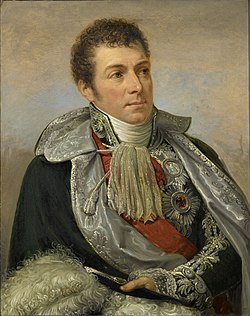
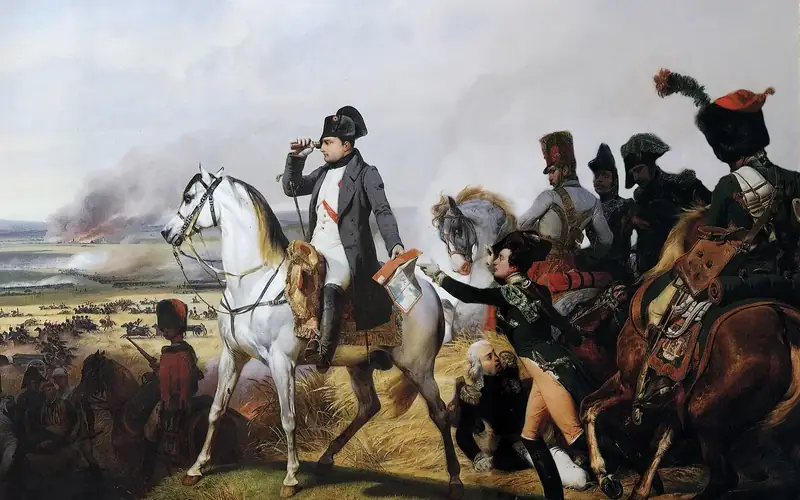
In the field Berthier and his entourage were marked by marshal's uniform and princely insignia, but their primary weapon remained pen and map. Staff officers wore regulatory distinctions of rank; their visibility chiefly identified the command's official channel.
The role was not spectacular in the cavalry-charge sense: it was one of continuity. When Napoleon altered a plan at midnight, someone had to wake the bureaux, rewrite orders and dispatch them before dawn. Berthier made a speciality of that total availability.
Austerlitz, Jena, Wagram and Borodino
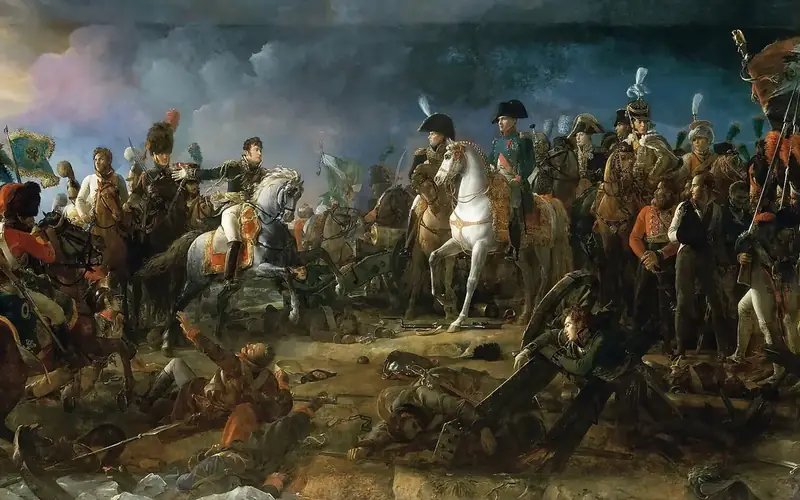
At Austerlitz (2 December 1805) the disposition allowing Soult's corps to strike the Allied centre on the Pratzen Heights assumed coordinated marches and flawlessly transmitted orders. Berthier was the backstage organiser; situation tables he kept let Napoleon read the battle in real time.
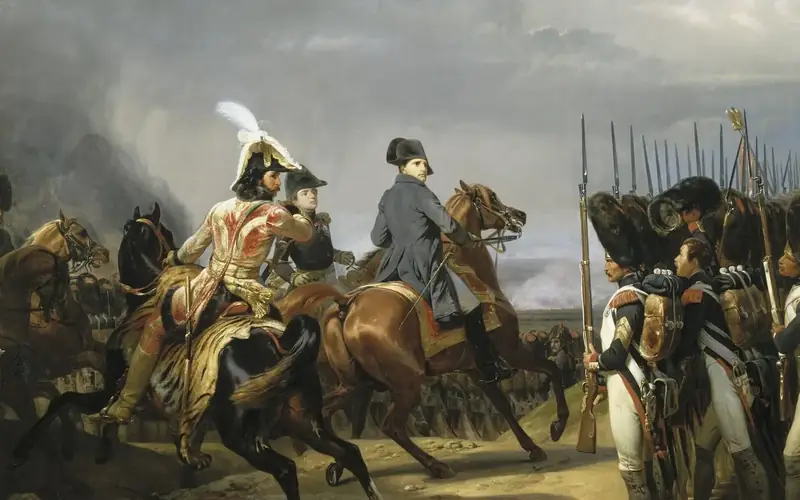
The 1806 campaign against Prussia rested on speed of concentration: Jena and Auerstedt (14 October) illustrated an army arriving in the right place because the general staff had calculated stages. Berthier recalled, urged and corrected calendar drift.
At Wagram in July 1809 scale reached new proportions — several hundred thousand men engaged in the Austrian campaign. The title Prince of Wagram rewarded the organiser-marshal as much as the soldier.
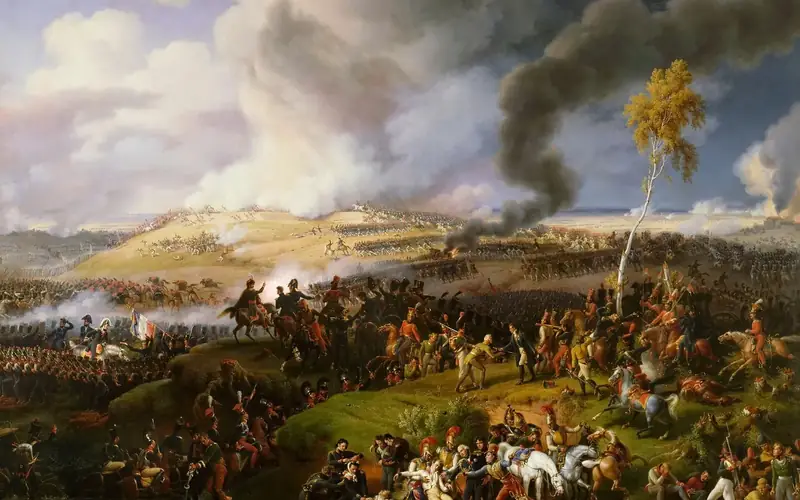
In 1812 Berthier accompanied the Grande Armée deep into Russia. Borodino (7 September) and the catastrophe that followed tested a machine built for advance more than retreat; the general staff nonetheless tried to maintain links between dispersed, exhausted, starving corps.
In 1814 Berthier still followed Napoleon in the French campaign; but during the Hundred Days of 1815 he remained with the Bourbons and died at Bamberg on 1 June, before Waterloo. It was Soult, not Berthier, who then assumed the post of major-general — an absence Napoleon, on Saint Helena, would judge heavy with consequence.
Legacy: birth of the modern general staff
Berthier did not alone invent the contemporary general staff, but he fixed a Napoleonic model: close collaboration with the commander-in-chief, primacy of geographic information, discipline of transmissions. Nineteenth-century armies would partly imitate this articulation.
For Empire Napoléon this entry links Berthier's biography to the great battles where the command machine worked — and recalls that without his successor during the Hundred Days, the imperial epic lost an essential cog.