Origins and creation
On 17 September 1803 a marine battalion was created within the Consular Guard. The initial intention fitted the plan for a descent on England: to have elite sailors manoeuvre boats and pontoons under the eye of power. When the Guard became imperial in 1804, the sailors followed.
Very soon operational reality drew them from the sea. Lacking an invasion of England, the Sailors of the Guard were employed as versatile land troops — bridge-building, river service, infantry combat.
Their identity remained naval in uniform and shipboard spirit, terrestrial in employment. That ambiguity made their singularity in the Guard establishment.
Organisation and strength
The battalion numbered, according to period, from several hundred to over a thousand men (returns vary; orders of magnitude around eight hundred to fifteen hundred are often cited). It was divided into crews rather than companies in the strict infantry sense, a legacy of maritime vocabulary.
Naval officers — captains of the line or frigate such as Daugier, Baste and others according to phase — commanded the corps. In the land theatre they depended operationally on Guard chiefs and the imperial staff.
In status the sailors belonged to the Imperial Guard; their fine place in the Old/Middle/Young Guard distinction is less sharp than for foot infantry, but their prestige as an elite unit is not contested.
Uniform, arms and recruitment
The navy-blue uniform, details of maritime inspiration and the boarding sabre composed a distinct silhouette amid bearskins and shakos. In the field they also carried the infantry musket when fighting in line.
Recruitment drew on sailors and naval workmen chosen for vigour and discipline. Entry into the Guard enhanced a trade often harsh and poorly paid in the arsenals.
Their technical skills — knots, boats, boat-bridges — remained precious even when the Grande Armée left the coasts: river crossings, ferry installation, service of the imperial household crews.
Deeds of arms
At the Boulogne camp the Sailors of the Guard drilled amphibious manoeuvres and flotilla service. When the Grande Armée pivoted toward Austria in 1805, part of them followed the land columns.
In 1808 in Spain a strong contingent of Guard sailors was engaged in southern operations; many were taken prisoner at the Bailén capitulation (19-22 July 1808), a hard blow to French prestige and to the unit itself. Cadres and strengths had to be reconstituted.
During later campaigns — Austria, Russia, Germany — the sailors continued to provide technical missions and occasional combat. Their role was not that of an infantry division but of a versatile elite detachment.
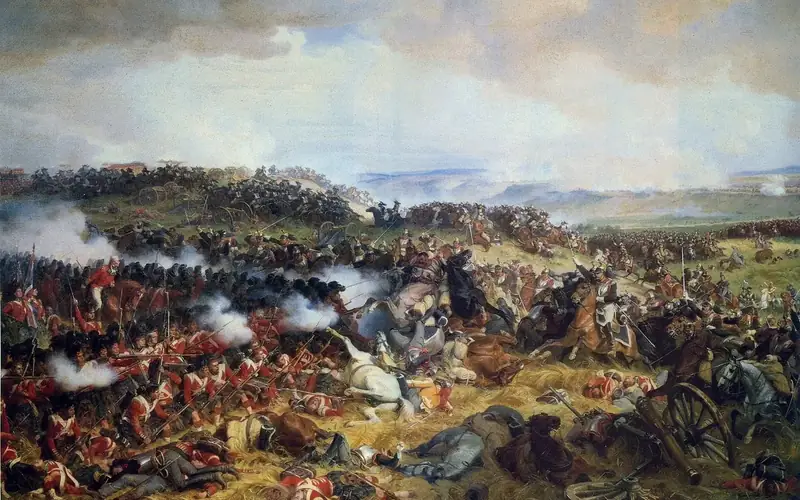
Under the Hundred Days the battalion was again present. At Waterloo the Sailors of the Guard figured among the imperial reserve units engaged on 18 June 1815.
Legacy and memory
Less famous than the grenadiers, the Sailors of the Guard nonetheless fascinate uniformologists by their land-sea hybridisation. Bailén remains the founding drama of their dark memory; Waterloo, the end point.
They recall that the Imperial Guard was not only a showcase of infantry and cavalry: it also included specialists, witnesses to the broken naval dream of 1803-1805 and the forced reconversion to continental war.