A vital speciality
Without bridges, Napoleonic manoeuvre stopped at the banks. Pontonniers, attached to the engineers and pontoon train, floated pontoon boats, spans and moorings to pass troops, guns and convoys.
Their trade combined carpentry, rough boat-work and coolness under fire or in the elements. Less famous than cuirassiers, they nonetheless decided a campaign's success when a river barred the road.
Equipment — pontoon trains, tools, forges — was heavy to haul; abandoning it condemned the army to isolation.
Organisation
Pontonniers companies or battalions accompanied the Grande Armée with bridging matériel. Detachments could be assigned to corps for local crossings.
Technical command fell to experienced engineer officers. Jean-Baptiste Éblé (1758-1812), an artillery general and renowned organiser of bridges and trains, remains the central figure of the Berezina.
In 1812, part of the bridging matériel had been destroyed or left behind on the march to Moscow — a decision heavy with consequences when the retreat reached frozen rivers and marshy banks.
The bridge trade
Boats had to be assembled, moored in the current, decked, and the work held under the endless passage of men and wagons. A pontoon bridge's life in full retreat was sometimes counted in hours.
Icy water, lack of tools, exhaustion and enemy harassment turned each span into an ordeal. Accounts of 1812 describe men working in water up to the chest.
When a bridge failed or burned, immediate restoration became a question of collective survival.
Berezina, November 1812
In late November 1812 the retreating army had to cross the Berezina near Borisov under threat from Russian forces. Existing bridges were unusable or held; others had to be built.
Éblé gathered what remained of smiths, tools and timber to improvise trestle/boat bridges. Two crossings were established — precise details (exact pontoon numbers, hour-by-hour timings) vary by witness, but the central fact is established: bridges were built in the cold, allowing part of the army to cross around 26-29 November 1812.
Thousands of men, non-combatants and stragglers still perished on the banks or in the rout. Éblé himself, exhausted, died soon after (December 1812), worn by effort and conditions.
The Berezina was not a victory: it was a partial rescue, dearly bought, that prevented the immediate total annihilation of what remained of the Grande Armée.
Other campaigns
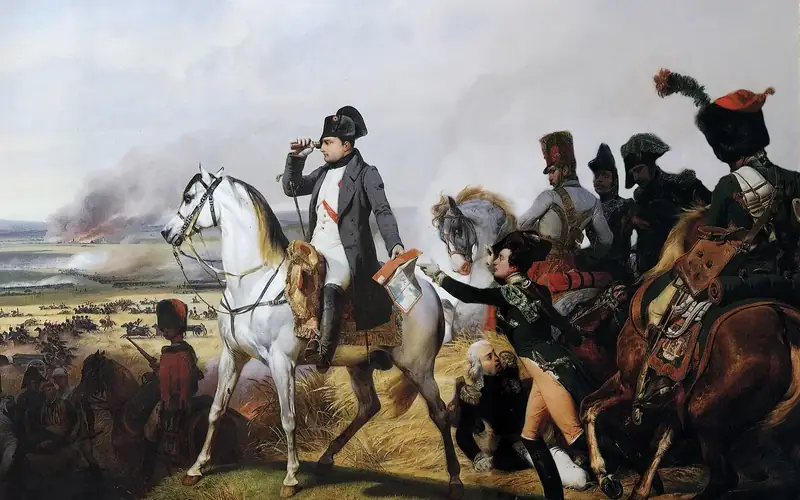
Before 1812, pontonniers enabled river crossings in the German and Austrian campaigns — the Danube and its tributaries played a major role in 1805 and 1809. Wagram, on the Danube's left bank, presupposed crossing and communication works after Essling.
Every great river crossed without prolonged disaster owed something to these specialists. Their absence or under-equipment was paid at once.
In 1813-1814, successive withdrawals again recalled the price of bridges destroyed and rebuilt under enemy pressure.
Legacy
Collective memory has retained Éblé and his pontonniers as the obscure saviours of 1812. Less celebrated than the marshals, they embody the technical sacrifice of the Russian retreat.
For Empire Napoléon, pontonniers prove that the epic sometimes hung on planks thrown across black water — and on men stubborn enough to hold them there.