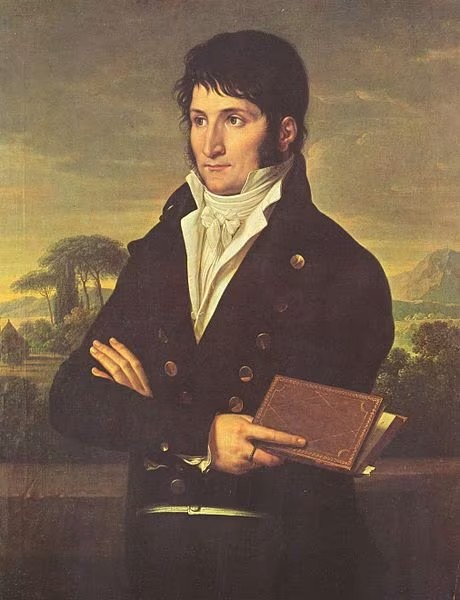
Born at Ajaccio in 1775, the third Bonaparte son grew up between Brienne and the Revolution: an eloquent tribune, he signed a pamphlet against his brother before reconciling. President of the Council of Five Hundred on Napoleon's return from Egypt, he was the man who at Saint-Cloud refused the outlaw motion and pointed his sword at Napoleon's chest before the grenadiers — the gesture that saved 18 Brumaire. As Minister of the Interior he launched the Moniteur and clashed with Fouché; widowed by Christine Boyer, he secretly married Alexandrine de Bleschamp and refused every imposed princely match. Exiled in Rome under Pius VII, Prince of Canino and later Musignano, he missed the Hundred Days when the Austrians intercepted him; he died at Viterbo in 1840, defending in his Memoirs the republican he believed himself to be.
Corsica, Brienne, and Brutus's Mask
Lucien Bonaparte was born at Ajaccio on 21 May 1775, in the house that already counted Joseph the eldest and Napoleon the younger — he would be the third son, the one whose tongue moved faster than his sword. Letizia found him talkative, sometimes insolent, greedy for books and quarrels; Charles Bonaparte died too soon to check him. Studies took him to Autun, then to Brienne, where he crossed the shadow of his brother who had left before him: the same cold courtyards, the same Jesuit rules, another temperament. Lucien was not the silent cadet dreaming of artillery; he was the rhetorician who recited Voltaire, burned for the Roman Republic, and ended by taking the pseudonym Brutus when the family settled at Saint-Maximin in the Var after fleeing Corsica in 1793.
Revolutionary Corsica marked him: clashes between Paolist and Bonapartist partisans, neighbourhood betrayals, the bitter taste of politics as miniature civil war. At eighteen he married Christine Boyer — a merchant's daughter from Saint-Maximin, young and without a glittering dowry. Napoleon, already gripped by military ambition, judged the match ill-advised: not enough shine, too much feeling. The brothers quarrelled; Lucien, furious, went so far as to publish a pamphlet hostile to General Bonaparte. Reconciliation would come — the Corsican family closed ranks when the wind shifted — but the pattern was set: Lucien believed in the right to say no, even to the one who was rising.
He climbed the republican ladder: army commissioner, salon agitator, elected to the Council of Five Hundred in 1798 for the Var. The hemicycle suited him: the rostrum, motions, the crash of voices. He was not yet twenty-five when, in Brumaire Year VIII, he became its president — the most exposed presidency of the Revolution, just as his brother landed at Fréjus, overthrew the Directory on paper, and prepared the stroke of force with Sieyès. Lucien was not an extra: he was the hinge between parliamentary legality and the bayonet.
The Sword on the General's Chest
On 18 Brumaire in Paris, at the Tuileries, the comedy nearly ended badly: Bonaparte harangued, threatened, forced to slip away. The real danger was the next day, at Saint-Cloud, in the orangery where the Five Hundred sat. The air hung heavy with wet coats and legitimate anger: the deputies refused to dissolve the Directory, cried treason, demanded the general's head. A motion of outlawry — hors la loi — circulated; if it passed, the coup would tip into trial or firing squad. Lucien, as president, used every trick of procedure: he did not put it to the vote, he stalled, he let the crowd howl while minutes became centuries.
Then he went down to the courtyard where Murat had drawn up the grenadiers. What he said, memorialists recorded with variants — but the gesture stayed engraved: he announced that daggers threatened the national representation; he swore on his honour that the majority of deputies were terrorised. To make the soldiers believe the brother's sincerity, he drew his sword and set it — or pointed it — at Napoleon's chest: « If he ever harmed the liberty of the French, I would pierce his heart. » It was political theatre in service of reality; it was also the only rhetoric that could sway a hesitant unit. The grenadiers entered the chamber; the Five Hundred scattered; the Directory's Republic collapsed. Without that moment, without the president who refused the vote and the tribune who turned director, 18 Brumaire might have joined the long list of failed coups.
Lucien would never draw gratitude proportionate to the stakes. Napoleon knew what he owed his brother; he would not forgive him for having been indispensable while remaining unpredictable. Already in the corridors, Sieyès murmured that the Bonapartes — all of them — would have to be tamed.
The Moniteur Against Fouché's Police
The Consulate rewarded Lucien: Minister of the Interior from December 1799. He seized the Moniteur universel, made it the new regime's official organ, refounded the prefectoral administration, patronised painters and scholars. It was a machine for manufacturing opinion — and Lucien loved levers. But the First Consul centralised; Fouché, at police headquarters, gathered threads the Interior minister still thought his own. Hunted Jacobins sometimes found recourse with Lucien; Napoleon saw obstruction. Rows exploded in the Council of State: the brother too republican, too journalist, too little soldier.
In January 1801, Christine died giving birth to a daughter who did not survive. Lucien was shattered; the marriage of love had been the only one he had not negotiated with ambition. Napoleon, coldly, pushed for dynastic remarriage; Lucien fled into discretion. In May 1803, at Pontoise, he secretly married Alexandrine de Bleschamp, widow Jouberthon — a woman of reading, refined speech, without lineage to satisfy the Emperor in the making. When news leaked, the storm broke: annulment, princess of the blood, some tinpot throne in exchange. Lucien held firm. Joséphine, for her part, had never been his ally; he openly despised her in Bonaparte intimacy, and she returned the favour. In that household on its way to Empire, Lucien was the grain of sand that refused to become palace stone.
Madrid, Paintings, and Dynastic Ultimatum
To remove him from Paris without losing him entirely, Napoleon sent him ambassador to Spain — a court of intrigue, attenuated Inquisition, and empty finances. Lucien proved skilful: Spanish neutrality in the economic war against London, art-dealer networks from which he drew a comfortable fortune and a collection that would make a mark. He negotiated as he collected: each painting was a victory over the boredom of diplomatic exile. But behind him the Empire closed in; in 1804, the coronation at Notre-Dame sealed a monarchy that republican Lucien watched with unease.
The family ultimatum was brutal: divorce Alexandrine, marry a princess — Marie Louise of Bourbon-Parma, Queen of Etruria, or other combinations of that register were mentioned — and in return the crown of Spain or Portugal. Napoleon believed in the deal; Lucien believed in a love bargain. He refused. Letters turned sour; mother Letizia sometimes tried mediation; Joseph and Louis looked elsewhere. In 1804 Lucien left France for Rome with Alexandrine and the children: no French prince's title, no place in Jacques-Louis David's imperial tableau. He had chosen his wife and the freedom to scorn a throne over a throne offered in exchange for his wife.
Rome, Pius VII, and the Recalcitrant Brother's Memoirs
In Rome Lucien bought, built, collected: Palazzo Nuñez, the Ruffinella estate at Frascati, antiquities, manuscripts, a circle of scholars. Pius VII, with much to forgive Napoleon for and much to fear from him, received the disinherited brother with calculated goodwill: Lucien embodied a salon opposition compatible with the tiara. In 1808 the Emperor made a last offer — divorce, Iberian throne —; refusal closed the breach. Lucien was no longer negotiable; he had become a symbol.
The Hundred Days drew him from retirement: he left for Paris, crossed Italy, still believed in his brother and in luck. The Austrians intercepted him at sea or on the roads — accounts vary —; he would witness neither the Champ de Mars nor Waterloo. When Europe closed on Napoleon again, Lucien became princely shadow once more in Rome. Pius VII granted him the principality of Canino and Musignano after the abdication of 1814; Gregory XVI in 1832 confirmed and extended the papal titles. It was not the Empire; it was noble survival with patronage and debts.
He died at Viterbo on 29 June 1840, a few weeks before the ship brought Napoleon's remains to the Invalides. The Memoirs, published after his death, celebrated the Lucien of 18 Brumaire and softened contradictions: the republican who served the Consulate, the lover who refused the Europe of state marriages. Historians mine them for precious detail and blind spots. In Bonapartist legend he remains the man who saved the Empire before it existed — and who refused to take his place in it on the master's terms.
Discover other characters



Go further
Recommended books to dig deeper (affiliate links)
Napoleon — A magisterial biography
An exhaustive biography of the Emperor, the fruit of rigorous research.
≈ £14.99Napoleon's Army
Organization, tactics and daily life of the Grande Armée soldiers.
≈ £18.00Austerlitz 1805
The detailed account of the Battle of the Three Emperors.
≈ £12.99As an Amazon Associate, this site earns from qualifying purchases.
Support the encyclopedia
Napoleon Empire is an independent project. Your contribution helps grow the content and keep the site running.
Donate