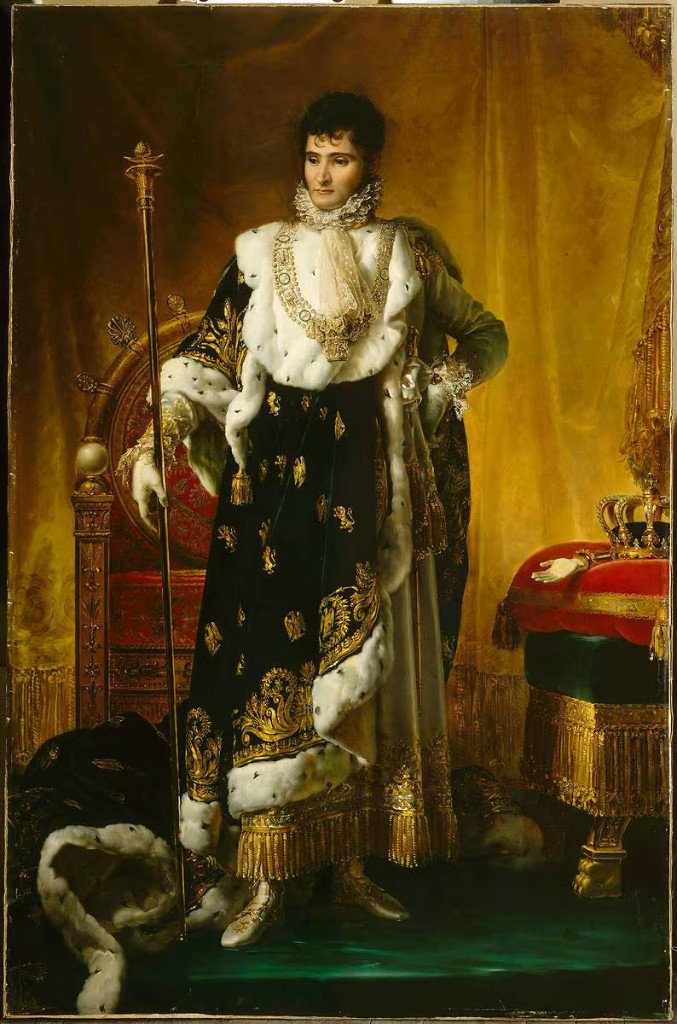
The youngest Bonaparte, born in Ajaccio in 1784, he escaped the British blockade to Baltimore and secretly married Elizabeth Patterson — a scandal Napoleon crushed by decree. King of Westphalia at twenty-three, he embodied the Empire's reforming showcase as much as the extravagance that irritated the Emperor; sent home from Russia in 1812, he fought again in 1814 and at Waterloo. Long exiled with Catherine of Württemberg, he returned to prominence under Napoleon III: Marshal of France, President of the Senate, last of the brothers to die, in 1860, at the Invalides.
The Youngest Brother Between Shadow and Sea
Girolamo Buonaparte was born at Ajaccio on 15 November 1784, eleven months after Charles Bonaparte's death: the infant Letizia Ramolino nursed was the only son never to know his father living. He grew in the wake of his elders — Joseph Bonaparte, Napoleon, Lucien Bonaparte, Louis Bonaparte — whose destinies exploded with the Revolution while he was still a child. In Marseille and then in France, he was trained for a cadet's future: not the throne, not the foremost sword, but service, the obligatory dependence on the one who rose.
The navy seemed a path to a kind of freedom. In 1800 Jerome was a midshipman; in 1803, ship's lieutenant aboard the ship of the line Éole, bound for the West Indies. The Royal Navy closed the trap: blockaded, unable to reach his station, the crew chose escape to the American coast. He landed at Norfolk, then Baltimore — a city of merchants, balls, Anglophiles curious about a young man whose name made Europe tremble. He was nineteen, the bearing of a prince without a crown, and the impatience of the youngest not yet broken by the Emperor's orders.
Already, across the Atlantic, Napoleon drew other designs: princely alliances, geopolitics, dynasty. A marriage to an American heiress fit no plan. Jerome knew it; he married her anyway. It was not mere recklessness — it was the claim to a life of his own, before the imperial steamroller reclaimed its due.
Betsy Patterson and the Law of the Empire
In Baltimore, at a ball, he met Elizabeth Patterson — eighteen, finely educated, fabulously wealthy father, striking beauty. The affair moved fast: a civil marriage on 24 December 1803 (Gregorian), without waiting for Paris's permission. Napoleon, now First Consul for life and Emperor in prospect, reacted as expected: « I will have no Patterson in my family. » This was not salon temper; it was a dynastic red line. Imperial letters ordered annulment; American ambassadors received instructions not to recognise the union — at least on the French side.
In March 1805 Jerome obeyed enough to return to Europe to plead his case, leaving Betsy pregnant on American soil. She would give birth alone in London, then return to the United States: a son, Jerome Napoleon Bonaparte — known as « Bo » — was born in July 1805. The Emperor would never legitimise him; for the House, the child did not exist. The Paris civil court, backed by imperial decree, declared the marriage null: in Napoleonic France, Betsy was never queen nor even wife. In her own eyes and those of many American witnesses, she remained so until her death — widow of a love and a status confiscated.
Jerome had to pay the price of return to the fold: French princely title, largely nominal naval commands, and above all the arranged marriage to Catherine of Württemberg, daughter of King Frederick I — a sovereign whose realm was a Napoleonic creation after Austerlitz. The contrast was cruel: the imposed wife was an archduchess of the purest Germanic water; the rejected wife sold French lessons in Baltimore and bore in silence the Bonaparte name she was denied. Jerome's story cannot be understood without this triangle of flesh, law, and wounded pride.
King of Westphalia, Showcase and Mirage
The marriage to Catherine was celebrated with calculated magnificence — August 1807, royal cathedral, festivities, gifts, processions. That same year, after Tilsit, Napoleon assembled the Kingdom of Westphalia: pieces of defeated Prussia, Hessian parcels, mediatised principalities. Constitution, Reichsstände (assembly of estates), civil code modelled on the French, abolition of birth distinctions in law: the whole was to prove Napoleonic modernity could be embodied outside France. Jerome, at twenty-three, became its monarch on paper — and in the flesh.
He settled at Cassel. The court rivalled the Tuileries in brilliance: hunts, theatre, embroidered uniforms, mistresses chroniclers savoured. Debts mounted; the Emperor raged, paid, raged again. In parallel, the king founded lycées and a university, rationalised administration, abolished the most glaring feudal survivals. Peasants and bourgeois paid taxes and conscription for a war not their own; anti-French feeling rose with the imperial army's reverses. Westphalia was neither toy nor pure laboratory: it was a tutelary state held by bayonets, whose sovereign embodied both the promise of the Enlightenment and the image of the heedless cadet his elder brother always ended up calling to order.
Ambassadors read the game: Jerome wanted his subjects' love and feared Napoleon; Napoleon wanted a docile satellite and got a sumptuous one. Letters between them — where tone survives — mix paternal rebuke and spoiled-child promises. This kingdom would last until the Sixth Coalition tore the map from the Empire's hands.
Russia, Recall, Fall, Hundred Days
In 1812 Napoleon folded Jerome into the Grande Armée: at the head of the 8th Corps, he was to hold the southern flank, link with Saxon and Polish allies, pin Bagration. The reality of terrain — communications, slowness, neighbouring marshals' egos — ground the plan on paper. Delays at Grodno, hesitation before the fortress of Bobruisk, needless losses in early engagements: all fed the Emperor's fury, who expected of his brothers the same tactical genius he claimed for himself. In July Jerome was sent back to Cassel, officially for health reasons; the court understood the humiliation. He would see neither Moscow in flames nor the Berezina — the paradox of a soldier-king dismissed as the edifice began to crack.
The next year the Coalition closed the net. Cassel fell in October 1813; the kingdom evaporated. Jerome fought for France with Catherine beside him in retreat: the 1814 campaign, defence of the Vosges, skirmishes where he showed courage his 1812 detractors had denied. The abdication at Fontainebleau left him without throne, without German title, with a name that drew hostile stares.
The Hundred Days brought him back to Belgium. At Waterloo, under Reille, he commanded a division of the II Corps: assaults on Hougoumont and Allied positions cost dear in men and reputation. After defeat, flight to France, then Switzerland — the classic path of the outlaw who did not choose resistance to the end. Exile awaited: Austria, Italy, meagre pensions, until history, through his nephew, opened a door again.
The Nephew's Marshal, Senator of the Age
The 1820s-1840s were long. Jerome drifted between borrowed lodgings and modest rents, supported by Catherine until her death in 1835 — a political match at first, but witnesses often stressed real companionship, unlike the Louis-Hortense couple torn by court and grief. Cassel's creditors did not forget him; royalist memoirs caricatured him as a revel king. Yet he survived, a widower, witness to a world that had buried his brother and his German dreams.
The revolution of 1848 shifted the scales: Louis-Napoleon Bonaparte, elected president in December, recalled the discredited uncle — living symbol of lineage, Bonapartist guarantee for a Republic seeking its bearings. In 1850 Jerome was made Marshal of France — a political as much as military promotion, which old veterans noted with a grimace. Under the Second Empire he became French prince, President of the Senate: the turbulent cadet sat in the chair of constitutional conservatism, presiding over sessions with a dignity that surprised those who had seen him only at the hunt in Cassel.
He died at the Château de Villegenis, near Massy, on 24 June 1860, aged seventy-five — last of Napoleon I's brothers. National funeral, procession to the Invalides: under the dome's marble he rejoined the one he had loved, disappointed, feared, and served. Bo, the Baltimore son, would live a prosperous American life; the Württemberg branch produced royal descendants. Jerome remains in memory as the Bonaparte by birth who paid dearly for the right to choose his first love — and who ended up embodying, under his nephew, the institutional continuity of a family Europe thought buried at Waterloo.
Discover other characters




Go further
Recommended books to dig deeper (affiliate links)
Napoleon — A magisterial biography
An exhaustive biography of the Emperor, the fruit of rigorous research.
≈ £14.99Napoleon's Army
Organization, tactics and daily life of the Grande Armée soldiers.
≈ £18.00Austerlitz 1805
The detailed account of the Battle of the Three Emperors.
≈ £12.99As an Amazon Associate, this site earns from qualifying purchases.
Support the encyclopedia
Napoleon Empire is an independent project. Your contribution helps grow the content and keep the site running.
Donate