On 16 June 1815, at the crossroads of Quatre Bras, Marshal Ney's left wing attacked Wellington's first troops, who were reinforced hour by hour. Deprived of d'Erlon's corps, diverted towards Ligny and then recalled too late, Ney could not carry the position; but he prevented Wellington from helping Blücher.
Forces at play
Outcome: Crossroads held by the allies

France
- Ney
- Reille
- Kellermann
- Jérôme Bonaparte
18,000 men at the outset, about 24,000 by evening
Casualties: 4,000 to 4,400 men


United Kingdom · Netherlands · Brunswick · Hanover
- Wellington
- prince d'Orange
- duc de Brunswick
- Picton
8,000 men at the outset, 32,000 to 36,000 by evening
Casualties: 4,800 to 5,600 men, including the Duke of Brunswick
Flags: Oren neu dag, CC BY-SA 2.5, Wikimedia Commons
Battle coordinates
Quatre Bras
Coordinates 50.5830° N · 4.4500° E
Battle narrative
A decisive crossroads
At Quatre Bras the main road from Charleroi to Brussels crosses the road from Nivelles to Namur. It was by this lateral road that Wellington's Anglo-allied army could join Blücher's Prussians, gathered further east around Ligny. In June 1815 Napoleon wanted to drive in between the two armies and beat them separately: holding Quatre Bras meant preventing Wellington from helping Blücher. That task fell to the left wing of the Army of the North, entrusted to Marshal Ney on the very eve of the battle.
Constant Rebecque's initiative
On 15 June the French offensive caught Wellington off guard. He learned of the outbreak of hostilities only in the afternoon and, fearing an outflanking move through Mons, waited until almost midnight before directing his army eastwards. "Napoleon has humbugged me," he is said to have admitted. Meanwhile, at the Prince of Orange's headquarters, the chief of staff, General de Constant Rebecque, saw the danger: disregarding the order to assemble the troops at Nivelles, he sent Prince Bernhard of Saxe-Weimar's brigade, made up of Nassau regiments, to Quatre Bras. It arrived at about 2 p.m.; in the evening the Guard lancers clashed with its outposts at Frasnes, then were driven back before the crossroads. Ney, whose infantry was still strung out along the road, pushed no further.
A lost morning
On the morning of 16 June the crossroads was held by only about 8,000 Dutch and Nassau infantry and sixteen guns under the Prince of Orange. Ney, who already had some 18,000 men, assembled his corps and reconnoitred the position, but attempted nothing serious before the early afternoon. The delay gave Wellington's reinforcements time to arrive.
2 p.m.: Ney attacks
At about 2 p.m. Ney opened fire with a battery of 22 guns and launched his columns, preceded by swarms of skirmishers. The Dutch outposts were driven in; the farms of Gemioncourt and Grand-Pierrepont were fought over, but the defenders clung to the Bossu wood. At about 3 p.m. Picton's British division and a Dutch cavalry brigade arrived, and Wellington, back from his meeting with Blücher at the Bussy windmill, took command. The division of Prince Jérôme, the Emperor's brother, came into line in turn. The Duke of Brunswick was mortally wounded leading a charge.
At about 4.15 p.m. Ney received Napoleon's order, sent at 2 p.m., to attack vigorously. Jérôme drove the Allies out of the Bossu wood, and the French closed in on the crossroads. The Scottish and English regiments of Pack's brigade held firm, although Piré's lancers badly mauled two of them.
Kellermann's charge and d'Erlon's recall
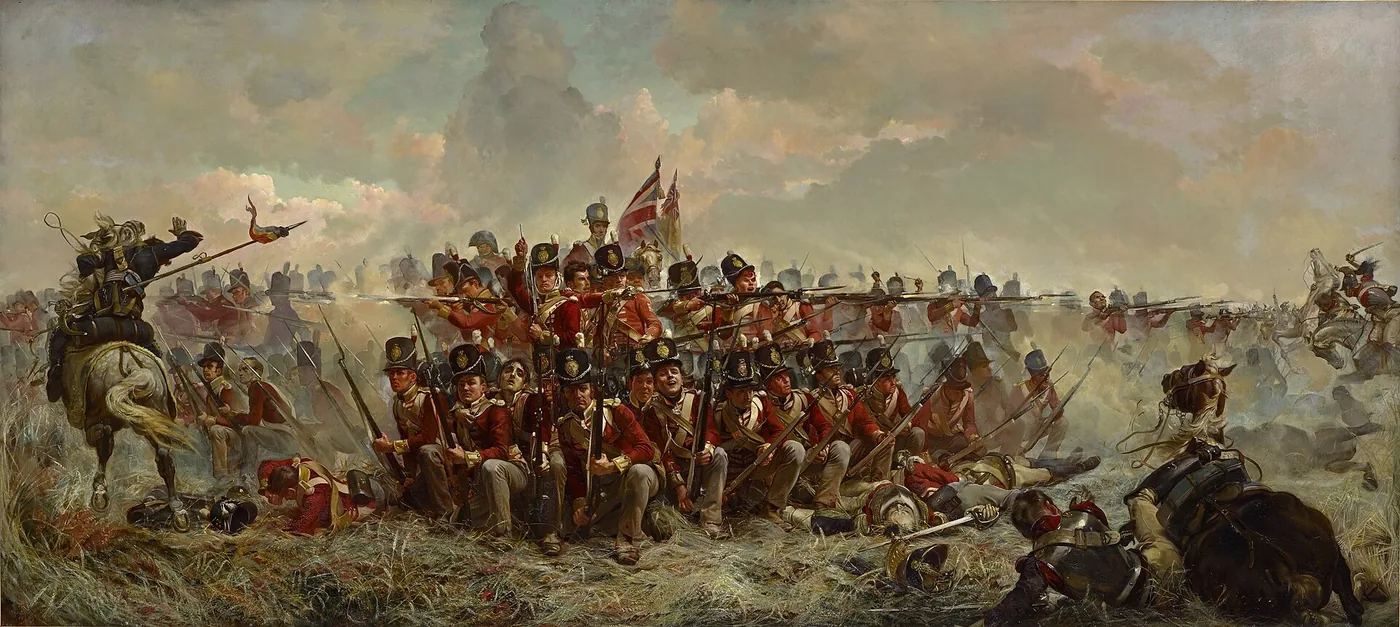
At about 5 p.m. the arrival of Alten's division tipped the balance in the Allies' favour. It was then that Ney learned that Drouet d'Erlon's I Corps, which he was expecting, had been diverted towards Ligny without his being told; at the same time an unclear order from Napoleon asked him to take Quatre Bras and then turn on the Prussians. Convinced that he could not win without that corps, Ney recalled it peremptorily. To keep up the pressure, he launched Kellermann with the only cuirassier brigade he had to hand: it caught Halkett's British brigade in line, took a colour from the 69th Regiment and reached the crossroads before being driven back by close-range fire from infantry and artillery.
The arrival of the British Guards Division finally allowed Wellington to counter-attack. Jérôme had to give up the Bossu wood, although the Guards, emerging from it in line, were in turn thrown back by Piré's lancers. At about 9 p.m. the fighting stopped: the French had lost all the ground gained during the day. D'Erlon's corps, recalled too late, had fought neither at Ligny nor at Quatre Bras.
Outcome
The French lost 4,000 to 4,400 men, the Allies 4,800 to 5,600. By the evening the latter had 32,000 to 36,000 men in the field against about 24,000 French. Wellington remained master of the crossroads, but Ney had prevented him from helping Blücher, who was beaten at Ligny. On 17 June, learning of the Prussian retreat towards Wavre, Wellington in turn fell back northwards to the position of Mont-Saint-Jean, which he had reconnoitred the year before. Two days later he fought the Battle of Waterloo there. What d'Erlon's corps might have changed on either battlefield has been debated ever since.
Go further
Recommended books to dig deeper (affiliate links)

Napoleon the Great
Andrew Roberts · 2014
A monumental biography drawing on Napoleon’s 33,000 surviving letters, admiring but rigorous.
See on Amazon
Napoléon ou le mythe du sauveur
Jean Tulard · 1977
The book that reshaped how the man is read: how France gave itself a saviour, and what it cost.
See on Amazon
Nouvelle histoire du Premier Empire
Thierry Lentz · 2002-2010
Four reference volumes on institutions, diplomacy and collapse: the scholarly synthesis of the subject.
See on AmazonAs an Amazon Associate, this site earns from qualifying purchases.
Support the encyclopedia
Napoleon Empire is an independent project. Your contribution helps grow the content and keep the site running.
DonateSecure payment on the platform you choose.