On 1 August 1798, a month after the Army of the Orient had landed, Nelson's squadron caught the fleet that had carried it lying at anchor in Aboukir Bay. By the morning of 2 August, L'Orient had blown up with Admiral Brueys aboard and eleven of the thirteen French ships of the line were taken or lost. Bonaparte remained master of Egypt, but he could no longer leave it.
Forces at play
Outcome: Decisive British naval victory: eleven of the thirteen French ships of the line taken or destroyed, the Army of the Orient cut off from France

French Republic
- Brueys
- Blanquet du Chayla
- Villeneuve
- Ganteaume
13 ships of the line (including L'Orient, 120 guns) and 4 frigates; about 1,190 guns and 10,800 men, with crews below strength
Casualties: Between 2,000 and 5,000 killed and wounded depending on the estimate (about 1,700 killed and 1,500 wounded according to Michèle Battesti), more than 3,000 prisoners; 9 ships of the line taken, 2 ships of the line and 2 frigates destroyed
Royaume de Grande-Bretagne
- Nelson
- Foley
- Hood
- Troubridge
- Hallowell
13 ships of 74 guns and one of 50 (Leander); about 1,010 guns and 8,000 men. Culloden ran aground and took no part
Casualties: 218 killed and 677 wounded; no ship lost
Battle coordinates
Battle of the Nile
Coordinates 31.3333° N · 30.1167° E
Battle narrative
Which battle of Aboukir?
The name Aboukir, a peninsula and small town some twenty-five kilometres north-east of Alexandria, covers two battles fought a year apart. This one, the first, was fought at sea on 1 and 2 August 1798: a French defeat that the British call the Battle of the Nile. The second, on land on 25 July 1799, was by contrast a victory for Bonaparte over an Ottoman army landed in the same bay; it has its own page, the battle of Aboukir (25 July 1799).
A fleet without a harbour
Having sailed from Toulon on 19 May 1798, the Egyptian expedition took Malta on the way and landed before Alexandria at the start of July; the city fell on 2 July. Meanwhile Nelson was hunting for it across the Mediterranean, a pursuit that lasted some seventy days. Vice-Admiral Brueys's battle fleet, thirteen ships of the line and four frigates, now had to find shelter. Bonaparte wanted it inside the Old Port of Alexandria, but the Egyptian pilots refused to take the 74-gun ships in, for lack of water, and Brueys feared being bottled up there. He offered ten thousand francs to any pilot who could find a deeper channel, to no avail.
So the admiral chose the open roadstead of Aboukir, a shallow, exposed anchorage from which he could still support the army. His orders have been argued over ever since: the instructions of 3 July that supposedly left him free to make for Corfu survive only as a copy in the Navy archives, which Michèle Battesti suspects was drawn up after the event. The fleet also suffered from a more mundane ailment. A fifth of its crews had been missing at departure; in Egypt nearly a third were, after some six hundred seamen had been drafted into Perrée's Nile flotilla. Brueys wrote to the minister that his crews were "very weak in number and in quality of men". On top of this, every ship sent working parties ashore to dig wells and gather food, under escort because of the Bedouin.
Brueys's line
Brueys decided to fight at anchor. His thirteen ships formed a line about 2.6 kilometres long, parallel to the coast and running north-west: the van under Rear-Admiral Blanquet du Chayla in Franklin; the centre around the admiral in L'Orient, a 120-gun ship flanked by two 80s; the rear under Rear-Admiral Villeneuve in Guillaume Tell. The frigates lay closer inshore. The arrangement had two weaknesses for which it has been blamed ever since. The ships were about 150 metres apart, too far to support one another. And the head of the line, Guerrier, lay some 900 metres from the shoals closing the bay to the north-west, leaving a passage between them. The small fort of Aboukir, armed with two mortars and four 6-pounders, was too far off to cover it. Captain Lachadenède's proposal for a tight concave line hugging the shoals had been turned down.
Nelson appears
At about 2 p.m. on 1 August, lookouts in Zealous sighted the French fleet. Nelson had thirteen 74-gun ships and one of 50 guns, Leander; two of them, Alexander and Swiftsure, away scouting off Alexandria, would join later. He attacked at once, without waiting for the next day, as the sun went down. At 6.20 p.m. Guerrier and Conquérant opened fire. At about 6.30 Captain Thomas Foley took Goliath through the gap ahead of the line and placed her between the French and the shore; Samuel Hood's Zealous, Orion, Theseus and Audacious followed. Nelson in Vanguard ran down the seaward side of the line with Minotaur, Defence, Bellerophon and Majestic. Troubridge's Culloden, coming up as night fell, grounded on the Aboukir shoal and took no part in the fight.
The French van was caught between two fires. Its ships had not believed in an attack from the landward side: their larboard batteries were cluttered, and the rear, anchored downwind, could not work up the line to help them. Guerrier surrendered at about 9 p.m., Spartiate at the same hour with her captain badly wounded; Aquilon, dismasted, struck at 9.25 after her captain had been killed. At about 8.30 Nelson was hit on the forehead, above his already blind right eye, by a flying piece of iron; he was thought to be dying, but the wound was only superficial and he was back on deck before the night was out.
The explosion of L'Orient
In the centre, L'Orient first battered Bellerophon, which had missed her anchorage and drifted out of the line dismasted. Then Captain Benjamin Hallowell's Swiftsure and Alexander arrived and engaged her. Brueys, already wounded, was almost cut in two by a cannonball; he refused to be carried below and died on deck a quarter of an hour later. Fire broke out on board. The flag captain, Luc-Julien-Joseph Casabianca, was wounded in his turn, and his young son Giocante was mortally hit beside him. At about 10 p.m. the fire reached the magazines and the ship blew up. For a while the firing stopped across the whole bay. The chief of staff, Honoré Ganteaume, who reached the shore on a raft, wrote the report that told Bonaparte of the disaster.
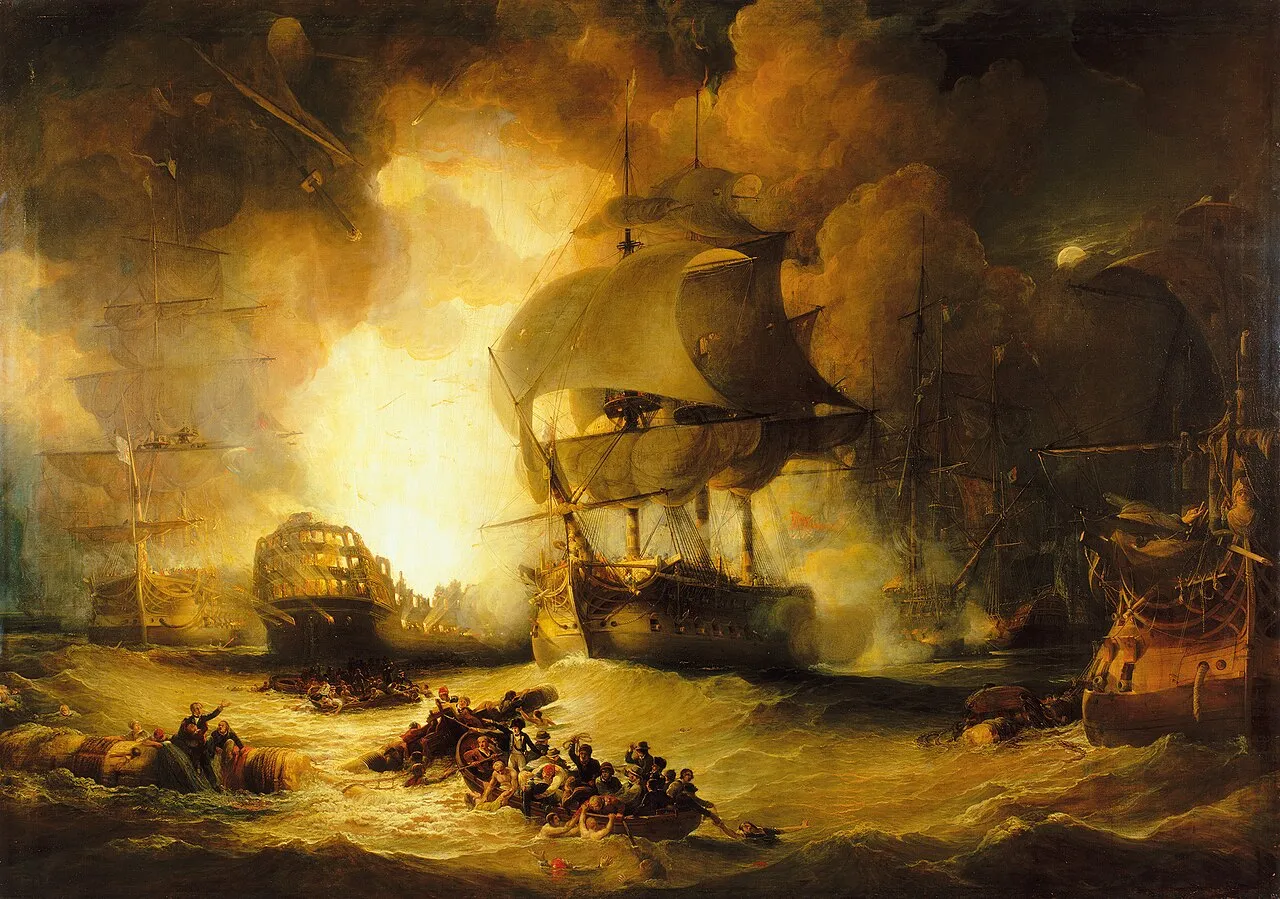
The fighting resumed and went on until morning. In Tonnant, Captain Aristide Aubert Du Petit-Thouars, who had lost both legs and an arm, kept command until his wounds killed him; at his own request his body went over the side. Franklin, where Blanquet du Chayla had been badly wounded in the head, struck in her turn.
2 August: Villeneuve's escape
At daybreak the French rear was almost untouched. At about 11 a.m. Villeneuve got under way with Guillaume Tell, Généreux and the frigates Diane and Justice, and reached the open sea despite pursuit by Zealous. The naval historian Onésime Troude would reproach him for putting to sea "by making the manoeuvre he had judged impracticable the day before, during the battle". Timoléon, aground, was set on fire by her crew on 3 August and blew up shortly after noon. The frigate Artémise, abandoned and fired by her captain, exploded on the 2nd; Sérieuse had sunk on the shoals with her masts above the water.
The reckoning
Nine ships of the line were taken and two destroyed (L'Orient and Timoléon), along with two frigates. French human losses are poorly known: between 2,000 and 5,000 killed and wounded depending on the author, about 1,700 killed and 1,500 wounded according to Michèle Battesti, plus more than 3,000 prisoners whom Nelson, unable to feed them, sent ashore. The British counted 218 killed and 677 wounded, and not a single ship lost. On 18 August, off Crete, Généreux nevertheless captured Leander, which was carrying the dispatches of the victory to England.
An army imprisoned by its conquest
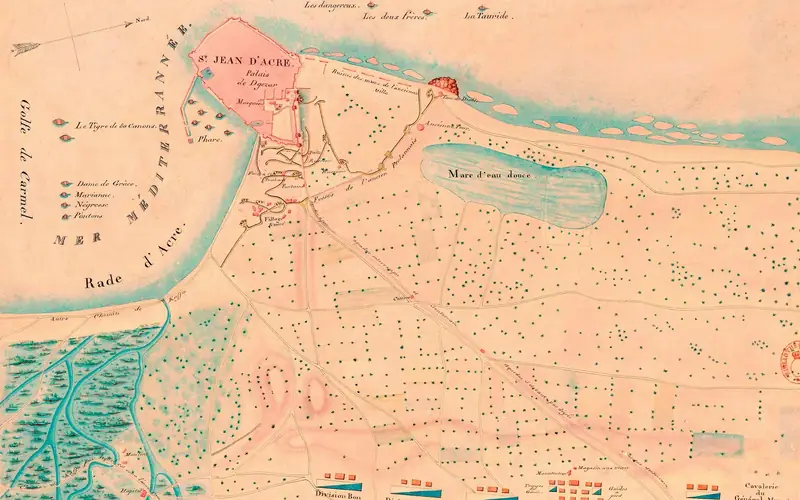
Bonaparte heard the news on 14 August, in his camp between Salheyeh and Cairo. He played down its gravity and gave Ganteaume command of the ships left at Alexandria. But the Army of the Orient was now cut off from France: messages took more than two months to get through, on neutral ships. Samuel Hood blockaded the Egyptian coast and Nelson reached Naples on 22 September; the British took Gozo on 28 October and Minorca on 16 November. According to Michèle Battesti, the Ottoman Empire, Egypt's overlord, and Russia declared war on the Directory on 9 September; the Second Coalition took shape the following year. Unable to be supplied or brought home by sea, the army would try to force the road into Syria, until its failure before Acre.
Nelson reaped the glory. Raised to the peerage as Baron Nelson of the Nile, he also received an unusual gift from Captain Hallowell: a coffin made from the mainmast of L'Orient. He kept it, and it was in that coffin that he was buried after Trafalgar.
Debates, wreck and memory
From 1798 onwards the question of responsibility divided opinion. Bonaparte laid the blame on Brueys, killed in action; the admiral's defenders pointed to the impossibility of entering Alexandria and to the weakness of the crews, while Villeneuve's conduct remains disputed. Historians above all stress Foley's daring and the initiative Nelson left to his captains.
The wreck of L'Orient was found in 1983 by a French team led by Jacques Dumas. From 1998 the excavations of Franck Goddio mapped debris scattered over more than five hundred metres and brought up gold and silver coins, probably part of the treasure taken at Malta. In Britain, Felicia Hemans's poem "Casabianca", published in 1826, long had schoolchildren reciting the death of the boy who stood on the deck of the burning ship.
Sources: Michèle Battesti, "La bataille d'Aboukir. Ses implications stratégiques", Revue du Souvenir napoléonien, no. 421, 1998-1999, online at napoleon.org; Michèle Battesti, La Bataille d'Aboukir, 1798. Nelson contrarie la stratégie de Bonaparte, Paris, Economica, 1998; Brian Lavery, Nelson and the Nile: The Naval War Against Bonaparte, 1798, London, Chatham, 1998.
Discover other battles
 Victory
Read the account
Aboukir
25 July 1799
Aboukir, Egypt
 Victory
Read the account
Battle of the Pyramids
21 July 1798
Embabeh, near Cairo
 Defeat
Read the account
Trafalgar
21 October 1805
Off Cape Trafalgar (Andalusia, Spain)
 Defeat
Read the account
Siege of Acre
20 March — 21 May 1799
Acre, Ottoman Syria
Go further
Recommended books to dig deeper (affiliate links)

Bonaparte (1769-1802)
Patrice Gueniffey · 2013
The rise alone, from Corsica to the Consulate, by a historian of the Revolution who takes time to explain.
See on Amazon
La bataille d'Aboukir, 1798. Nelson contrarie la stratégie de Bonaparte
Michèle Battesti · 1998
The naval defeat of 1 August 1798 set within the Mediterranean strategy of the Directory and Bonaparte, by a French naval historian (in French).
See on Amazon
The Campaigns of Napoleon
David G. Chandler · 1966
Eleven hundred pages on Napoleonic warfare, a staff-college standard for sixty years.
See on AmazonAs an Amazon Associate, this site earns from qualifying purchases.
Support the encyclopedia
Napoleon Empire is an independent project. Your contribution helps grow the content and keep the site running.
DonateSecure payment on the platform you choose.