On 7 September 1812 the two armies fought on a rolling plateau cut by the Kolocha and its ravines, west of Mozhaysk. The redoubts have lost their shape, but the ground, protected since 1961, can still be read.
Historical context
In France the battle takes its name from a river, the Moskva, which flows several kilometres away; the Russians call it after a village, Borodino, about a hundred kilometres west of Moscow, on the road that then ran through Mozhaysk. The account of 7 September 1812 is in the entry on the battle of the Moskva; this one is concerned with the ground as one walks it today.
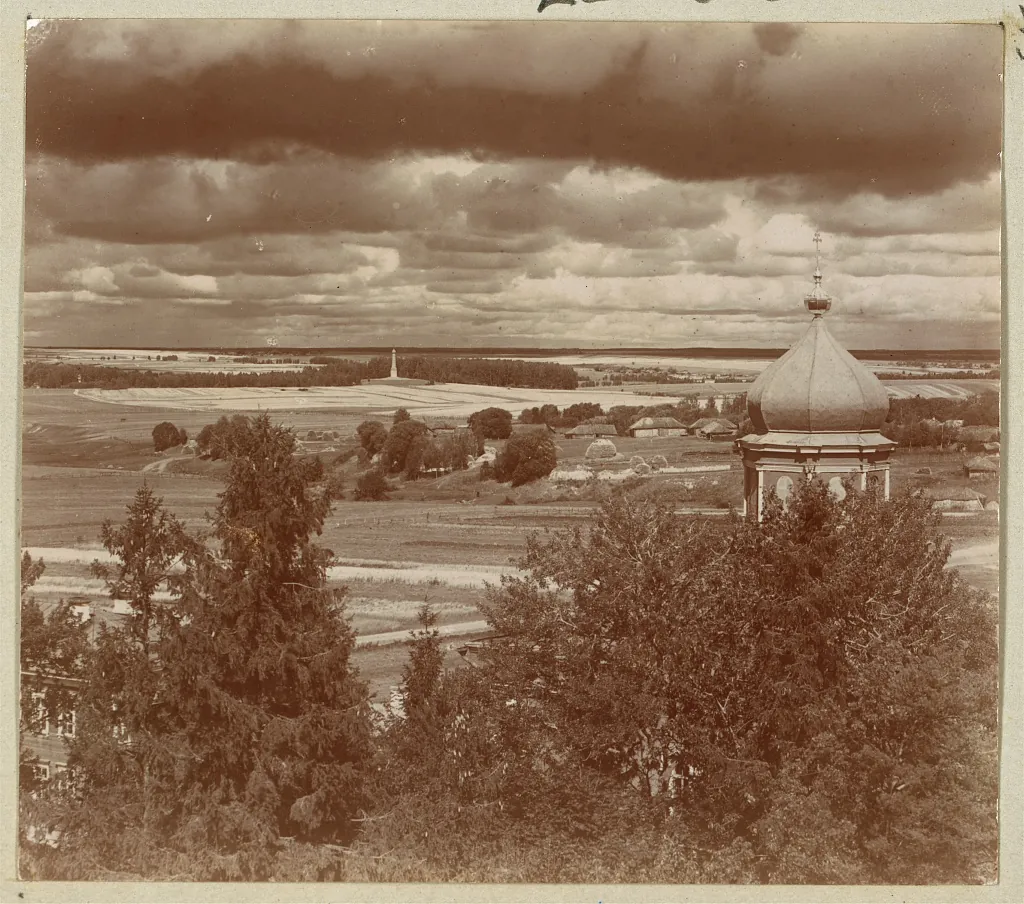
What strikes the visitor first is that the landscape is not flat. A rolling plateau, cut by ravines, slopes down to the Kolocha, a small tributary of the Moskva; the Russians had chosen it for its line of heights, and that line explains the day's dispositions. On the left, facing the French army, Bagration held earthworks in the shape of arrowheads, the flèches, near the village of Semyonovskoye. In the centre, on a rise still called the Raevsky height, a great battery dominated the ground. On the right, along the river, Borodino itself, a village built on the bank, barred the way to the highway.
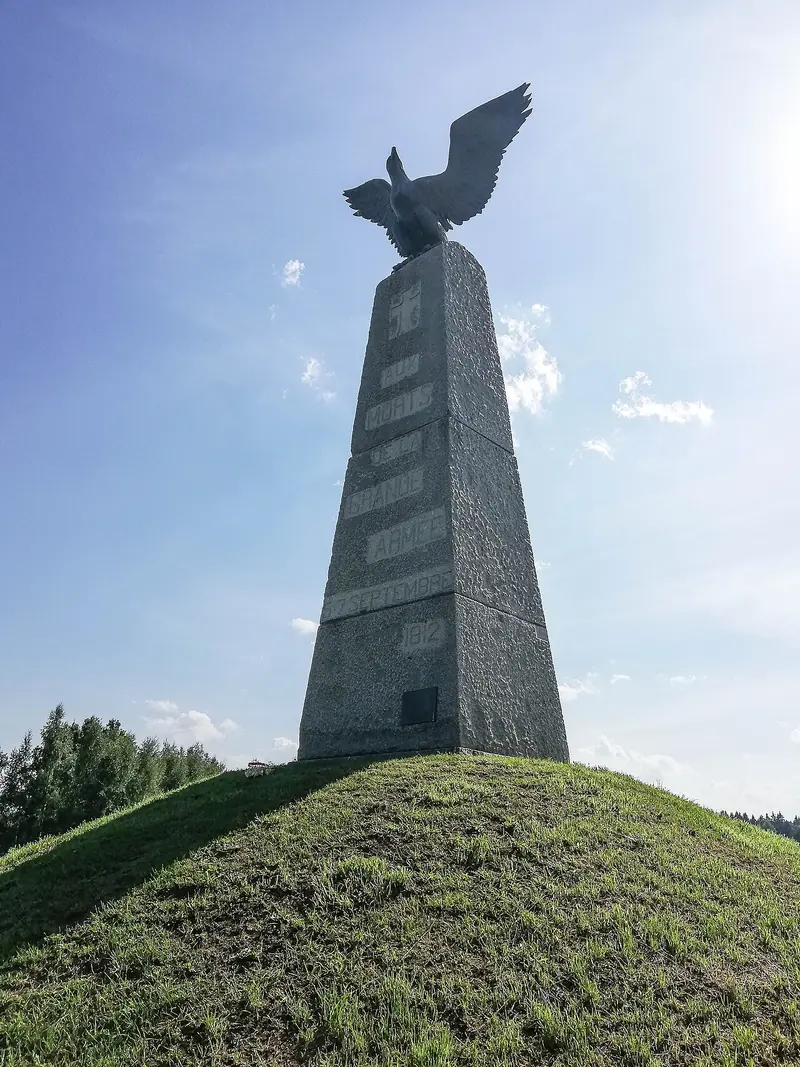
Two days earlier, on 5 September, the French had taken the Shevardino redoubt, in front of this line. The ground still bears its trace as a mass of earth, and visitors come mostly for what followed: it was here that Napoleon set up his command post, from which he watched the battle without leaving it. In 1913 France raised an obelisk of granite topped by an eagle with outstretched wings, dedicated "To the dead of the Grande Armée". Destroyed in the Soviet period, it was restored in the 1980s; it is one of the few monuments built on Russian soil in memory of former adversaries.
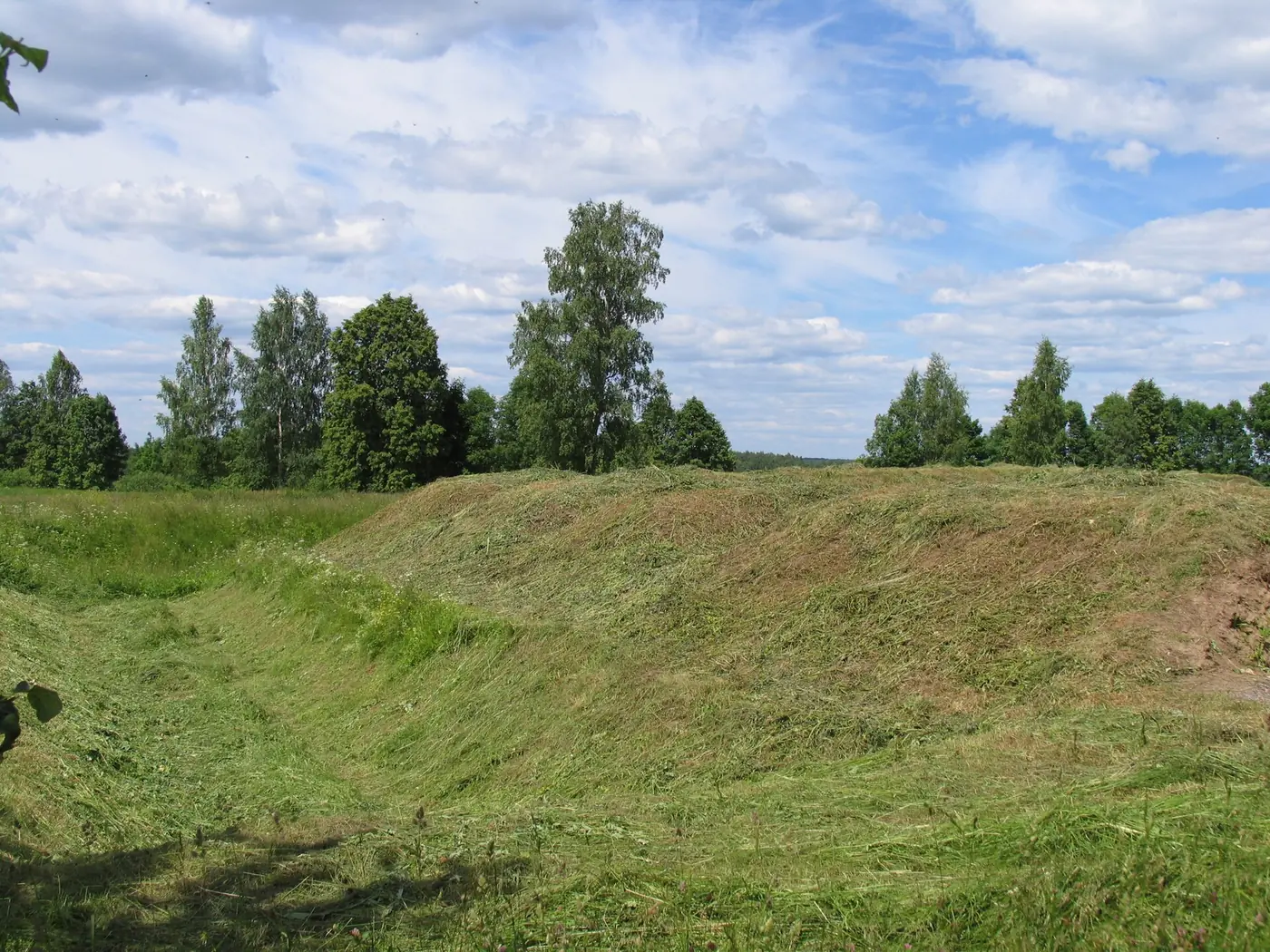
Bagration's flèches are now only grassy banks fronted by a ditch. Yet they changed hands several times during the morning, and it was here that the Russian general was mortally wounded; he died a few weeks later, on 24 September. A little further north, the Raevsky height was taken in the afternoon by Prince Eugène's troops, in a fight that cost the life of Auguste de Caulaincourt, who had come to charge at the head of the cuirassiers. The two positions lie less than two kilometres apart, and that proximity, more than any figure, gives the measure of the ferocity.
The field filled with monuments as Russian memory took hold of it. In 1820 Margarita Tuchkova, whose husband, General Alexander Tuchkov, had been killed near the flèches, had a church built at the presumed spot of his death; it became the Spaso-Borodino monastery. In 1839 a great monument to the defenders of Russia, designed by Antonio Adamini, was unveiled on the Raevsky height, and Bagration's remains were buried at its foot. For the centenary, in 1912, thirty-two new monuments were raised, most of them dedicated to the divisions and regiments that had fought there. The site now has more than fifty.
The twentieth century did not spare these stones. The 1839 monument was torn down in 1932 before being rebuilt in 1987 together with the general's tomb. In between, the field had known a second war: in October 1941 Colonel Polosukhin's 32nd Rifle Division held the Moscow defence line there for several days against the Wehrmacht. The museum and several monuments were damaged, and the ground was not freed until January 1942. Today's visitors thus meet, on one and the same soil, the memory of 1812 and that of 1941.
The site was made a museum-reserve in 1961, which has protected it from building and ploughing: most of the field remains meadow and woodland. One moves from point to point along the line of battle, from the flèches to the Raevsky height, then towards Shevardino. Every year in early September a large reenactment of the battle gathers enthusiasts from many countries, and 8 September is a day of military glory in Russia.
To read Borodino on the ground is to understand why this battle remained without a clear victor: the Russian position was never broken, and yet it was abandoned. Napoleon entered Moscow a week later, but Kutuzov's army, intact in principle, had kept the chance to re-form. Silent meadows and earth banks tell this logic poorly, which is why the visit is best prepared by reading the account of the day.
Go further
Recommended books to dig deeper (affiliate links)
Napoleon the Great
Andrew Roberts · 2014
A monumental biography drawing on Napoleon’s 33,000 surviving letters, admiring but rigorous.
See on Amazon
Napoléon ou le mythe du sauveur
Jean Tulard · 1977
The book that reshaped how the man is read: how France gave itself a saviour, and what it cost.
See on Amazon
Nouvelle histoire du Premier Empire
Thierry Lentz · 2002-2010
Four reference volumes on institutions, diplomacy and collapse: the scholarly synthesis of the subject.
See on AmazonAs an Amazon Associate, this site earns from qualifying purchases.
Support the encyclopedia
Napoleon Empire is an independent project. Your contribution helps grow the content and keep the site running.
DonateSecure payment on the platform you choose.