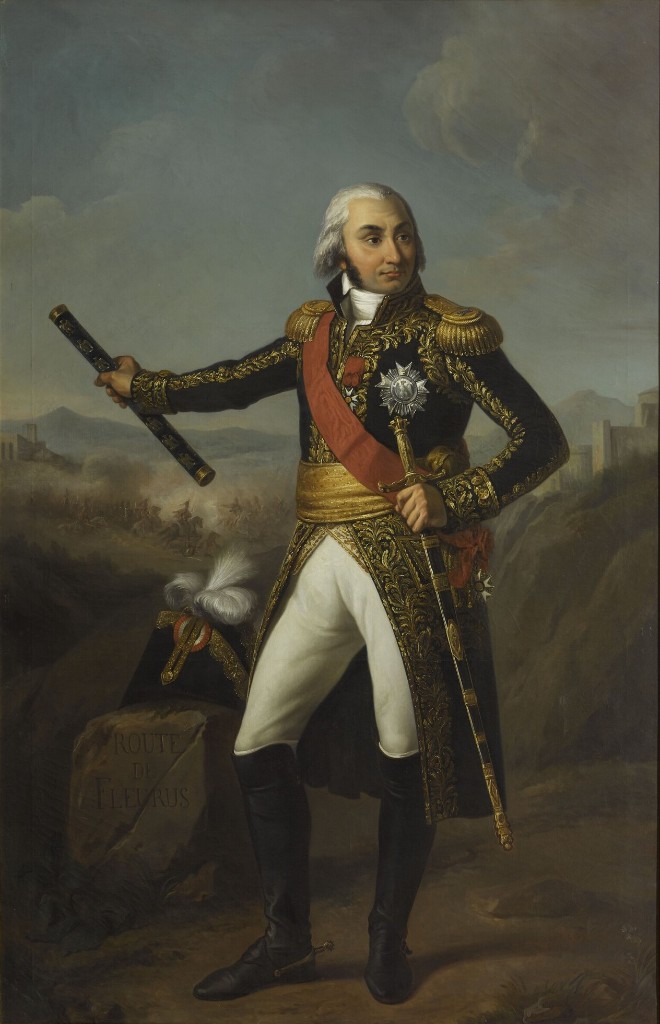
A cylinder of blue velvet strewn with golden eagles, the baton has marked the Marshals of the Empire since 19 May 1804. Inherited from the Old Regime and retained almost to the letter, it rewards a career open to talent: twenty-six holders under Napoleon.
Origins and precedents
In the portrait of Marshal Jourdan, one object catches the eye before the face does: a dark cylinder flecked with gold, held up the way one points to a horizon. It is neither a weapon nor a sceptre but the marshal's baton, the simplest and probably the most coveted badge in the whole military hierarchy of the First Empire.
The word ‘marshal’ comes from a Germanic term for the servant in charge of horses, and a baton of command long went with the office. Under the Old Regime the baton of the marshals of France was of blue velvet strewn with golden fleurs-de-lis and bore a Latin motto, Terror belli, decus pacis: the terror of war, the ornament of peace.
Birth of the imperial symbol
The Revolution had little taste for personal dignities of this kind, nor for lilies. The office of marshal of France disappeared in 1793, and for nearly eleven years the highest military position was that of general-in-chief, a function one exercised rather than a rank one held for life.
Its restoration came with the Empire. The senatus-consultum of 28 Floréal Year XII, that is 18 May 1804, created the dignity of Marshal of the Empire, and the very next day fourteen generals on active service received the title: Berthier, Murat, Moncey, Jourdan, Masséna, Augereau, Bernadotte, Soult, Brune, Lannes, Mortier, Ney, Davout and Bessières. Four older senators, Kellermann, Lefebvre, Pérignon and Sérurier, were added as honorary marshals, bringing the first promotion to eighteen names.
Official uses
The baton itself kept the old form while changing the decoration. Golden eagles replaced the fleurs-de-lis on the blue velvet, while the Latin motto stayed. Napoleon applied here the method he followed for every emblem: keep the medium everyone recognises so that the image of his own power can settle into it without friction.
The marshals took their place among the great officers of the Empire and soon passed from the army to the court. From 1808 most of them received a ducal or princely title, often drawn from a victory, such as Lannes at Montebello, Ney at Elchingen or Davout at Auerstaedt, together with endowments that turned a general of the Republic into a leading notable of the regime.
In the army and in battle
The baton also fills the imagery of these men. In official portraits it is held in the hand, as with Marshal Victor painted by Gros, and it goes with the full dress uniform embroidered with oak leaves. In the painting shown on this page, Jourdan raises it before a battle landscape, his bicorne resting on a milestone marked ‘Route de Fleurus’, a gesture of authority that speaks of command all by itself.
The social weight of the badge escaped no one. Ney was the son of a cooper from Saarlouis, Murat of an innkeeper, Lannes began as an apprentice dyer, and Lefebvre was a miller's son. Their rise illustrates the formula of a career open to talent, with all that the phrase has of appeal and all that it leaves out, since the Emperor's favour counted almost as much as merit.
Propaganda and representation
The baton was often won on campaign. Victor received it in July 1807, shortly after Friedland, and Suchet in July 1811 after the capture of Tarragona. Gouvion-Saint-Cyr obtained it in August 1812 following the second battle of Polotsk. In the wake of Wagram, on 12 July 1809, Macdonald, Marmont and Oudinot were promoted together, and Macdonald recounts in his Souvenirs that Napoleon, who had kept him at a distance after the Moreau affair, announced his promotion on the battlefield.
The last promotion of the Napoleonic period is the most singular. Józef Poniatowski, a Polish prince and the only foreigner to receive the baton, was appointed on 16 October 1813, the first day of the battle of Leipzig. Three days later he drowned in the Elster while covering the army's retreat. Grouchy was still promoted on 17 April 1815 during the Hundred Days, an appointment the Restoration refused to recognise until 1831.
Posterity and collections
The badge offered no protection against the reversals of History. On 4 April 1814 at Fontainebleau, Ney, Oudinot, Lefebvre, Macdonald and Moncey told the Emperor that the army would no longer follow him, and his abdication followed. Ney, who had rallied to him on his return from Elba, was shot on 7 December 1815: the baton he had received in 1804 did not save him from the firing squad.
Even so, the object outlived regimes. The Restoration had it fleur-de-lised again, the Second Empire revived it, and the dignity of Marshal of France still exists today, the last award dating from 1984, posthumously, to Marie-Pierre Kœnig. Napoleon's twenty-six holders remain nonetheless the golden age of the badge.
Memory and debate
People like to quote the saying that every soldier carries a marshal's baton in his cartridge pouch, which is often attributed to Louis XVIII rather than to Napoleon. Arithmetic contradicts it: twenty-six batons in eleven years for several hundred thousand men. The hope was nevertheless real, and it sustained many a march.
For Empire Napoléon, the marshal's baton condenses into a little velvet and gold an idea of the whole regime: an aristocracy of merit, rewarded in the field, yet bound to the Emperor by gratitude as much as by oath. Anyone who wants to understand the Grande Armée and its leaders should begin with this modest badge.
Go further
Recommended books to dig deeper (affiliate links)
Napoleon the Great
Andrew Roberts · 2014
A monumental biography drawing on Napoleon’s 33,000 surviving letters, admiring but rigorous.
See on Amazon
Napoléon ou le mythe du sauveur
Jean Tulard · 1977
The book that reshaped how the man is read: how France gave itself a saviour, and what it cost.
See on Amazon
Nouvelle histoire du Premier Empire
Thierry Lentz · 2002-2010
Four reference volumes on institutions, diplomacy and collapse: the scholarly synthesis of the subject.
See on AmazonAs an Amazon Associate, this site earns from qualifying purchases.
Support the encyclopedia
Napoleon Empire is an independent project. Your contribution helps grow the content and keep the site running.
DonateSecure payment on the platform you choose.