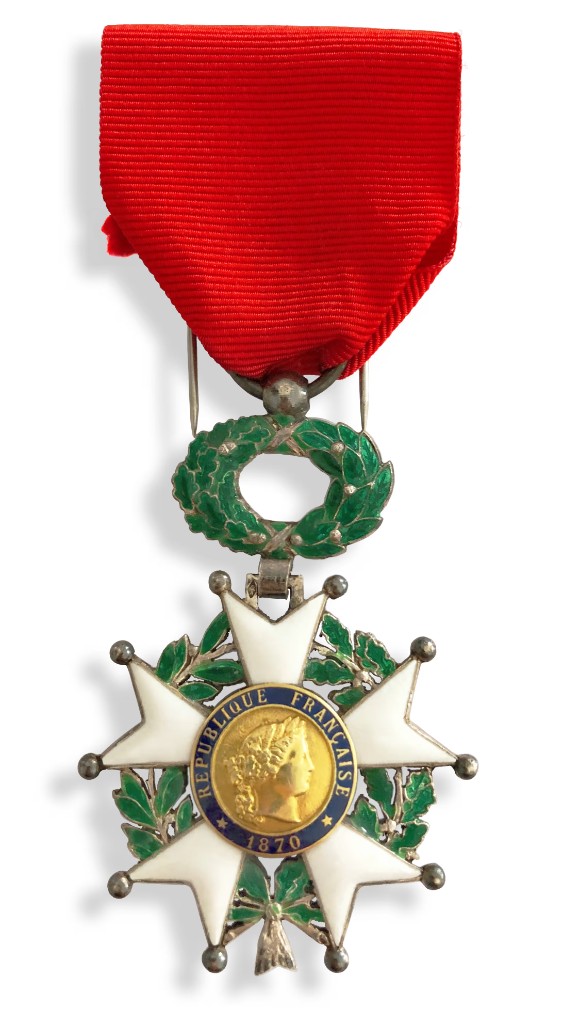
Founded in 1802, the Legion of Honour rewards military and civil merit: red ribbon, star and cross become the national order par excellence.
Origins and precedents
On 19 May 1802, by the law instituting the Legion of Honour, First Consul Napoleon created an order founded not on birth but on service to the state. The Revolution had abolished the orders of Saint-Louis and the Holy Spirit; the Consulate invented a republican distinction the Empire would turn into a pillar of the society of honours.
The project sparked violent Assembly debate: former nobles saw betrayal of egalitarian principles, purist republicans denounced disguised monarchy. Napoleon cut through: "Men must be honoured and bound by favours." The Legion was born of political calculation as much as generosity.
Birth of the imperial symbol
The cross, a five-pointed star on radiant ground, suspended from a red ribbon, was awarded to soldiers, officers, magistrates, scholars, artists and administrators. Grades — legionnaire, officer, commander, grand officer, grand eagle — structured a hierarchy of merit crossing corps and provinces.
On 15 July 1804 at Les Invalides the first grand distribution solemnised the institution. Napoleon himself presented insignia to officers, scholars like Monge and Berthollet, artists and civil servants. The spectacle was meant for posterity: David would fix its image.
Official uses
Napoleon used the Legion as a political instrument: rewarding loyalty, encouraging ambition, binding local notables to the regime. A decorated mayor, a general raised in grade, a scholar wearing the rosette embodied a state that sees and rewards. Refusals were rare and noted; strippings for fault still more spectacular.
Under the Empire the Legion imposed itself on uniform: red buttonhole, plaque on grand uniform, embroidered star on coat. It accompanied the soldier from battlefields to Paris salons. At Wagram or Smolensk legionnaires fell with the cross visible on their chests.
In the army and in battle
Illustrious foreigners — allied sovereigns, foreign generals — could be members, sign of the European extension of the Napoleonic system. Alexander I refused the grand cross Napoleon offered in 1807; other German or Italian princes accepted willingly.
The Legion partly financed its ceremonies from émigré property and state funds. It owned Paris town houses — including the Hôtel de Salm, later the Legion palace — and revenues assigned to maintaining decorated invalids.
Propaganda and representation
Women were initially excluded, save notable exceptions: Joséphine received the grand cross in 1805, a few princesses and court ladies followed. Only in the twentieth century would the Legion fully open to women, but the principle of national reward was established.
After the Empire's fall Louis XVIII kept the order despite ultra pressure: too many notables were attached to it. The Restoration altered ribbon and insignia, but the principle remained. July Monarchy, Second Empire and Republic perpetuated the institution.
Posterity and collections
Rare example of institutional continuity between Revolution, Empire and nineteenth-century monarchies, the Legion of Honour remains France's highest distinction today — direct heir of Bonapartist creation. Every 14 July promotion recalls this consular origin.
Historians stress the Legion helped forge a merit elite, foundation of the French administrative state. It rewarded battlefield courage and civil excellence alike: teachers, doctors, engineers entered the order in the nineteenth century.
Memory and debate
The Legion sums the regime's social philosophy: elevation by talent and courage, visible hierarchy, state as distributor of glory — an aristocracy of merit replacing that of blood. Napoleon saw in it a cement stronger than noble titles.
For Empire Napoléon the Legion of Honour remains the Consulate's most durable institution: created in 1802, alive in 2025, it still bears the red ribbon and star the First Consul gave to France in arms and learning.
Go further
Recommended books to dig deeper (affiliate links)

Napoleon — A magisterial biography
An exhaustive biography of the Emperor, the fruit of rigorous research.
≈ £14.99 Napoleon's Army
Organization, tactics and daily life of the Grande Armée soldiers.
≈ £18.00 Austerlitz 1805
The detailed account of the Battle of the Three Emperors.
≈ £12.99As an Amazon Associate, this site earns from qualifying purchases.
Support the encyclopedia
Napoleon Empire is an independent project. Your contribution helps grow the content and keep the site running.
Donate