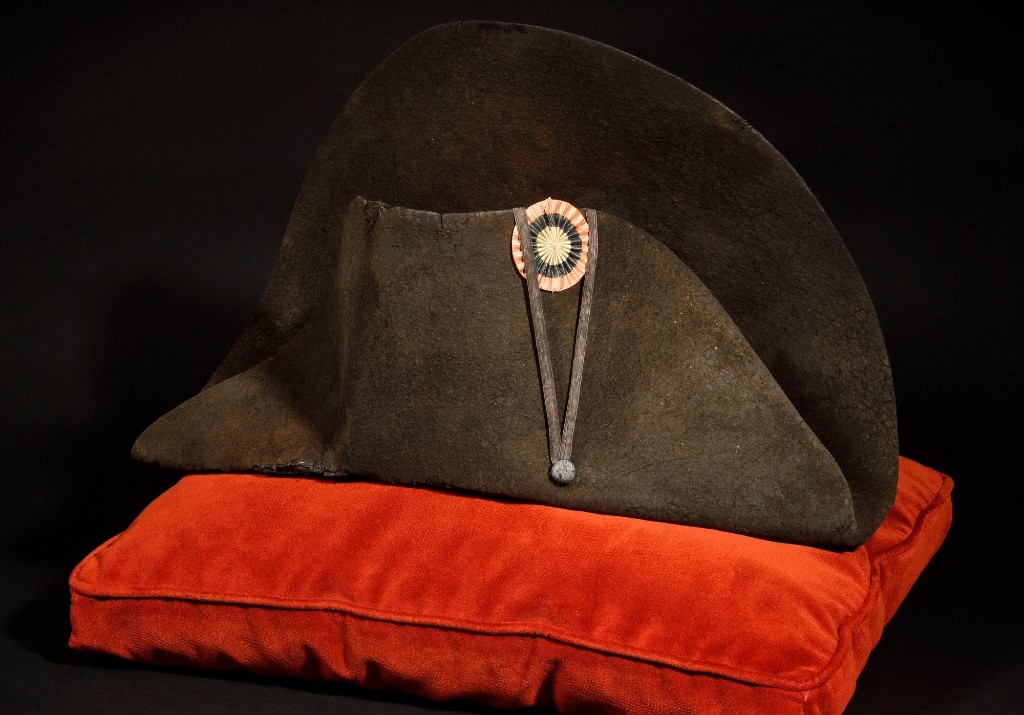
Worn athwart, hand in waistcoat: the hat become Napoleon Bonaparte's universal silhouette.
Origins and precedents
The bicorne — two-cornered or brim-up hat — was the most widespread military and civil headgear among French officers of the late eighteenth century and First Empire. Napoleon wore it almost constantly, but what distinguished him from other generals was not the model itself: it was how he wore it.
The so-called 'athwart' style — horns pointing fore and aft, not sideways — became the Emperor's visual signature. Official portraits by David, Ingres, Gros and Gérard fixed this angle; popular engravings reproduced it; British caricaturists seized on it for mockery, paradoxically strengthening universal recognition.
Birth of the imperial symbol
Contrary to the legend of one hat worn ten years, several examples exist. Hatters Poupard then Pouteau supplied the Emperor; models are kept at the Army Museum, Fontainebleau or in private collections. They differ in cords, tricolour cockades, plumes or felt quality — but the silhouette stays the same.
The bicorne was a working object as much as a symbol. Napoleon tucked notes, maps and correspondence inside; witnesses report him throwing it on the ground in council of war, picking it up, crushing it. This physical, almost brutal relationship with the hat fed the image of a direct chief careless of court etiquette.
Official uses
On the battlefield the bicorne allowed spotting the Emperor at distance — tactical advantage for aides-de-camp, target for enemy marksmen. At Eylau, Wagram or Waterloo his visible presence galvanised struggling columns; veterans claimed to recognise 'the little hat' in the smoke.
The hand-in-waistcoat gesture, often paired with the bicorne in post-1800 painting, completed the silhouette. Nineteenth-century physiologists sought illness in it; in truth it was chiefly a stable pose for portraiture, borrowed from classical rhetoric of self-mastery. Propaganda or convention, it linked hat and composure.
In the army and in battle
In civilian dress as in uniform Napoleon kept the bicorne: diplomatic audiences, ministerial councils, partial reviews. He rejected the English-fashion top hat and Ancien Régime tricorne. The bicorne said he remained, even as emperor, the general of Italy and Egypt.
Guard soldiers and staff officers imitated the Emperor's headgear without copying his exact angle. The bicorne became the unofficial emblem of Napoleonic elite — less regulated than the line shako, more prestigious in camp imagination.
Propaganda and representation
The British collected descriptions of the 'little hat' in newspapers and pamphlets. James Gillray and successors made it a grotesque accessory on a stocky body; but that satire also exported the image across Europe, including among admirers of the Corsican general.
After the 1814 abdication and Saint Helena exile Napoleon's bicornes became relics. Bertrand, Montholon and authorised visitors described worn hats at Longwood; at the Emperor's death in 1821 every personal object fed the Napoleonic souvenir market.
Posterity and collections
Second Empire and Third Republic reused the silhouette on monuments — Vendôme Column, place Vendôme statue, school prints. The bicorne eventually evoked Napoleon without a face: symbol reduced to its simplest shape.
Historians of military dress note the bicorne gradually vanished from European armies after 1815, replaced by shako then kepi. Its association with Napoleon froze the model in the past and turned it into historical icon rather than living headgear.
Memory and debate
Twentieth-century cinema, comics and advertising further stylised it: an athwart bicorne suffices to identify a Napoleonic character without a name. Rarely has headgear carried such identity.
For Empire Napoléon the bicorne is the regime's most instantly identifiable symbol: before the eagle, before the N, it is the athwart hat that says — Napoleon is here.
Go further
Recommended books to dig deeper (affiliate links)

Napoleon — A magisterial biography
An exhaustive biography of the Emperor, the fruit of rigorous research.
≈ £14.99 Napoleon's Army
Organization, tactics and daily life of the Grande Armée soldiers.
≈ £18.00 Austerlitz 1805
The detailed account of the Battle of the Three Emperors.
≈ £12.99As an Amazon Associate, this site earns from qualifying purchases.
Support the encyclopedia
Napoleon Empire is an independent project. Your contribution helps grow the content and keep the site running.
Donate