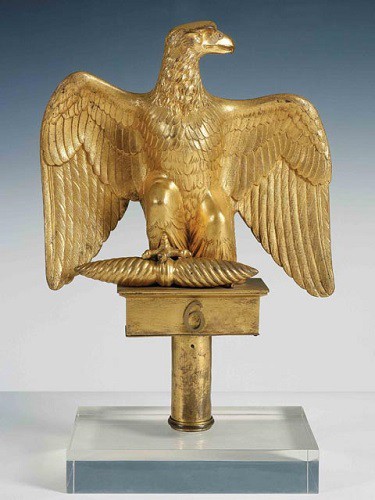
Gilded bronze standard entrusted to each regiment by the law of 28 Floréal Year XII: rallying point, coveted trophy and emblem of regimental identity.
Origins and precedents
The regimental ordnance eagle is the metal standard the law of 28 Floréal Year XII (18 May 1804) requires for each line, cavalry and artillery unit. Distinct from the battalion pennant — light cloth carried at company level — the eagle is the entire regiment's emblem, entrusted to the colonel and borne in battle by an elite NCO, the eagle-bearer.
The model, designed under Vivant Denon's direction and executed by Pierre-Philippe Thomire, shows an eagle with spread wings, talons gripping the lictor's fasces and Jupiter's thunderbolt. Weighing roughly four kilograms, the gilded bronze bird crowns an eight-foot staff; it is not parade ornament but the corps' symbolic heart.
Birth of the imperial symbol
The distinction between eagle and pennant structures regimental life. The pennant, often embroidered with number and honoured battles, accompanies close manoeuvres; the eagle, heavier and more sacred, advances at battalion centre when the line engages. Losing the pennant is grave; losing the eagle is humiliation official bulletins mention only indirectly.
The eagle consecration ceremony of 5 December 1804 — eve of the coronation — at Boulogne camp then Paris marks a turning point. Napoleon solemnly hands standards to colonels; troops swear to die rather than abandon the imperial bird. Words spoken that day bind regimental honour to the Emperor's person as much as to the fatherland.
Official uses
The eagle-bearer is chosen from the bravest NCOs. He marches in the front rank, surrounded by grenadiers ready to die defending the staff. At Austerlitz, Jena, Wagram campaign accounts glorify those who fall with hands still clenched on the standard.
Captured by the enemy, an eagle becomes diplomatic and military trophy. Russians display those taken in 1812; the British celebrate capture of the 45th and 105th line eagles at Waterloo. Each trophy feeds coalition propaganda; in France losing an eagle may trigger inquiry and disgrace for the responsible colonel.
In the army and in battle
The Imperial Guard receives more sumptuous eagles than the line. Foot grenadiers, chasseurs, Guard dragoons carry enriched models, sometimes doubled by a second eagle on the pennant. The Old Guard concentrates on its standards an almost religious aura line regiments admire and envy.
Manufacture mobilises Paris workshops: Thomire, the Mint, sometimes subcontractors pressed by 1805 campaign orders. Some replacement eagles differ slightly from first models — variations collectors and museum curators study meticulously today.
Propaganda and representation
On the battlefield the eagle orients formation. The soldier who sees it afar knows where his regiment stands; the general who spots it gauges line progress. The bronze bird thus structures combat's emotional geography as much as tactics.
Eagles were not reserved for infantry: heavy cavalry and horse artillery received models suited to their use. Every arm of the Grande Armée shared the same visual language: Rome revived under French flags, with tricolour ground.
Posterity and collections
After 1815 surviving eagles fed Napoleonic legend. Deposited at Les Invalides, displayed in provincial museums, copied for commemorations, they remain the most immediate visual symbol of the First Empire for the general public.
English engravings and nineteenth-century battle paintings endlessly depict struggle around the staff: favourite scene of military painters, from Detaille to Lady Butler, who make it the dramatic narrative of Napoleonic war.
Memory and debate
Historically the ordnance eagle sums regime tension: citizen army become subject of a personal imperial emblem; republic in colours, empire in bronze bird. It tells how Napoleon sought to bind each regiment to his person as much as to the nation.
For Empire Napoléon the regimental ordnance eagle remains the Grande Armée's red thread: from Thomire to museums, from Boulogne to Waterloo, it tells how a bronze bird became a corps' soul.
Go further
Recommended books to dig deeper (affiliate links)

Napoleon — A magisterial biography
An exhaustive biography of the Emperor, the fruit of rigorous research.
≈ £14.99 Napoleon's Army
Organization, tactics and daily life of the Grande Armée soldiers.
≈ £18.00 Austerlitz 1805
The detailed account of the Battle of the Three Emperors.
≈ £12.99As an Amazon Associate, this site earns from qualifying purchases.
Support the encyclopedia
Napoleon Empire is an independent project. Your contribution helps grow the content and keep the site running.
Donate