
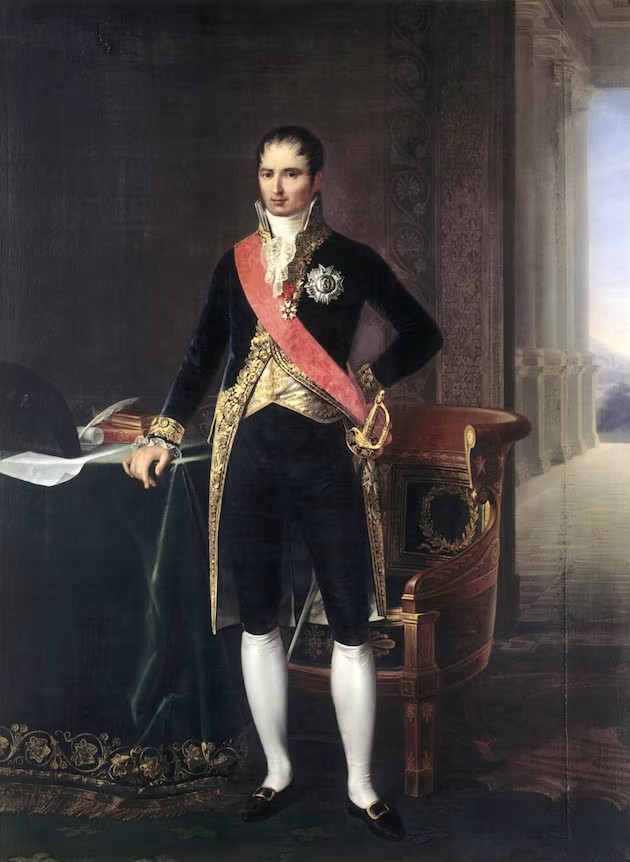
Marshal of the Empire, Prince of Pontecorvo. Elected Crown Prince of Sweden in 1810, he became King Charles XIV John in 1818. Founder of the Bernadotte dynasty. The only Napoleonic marshal to become sovereign.
From Béarnais Soldier to Prince of Pontecorvo
Jean-Baptiste Bernadotte was born on 26 January 1763 at Pau, into a bourgeois family. His father was a prosecutor. He enlisted in 1780 in the Royal-Marine regiment. The Revolution hastened his career: in 1794, he was a divisional general. He fought on the Rhine, in Italy, in Germany. In 1798, he married Désirée Clary — sister of Julie Clary, Joseph Bonaparte's wife. This marriage brought him closer to the Bonapartes without making him loyal. Bernadotte was ambitious, independent, sometimes rebellious. In 1799, he refused to support the 18 Brumaire; Napoleon did not hold it against him at first. In 1804, Bernadotte was created a marshal. In 1806, after the Prussian campaign, Napoleon gave him the Principality of Pontecorvo, in the Kingdom of Naples.
At Auerstedt, in October 1806, Bernadotte should have converged with Davout to crush the Prussians. He veered off, did not intervene. Davout won an almost single-handed victory. Napoleon fulminated: « Bernadotte disobeyed me. » The rift set in. In 1809, at Wagram, Bernadotte commanded the Saxon corps; his performance was mediocre. He was disgraced, lost his command. The break was final. Bernadotte looked to other horizons.
Crown Prince and King of Sweden
In 1810, Sweden sought a successor to King Charles XIII, who had no heir. A faction favourable to a French alliance proposed Bernadotte — he had shown clemency towards Swedish prisoners in 1806. On 21 August 1810, the Swedish Diet elected Bernadotte Crown Prince. He adopted the name Charles John (Karl Johan), converted to Lutheranism, learned Swedish. In 1812, he negotiated with Russia and Great Britain: Sweden broke with France. Bernadotte marched against Napoleon alongside the Coalition. In 1813, he commanded the Army of the North — Prussians, Russians, Swedes — and contributed to the defeat at Leipzig.
In 1818, Charles XIII died. Bernadotte became King of Sweden and Norway as Charles XIV John. He reigned until 1844. His dynasty — the Bernadottes — still occupies the Swedish throne. Irony of history: the marshal Napoleon had disgraced was the only one of his lieutenants to ascend a throne and found a royal house. Napoleon, on Saint Helena, was said to have remarked: « Bernadotte was not French; he was Swedish as soon as Sweden called him. »
Désirée Clary and the Bonaparte Links
Bernadotte's marriage to Désirée Clary in 1798 placed him in the Bonapartes' orbit. Désirée was the sister of Julie Clary, Joseph's wife — and Napoleon's first fiancée in 1795, before Josephine. The two families socialised; Bernadotte rubbed shoulders with the Bonaparte brothers without ever submitting to them. In 1799, during 18 Brumaire, he refused to march with Napoleon. As Minister of War under the Directory, he could have thwarted the coup. He remained neutral. Napoleon nevertheless made him a marshal in 1804 — the family tie weighed.
This independence cost Bernadotte dearly. At Auerstedt, in October 1806, Napoleon ordered him to converge with Davout to crush the Prussians. Bernadotte veered off, citing prior orders. Davout won an almost single-handed victory. Napoleon fulminated: « Bernadotte disobeyed me. He wants to wage war for his own account. » The rift was never repaired. At Wagram, in 1809, Bernadotte commanded the Saxon corps; his performance was mediocre, he was wounded. Napoleon dismissed him. The break was complete. When Sweden sought a crown prince in 1810, Bernadotte had nothing left to lose — and everything to gain.
Discover other characters



Go further
Recommended books to dig deeper (affiliate links)
Napoleon — A magisterial biography
An exhaustive biography of the Emperor, the fruit of rigorous research.
≈ £14.99Napoleon's Army
Organization, tactics and daily life of the Grande Armée soldiers.
≈ £18.00Austerlitz 1805
The detailed account of the Battle of the Three Emperors.
≈ £12.99As an Amazon Associate, this site earns from qualifying purchases.
Support the encyclopedia
Napoleon Empire is an independent project. Your contribution helps grow the content and keep the site running.
Donate