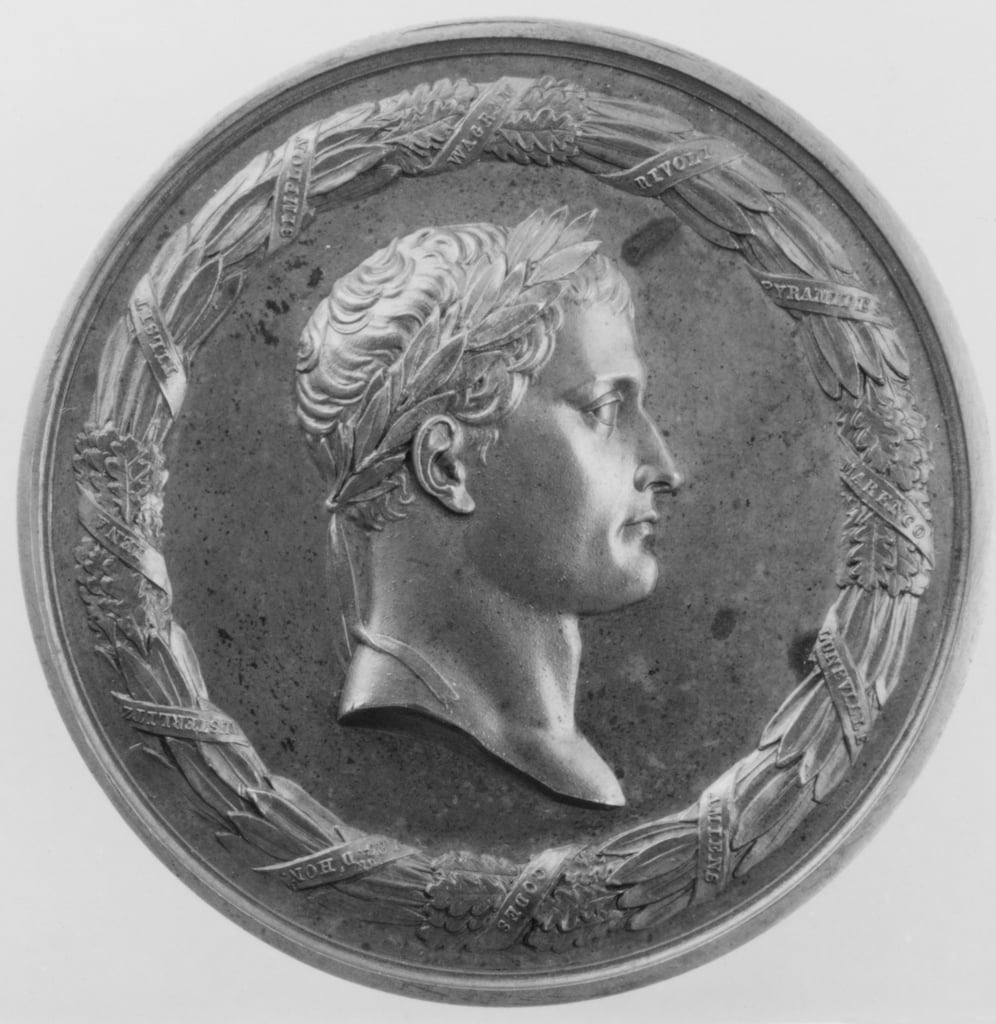
Head wreathed in laurel after the model of Roman emperors: the profile adorning First Empire coins, medals and cameos from 1807, Napoleon's official portrait until the regime's fall.
Origins and precedents
On First Empire coins, medals and cameos, Napoleon most often appears in profile, his head wreathed in laurel. This iconographic type, known as the "laureate head", became the sovereign's official portrait from 1807 and remained so until the Empire's fall, eclipsing nearly every other likeness in the everyday circulation of struck objects.
The device was nothing new: it borrowed directly from the vocabulary of Roman imperial coinage, where the emperor wore the civic or triumphal crown depending on the period. By choosing this antique framing for his own face, Napoleon placed his sovereignty in a lineage running back to Augustus and Caesar rather than to the Most Christian kings.
Birth of the imperial symbol
The earliest coins of the Republic and then the Consulate, engraved by the mechanic-engraver Jean-Pierre Droz, still show a bare-headed Bonaparte. After the 1804 coronation, the new chief engraver of the Mint, Pierre-Joseph Tiolier, initially kept this sobriety: the legend read "Napoléon Empereur", while the reverse still bore "République française" — a monetary paradox that lasted until 1809.
The 1807 change was as much a political as an aesthetic gesture. Under the impetus of Vivant Denon, director-general of museums and the true architect of the imperial iconographic programme, the laurel replaced consular restraint: a face was needed that could sum up, in a single silhouette, military victory and the legitimacy of the new regime.
Official uses
Tiolier's design was carried across the whole of the gold and silver coinage — 20-franc, 40-franc and 5-franc pieces — struck in Paris but also in the Empire's annexed or satellite workshops, from Turin to Utrecht. The same profile thus circulated in the millions, from Baltic ports to Mediterranean trading posts.
The laurel also adorns the medals of the "Histoire métallique" Napoleon commissioned to perpetuate the memory of his reign, on the model of Louis XIV's commemorative series. Every great day of the reign — coronation, victories, marriages, births — received its own piece, engraved by the leading medallists of the age around Bertrand Andrieu.
In the army and in battle
A bronze medal held at the Metropolitan Museum of Art in New York (inv. 1977.254.4) illustrates how the type endured even after the Empire's fall: struck in 1821, the year of Napoleon's death, it faithfully reproduces the laureate profile within a laurel wreath naming several of the reign's battles and treaties — Rivoli, the Pyramids, Marengo, Austerlitz and the Simplon road can be read there, alongside the Peace of Amiens.
The reverse of that same medal shows an eagle taking flight above the rock of Saint Helena, beneath the legend "Il mourut sur un rocher" ("He died on a rock") and the words "Île Ste Hélène, 5 mai 1821": the living sovereign's laureate head and the eagle escaping his exile together form, on a single object, the two images that would sum up the Napoleonic legend for generations.
Propaganda and representation
The format also lent itself to glyptics: hardstone engravers and cameo workshops reused the laureate profile to adorn rings, brooches and boxes made for the imperial family or given as diplomatic gifts. Inherited from the antique cameos depicting Roman emperors, the craft enjoyed a lasting commercial and artistic revival under the Empire.
Unlike the pomp of the coronation — Charlemagne's crown, the bee-embroidered mantle, sceptre and hand of justice — the laureate head chose a stripped-down register: bare neck, no insignia besides the laurel. The two repertoires do not contradict one another; they complement each other, one addressed to the court and its ceremonies, the other to monetary circulation and the public image of the warlord turned lawgiver.
Posterity and collections
British caricaturists, Gillray foremost among them, seized very early on this Caesarean imagery to mock the Emperor's ambition, turning the laurel of glory into a symbol of hubris. Anti-Napoleonic propaganda played relentlessly on this parallel with the tyrants of Antiquity — a comparison French coinage, for its part, claimed instead as a model of greatness.
After 1814–1815, French coinage reverted to the profile of Louis XVIII, but Napoleon's laureate head went on circulating in private collections, numismatists' cabinets and Bonapartist memory, before enjoying a renewed official interest at the 1840 Retour des Cendres and then under the Second Empire.
Memory and debate
Today these coins and medals remain, for numismatists and art historians alike, a valuable source for dating and one of the most widely reproduced vehicles of the Napoleonic image — visible on millions of pieces that crossed borders and regimes long after the Empire itself had disappeared.
For Empire Napoléon, the laureate profile sums up on its own the regime's whole strategy of image-making: an antique face, a wreath of leaves, and the certainty that an emperor must be seen as clearly on the battlefield as in his subjects' pockets.
Go further
Recommended books to dig deeper (affiliate links)
Napoleon the Great
Andrew Roberts · 2014
A monumental biography drawing on Napoleon’s 33,000 surviving letters, admiring but rigorous.
See on Amazon
Napoléon ou le mythe du sauveur
Jean Tulard · 1977
The book that reshaped how the man is read: how France gave itself a saviour, and what it cost.
See on Amazon
Nouvelle histoire du Premier Empire
Thierry Lentz · 2002-2010
Four reference volumes on institutions, diplomacy and collapse: the scholarly synthesis of the subject.
See on AmazonAs an Amazon Associate, this site earns from qualifying purchases.
Support the encyclopedia
Napoleon Empire is an independent project. Your contribution helps grow the content and keep the site running.
DonateSecure payment on the platform you choose.