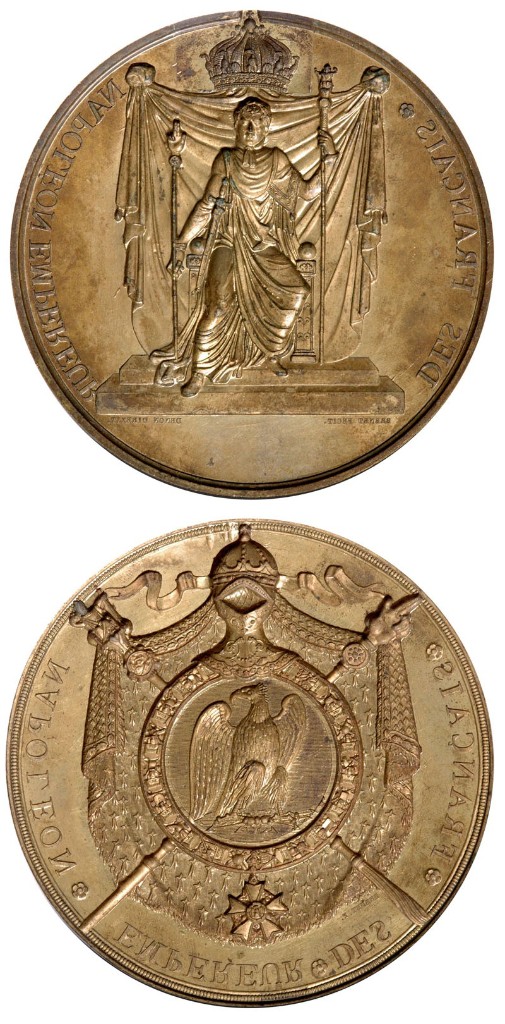
Napoleon on horseback, eagle and fasces: the official seal authenticating acts of the imperial state.
Origins and precedents
The great seal of the Empire, brought into service after the 1804 coronation, was the supreme legal instrument authenticating laws, treaties, letters patent and acts of grace. Its matrix, silver or bronze by version, impressed red wax with an instantly recognisable design: Napoleon as Roman emperor, laurel-crowned, on horseback, surrounded by imperial eagle and lictor's fasces.
Iconography drew on antique coinage and consular medals: the Emperor was not shown as traditional King of France crowned by God and Church but as conquering prince in the Roman sense, like emperors on denarii. The eagle held Jupiter's thunderbolt; Latin inscription affirmed imperial dignity and French nation sovereignty.
Birth of the imperial symbol
Each sealed document thus became propaganda act as much as legal text: the recipient of a treaty, appointment or law saw Napoleon's equestrian face before reading the fine print. The seal turned administration into power spectacle, repeated thousands of times yearly across French-influenced Europe.
Jean-Jacques Régis de Cambacérès, archchancellor of the Empire, was official keeper of the great seal: surrendering it symbolised transferring legal sovereignty. His role was not decorative — he countersigned major acts, headed the chancellery and ensured imperial law's coherence with codes promulgated since 1804.
Official uses
A small seal complemented the great for lesser acts; ministry, secretary of state and imperial court seals multiplied in series. Napoleonic administration was stamped, sealed, filed paperwork administration: the seal was its visual signature, harder to forge than a mere initial.
Matrices were entrusted to Paris Mint engravers and specialist craftsmen; their loss or capture was a political event. During the Hundred Days of 1815 who held the great seal had constitutional urgency comparable to flag or artillery.
In the army and in battle
In April 1814, after the first abdication, Cambacérès presented the great seal to Louis XVIII — a gesture legally closing the Empire and legitimising Restoration in notaries', embassies' and foreign courts' eyes. The seal changed keeper; French state continuity was affirmed.
Paris and Vienna treaties, imperial constitutions, organic senatus-consulta bore the great seal's imprint. Legal historians read there the will to found new legal order on Roman forms — Civil Code, Penal Code, Commercial Code — all authenticated by the same equestrian image.
Propaganda and representation
Napoleon on horseback also referred to projected equestrian statues for imperial squares and military glory monuments. The seal extended on wax what the Vendôme Column said in bronze: Emperor as war chief and legislator united in one figure.
Collectors and archivists study surviving matrices, wax fragments and later forgeries to distinguish consular, imperial and restorative periods. A poorly centred impression or pale wax might reveal rejected act or fraud.
Posterity and collections
Abroad enemy governments recognised validity of acts bearing the great seal while the Empire lasted; after 1814 some imperial documents remained in force — notably the Civil Code — under other seals, proof law survived the image.
The great seal was among the state treasury's most sensitive objects: to lose it was to lose capacity to govern in the Emperor's name. This material dimension of power reminds that Napoleonic legitimacy was not only military or plebiscitary: it was also notarial, sealed, archived.
Memory and debate
National museums and Archives services keep impressions and matrices; temporary exhibitions on Consulate and Empire display them beside crowns and honour swords, showing pen and wax accompanied the sword.
For Empire Napoléon the great seal sums fusion of law and image: the Napoleonic state does not merely conquer, it seals — and what is sealed bears the Emperor on horseback.
Go further
Recommended books to dig deeper (affiliate links)

Napoleon — A magisterial biography
An exhaustive biography of the Emperor, the fruit of rigorous research.
≈ £14.99 Napoleon's Army
Organization, tactics and daily life of the Grande Armée soldiers.
≈ £18.00 Austerlitz 1805
The detailed account of the Battle of the Three Emperors.
≈ £12.99As an Amazon Associate, this site earns from qualifying purchases.
Support the encyclopedia
Napoleon Empire is an independent project. Your contribution helps grow the content and keep the site running.
Donate