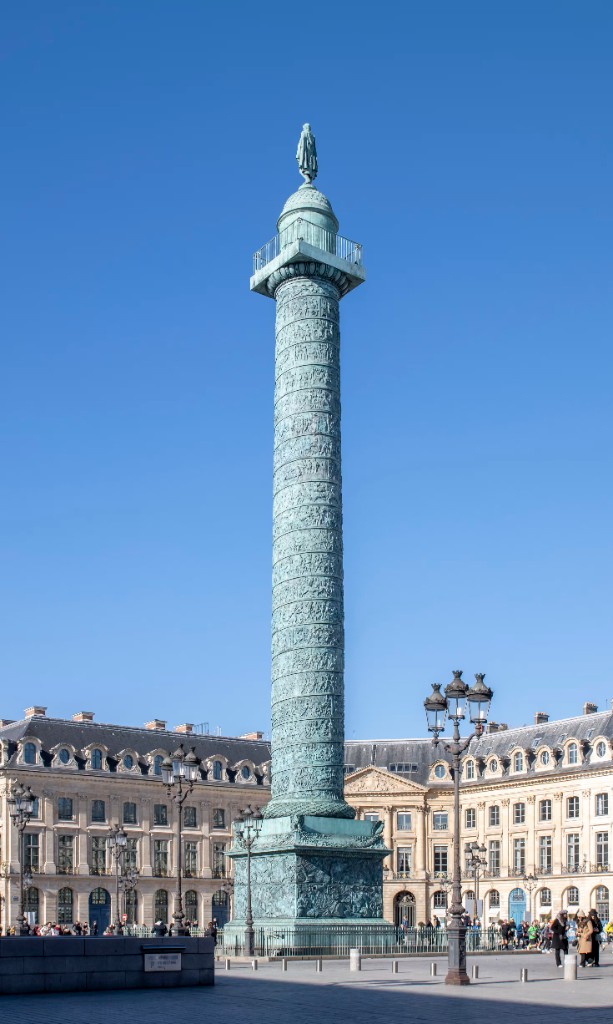
From Austerlitz bronze to Paris eagle: imperial victory monument at the heart of the capital.
Origins and precedents
The Vendôme Column, erected between 1806 and 1810 on Napoleon's orders, stands at the centre of the eponymous square — former Place Louis XV, renamed Place des Piques under the Revolution, then Place Vendôme in 1799. It celebrates Austerlitz victory of 2 December 1805, the 'Battle of the Three Emperors', which broke the Third Coalition.
The model is explicitly Roman: the shaft follows Trajan's Column, with a spiral of reliefs narrating the 1805 campaign — marches, bivouacs, battles, negotiations, entry into Munich and Vienna. Napoleon wanted a monument readable as a victory bulletin carved in bronze.
Birth of the imperial symbol
The monument's metal came from captured enemy cannon — nearly twelve hundred guns melted at the Mint under Dominique Vivant Denon, museum intendant and the Emperor's artistic adviser. The column is thus sculpture, propaganda and material war trophy at once.
Architect Jean-Baptiste Lepère designed the structure; sculptor Bergeret and statuary Gondouin directed relief workshops. The summit statue first showed Napoleon as Roman emperor, laurel-crowned, holding sceptre and hand of justice — image of pacified omnipotence.
Official uses
The 1810 inauguration coincided with Napoleon and Marie-Louise's wedding: Paris had to shine for dynastic Europe as much as for veterans. The column belonged to a building programme — Madeleine, Louvre Carrousel, Carrousel arch — turning the capital into imperial showcase.
In 1814 the Bourbons toppled the Napoleonic statue and replaced it with a white flag; in 1830 Louis-Philippe restored an effigy of the general in his small hat. After 1833, still under Louis-Philippe, a new statue in Roman dress rose, then in 1863 the Second Empire replaced it with an imperial eagle.
In the army and in battle
On 16 May 1871 the Paris Commune pulled the column down in the name of struggle against militarism and imperialism. Gustave Courbet, president of the Artists' Federation, was linked to this decision; bronze crashed on the pavement. The event shows the monument was no neutral décor but major political stake.
In 1875 the Third Republic had the column re-erected — Courbet was ordered to pay part of the cost. The imperial eagle again crowned the shaft. The symbol thus outlived Empire, Commune and later regimes: it became contested national monument.
Propaganda and representation
The spiral reliefs, hard to read from ground level, were designed for ideal viewing from square town-house windows or an aerial viewpoint the age did not offer. The monument works as vertical roll of honour more than detailed narrative for the passer-by.
Art historians see in it the peak of Napoleonic propagandist aesthetics: formal classicism, trophy recycling, association of chief and army in one victory column. No other Paris monument concentrates so many imperial references in one spot.
Posterity and collections
In the twentieth century the column repeatedly sparked debate — restoration after both world wars, polemics on colonial or military meaning, discussion of 'decolonising' public space. It remains one of Paris's most photographed landmarks.
For tourists and Parisians alike the Vendôme Column often sums Napoleon in one image: an eagle above a bronze shaft, ringed by jewellers and palaces. The battle of Austerlitz becomes permanent urban landscape.
Memory and debate
Nineteenth-century engineers admired the ashlar structure masked by bronze; successive restorations consolidated the shaft without altering its silhouette. The monument is listed and protected, yet never wholly apolitical.
For Empire Napoléon the Vendôme Column is victory turned to stone and bronze: Austerlitz carved into Paris sky, under the eagle dominating the city.
Go further
Recommended books to dig deeper (affiliate links)

Napoleon — A magisterial biography
An exhaustive biography of the Emperor, the fruit of rigorous research.
≈ £14.99 Napoleon's Army
Organization, tactics and daily life of the Grande Armée soldiers.
≈ £18.00 Austerlitz 1805
The detailed account of the Battle of the Three Emperors.
≈ £12.99As an Amazon Associate, this site earns from qualifying purchases.
Support the encyclopedia
Napoleon Empire is an independent project. Your contribution helps grow the content and keep the site running.
Donate