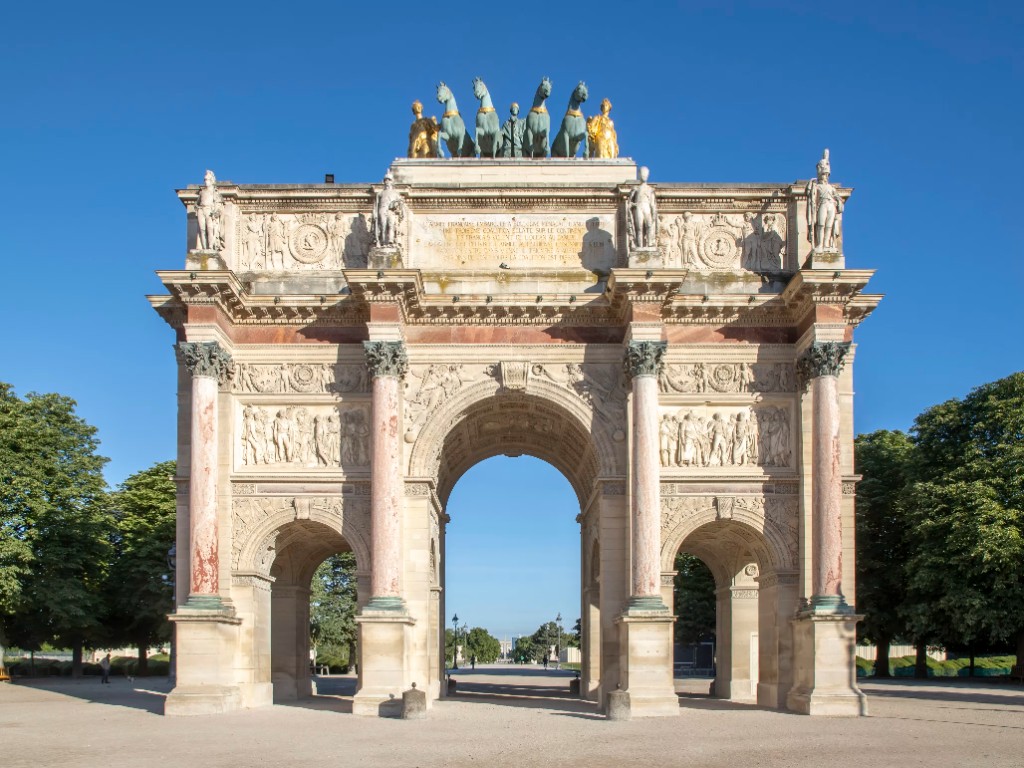
Raised between 1806 and 1808 by Percier and Fontaine, imperial gateway between Louvre and Tuileries, crowned by the bronze quadriga taken from Venice.
Origins and precedents
The Arc de Triomphe du Carrousel was raised between 1806 and 1808 on the axis linking the Louvre palace to the Tuileries gardens. Designed by Charles Percier and Pierre Fontaine, the Emperor's official architects, it commemorates the December 1805 victory at Austerlitz and asserts imperial presence at the heart of reinvented Paris.
More modest than the Arc de Triomphe de l'Étoile — whose building site opens the same year but will not finish until after the regime's fall — the Carrousel arch was conceived as gateway to the imperial palace. It frames the view from the square of the same name to the Louvre façades, extending the urban staging Napoleon wanted.
Birth of the imperial symbol
The monument follows the antique model of a single-fornix arch, flanked by Corinthian columns and crowned by an attic. Bas-reliefs, executed under sculptors of the imperial workshop, celebrate recent victories: peace with Austria, entry into Munich, Austerlitz triumph. Each panel links Paris stone to campaigns that remade Europe's map.
The arch summit bears a bronze quadriga: the Horses of Saint Mark, taken from Venice in 1797 then returned to the Republic of Saint Mark in 1815, but originally replaced by this restored antique chariot for the Empire. Winged Victory drives the car; the whole symbolises imperial dominion over art and war trophies.
Official uses
Percier and Fontaine did not settle for an isolated monument: they integrated the arch into a coherent urban ensemble — Louvre façades, Carrousel grille, neoclassical proportion harmony. The project belongs to transforming Paris into an imperial capital worthy of Rome.
The Carrousel arch works as parade gateway: foreign sovereigns, triumphant marshals and diplomatic delegations pass its fornix at solemn entries. It materialises the symbolic boundary between city and palace.
In the army and in battle
Compared with the Arc de Triomphe de l'Étoile, designed to immortalise the entire Grande Armée on the Chaillot hill, the Carrousel arch is more intimate and immediate: it speaks to the everyday Parisian, the Tuileries stroller, the courtier entering the Louvre. Both monuments answer each other on the capital's historic axis.
Bas-reliefs and imperial inscriptions suffer political vicissitudes: erased or altered under the Restoration, restored in the nineteenth century, they witness contested memory of the First Empire. The monument survives regimes as stone testimony.
Propaganda and representation
The summit quadriga knows several avatars: Horses of Saint Mark, then copies, then restitutions. Today antique replicas crown the arch; the originals' story illustrates back-and-forth of spoliation and restitution between Paris and Venice.
Engravings and panoramic views of imperial Paris show the Carrousel arch as pivot of urban landscape: between Tuileries garden and Napoleon court, it structures the image foreigners hold of the French capital.
Posterity and collections
Architecture historians see in this monument a laboratory of Empire style: antique proportions, martial ornaments, urban fabric integration. Percier and Fontaine experiment here a vocabulary that will mark palaces, furniture and decoration across allied Europe.
After 1815 the arch was not demolished: it remained, adjusted, restored, sometimes a little forgotten behind the Arc de Triomphe de l'Étoile's brilliance. Yet it stays one of the rare great Paris monuments completed under Napoleon himself.
Memory and debate
For the contemporary visitor the Carrousel arch offers human scale: one can walk around it, almost touch it, read its bas-reliefs without leaving the pavement. It tells a precise victory — Austerlitz — as much as a global urban ambition.
For Empire Napoléon the Arc de Triomphe du Carrousel is the gateway to imperial Paris: stone, bronze and perspective, between Louvre and Tuileries, it shows how military glory became the capital's architecture.
Go further
Recommended books to dig deeper (affiliate links)

Napoleon — A magisterial biography
An exhaustive biography of the Emperor, the fruit of rigorous research.
≈ £14.99 Napoleon's Army
Organization, tactics and daily life of the Grande Armée soldiers.
≈ £18.00 Austerlitz 1805
The detailed account of the Battle of the Three Emperors.
≈ £12.99As an Amazon Associate, this site earns from qualifying purchases.
Support the encyclopedia
Napoleon Empire is an independent project. Your contribution helps grow the content and keep the site running.
Donate