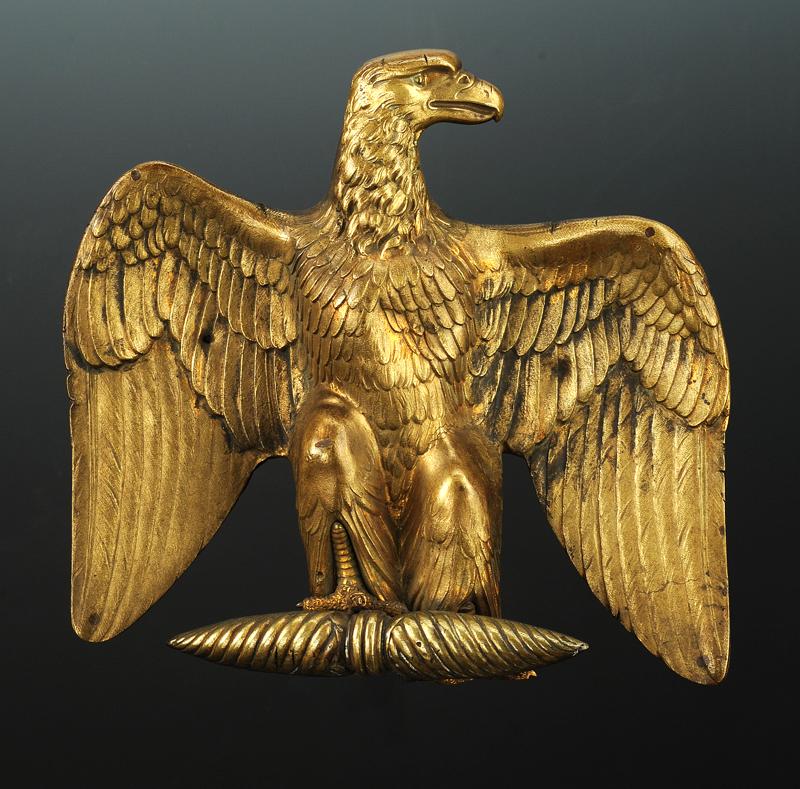
From the Roman eagle to the standards of the Grande Armée: an emblem of glory, victory and loyalty to the Napoleonic regime.
Origins and precedents
The eagle, heir to Roman legions and to the iconography of Jupiter hurling thunderbolts, became under the Consulate and Empire the foremost emblem of the French armies. Napoleon chose it to embody continuity with antiquity, military greatness and state sovereignty — without abandoning the revolutionary tricolour that remained the ground of regimental flags.
As early as 1800 the First Consul considered replacing Republican colours with a more imperial symbol. Debates in the Council of State pitted supporters of the Gallic cockerel, winged Victory and the Roman eagle. The last prevailed: by decree of 21 July 1804, confirmed by the law of 28 Floréal Year XII, each line, cavalry and artillery regiment was to receive a gilded bronze eagle.
Birth of the imperial symbol
The model, designed under Vivant Denon's direction and executed by Pierre-Philippe Thomire, shows an eagle with spread wings, talons gripping the lictor's fasces and Jupiter's thunderbolt. Weighing roughly four kilos, the metal bird was no mere ornament: it was the rallying point in battle, the object defended when the line wavered, whose loss equalled, in old soldiers' memory, collective disgrace.
The ceremony of 5 December 1804, on the eve of the coronation, at Boulogne camp then in Paris, solemnly entrusted these standards to colonels. Napoleon spoke words binding regimental honour to the Emperor's person: each eagle became pledge of sworn loyalty, no longer to an abstract fatherland alone but to the sovereign who bore it.
Official uses
On the battlefield the eagle advanced at the battalion centre. The eagle-bearer, often an NCO decorated for bravery, marched in the front rank; grenadiers closed around him. At Austerlitz, Jena, Friedland, Grande Armée bulletins glorified those who fell with hands still clenched on the staff.
Lost in battle, an eagle was tragedy for the regiment; captured by the enemy, it became a trophy heavy with meaning. Russians displayed those taken after the 1812 retreat; Austrians kept several in Vienna arsenals. The British celebrated capture of the 45th and 105th line eagles at Waterloo — an event English engraving turned into symbol of the Empire's fall.
In the army and in battle
Coalition propaganda turned each trophy into proof Napoleon was not invincible. In France, conversely, losing an eagle sometimes justified severe military inquiries: the colonel who let it be taken risked disgrace. The bronze bird thus concentrated a moral charge no other camp object bore.
The Imperial Guard bore still more prestigious eagles. Foot grenadiers, chasseurs, Guard dragoons carried more sumptuous models, sometimes doubled by a second eagle on the pennant. The Old Guard in particular concentrated on its standards an almost sacred aura: at Waterloo their late withdrawal around these staffs fed legend of boundless fidelity.
Propaganda and representation
Eagles were not reserved for infantry. Heavy cavalry and horse artillery received models suited to their use; the navy flew ensigns where the eagle stood beside anchor and tricolour. Every arm of the Grande Armée shared the same visual language: Rome revived under French flags.
Paris makers — Thomire, but also Mint workshops — sometimes struggled to meet orders: the 1805 campaign accelerated production, and some replacement eagles differ slightly from first models. These minute variations fascinate collectors and museum curators today.
Posterity and collections
After 1815 surviving eagles fed Napoleonic legend. Deposited at Les Invalides, copied for monarchical restorations, displayed in provincial museums, they remain the most immediate visual symbol of the First Empire for the general public. The Second Empire would order new ones for its regiments, proof of the emblem's lasting force.
The eagle also crosses into culture: it appears on monuments, medals, Sèvres plates, Gobelins tapestries. It accompanies the crowned N and imperial bees in a coherent decorative grammar where each motif refers to the others.
Memory and debate
Historically the eagle sums Bonapartist regime tension: republican heir in colours, Roman empire in emblem; an army of citizens become subjects of an imperial bird knowing only one master and one flag. This synthesis explains both the victories and fractures of imperial society.
For Empire Napoléon the eagle remains the thread of an entire era: from Boulogne to Waterloo, from Thomire's workshops to museum display cases, it tells how nineteenth-century France wanted to see itself heir to Rome while marching under the tricolour.
Go further
Recommended books to dig deeper (affiliate links)
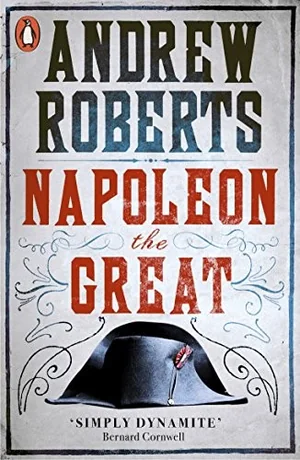
Napoleon the Great
Andrew Roberts · 2014
A monumental biography drawing on Napoleon’s 33,000 surviving letters, admiring but rigorous.
See on Amazon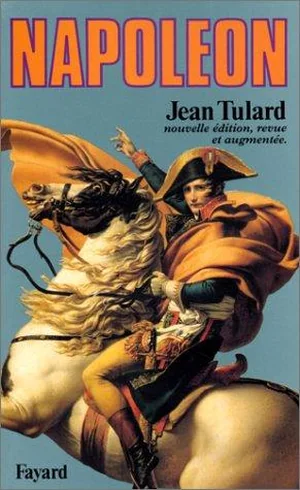
Napoléon ou le mythe du sauveur
Jean Tulard · 1977
The book that reshaped how the man is read: how France gave itself a saviour, and what it cost.
See on Amazon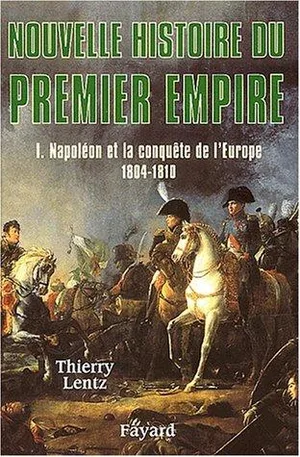
Nouvelle histoire du Premier Empire
Thierry Lentz · 2002-2010
Four reference volumes on institutions, diplomacy and collapse: the scholarly synthesis of the subject.
See on AmazonAs an Amazon Associate, this site earns from qualifying purchases.
Support the encyclopedia
Napoleon Empire is an independent project. Your contribution helps grow the content and keep the site running.
DonateSecure payment on the platform you choose.