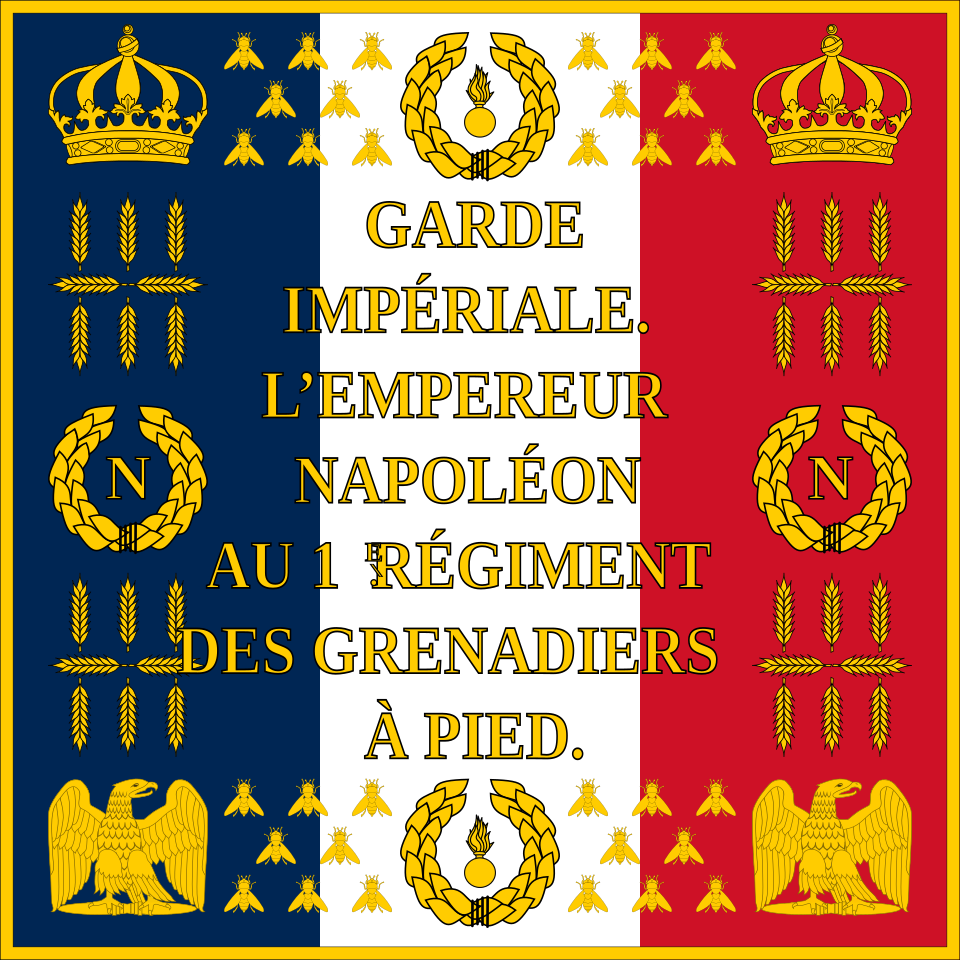
Old Guard, Middle Guard, Young Guard: eagles, grenades and the motto 'Valour and Discipline' on elite standards.
Origins and precedents
The Imperial Guard formed the Napoleonic army's elite corps: foot chasseurs and grenadiers, heavy and light cavalry, foot and horse artillery, Guard marines, engineers. Its colours — or eagles, depending on branch — were more sumptuous than line regiments' and carried special aura in the military honours hierarchy.
The motto 'Valour and Discipline', inscribed on several Guard standard patterns, summed the moral contract between Emperor and veterans: bravery in battle, obedience off it. It distinguished the Guard from line regiments whose inscriptions varied with campaigns and feats of arms.
Birth of the imperial symbol
The Old Guard, soldiers who had served since the Consulate or early campaigns, bore the most venerated colours. Old Guard grenadiers and chasseurs marched with deliberate slowness in battle; losing the eagle was unthinkable — last defenders died around the staff.
Guard eagles followed the general 1804 model — gilded bronze bird, spread wings, talons on fasces and thunderbolt — but with richer cravats, gold fringe and sometimes commemorative inscriptions. The flaming grenade often appeared beside the eagle for grenadier companies.
Official uses
The Middle Guard, created to absorb still-fit but less senior veterans, and Young Guard, raised from 1809 for selected recruits, received similar standards with distinctions of size, border or cravat colour. The whole formed an elite pyramid within the elite.
Colour presentation ceremonies for the Guard followed solemn protocol: the Emperor in person when possible entrusted the eagle to the colonel, who swore to surrender it only with his life. These rites, inherited from Revolution then amplified under Empire, bound the corps to Napoleon's person.
In the army and in battle
In campaign Guard colours served as decisive rallying points. At Austerlitz, Friedland or Wagram the appearance of bearskins and Old Guard eagles on a threatened flank often seemed to tip the day — or at least the bulletins claimed so.
The Guard was not invulnerable: the 1812 Russian campaign exhausted the Old Guard; 1813 rebuilding mixed veterans and conscripts. Colours lost or burned in the Moscow retreat marked a turning point in corps prestige.
Propaganda and representation
At Waterloo on 18 June 1815 the Young Guard led last attacks around La Haye Sainte farm and Mont-Saint-Jean plateau. Old Guard tirailleurs held the centre; their eagles finally gave way under coalition pressure. Guard colours marked the Empire's death throes.
Capturing a Guard colour was exceptional trophy: few enemies achieved it. Those taken at Waterloo — notably by the British — were displayed as proof of final victory; in France their loss fed the black legend of betrayal and Grouchy's ill timing.
Posterity and collections
After 1815 some Guard eagles survived in museums — Les Invalides, British regimental collections — or vanished into antiquarian trade. Nineteenth-century copies for military ceremonies kept the corps' visual memory alive.
Battle painters — Detaille, Philippoteaux, Rouget — fixed the image of Guard eagle-bearers, often grouping tricolour, eagle and bearskin in one composition. These canvases still feed school and patriotic imagination.
Memory and debate
Today Imperial Guard colours embody for the public the romantic elite of Napoleonic wars: mature men, moustaches, martial silence — even though the Young Guard held many very young faces in 1815.
For Empire Napoléon Imperial Guard colours symbolise elite in the Emperor's service: under these eagles one does not retreat — or dies standing.
Go further
Recommended books to dig deeper (affiliate links)

Napoleon — A magisterial biography
An exhaustive biography of the Emperor, the fruit of rigorous research.
≈ £14.99 Napoleon's Army
Organization, tactics and daily life of the Grande Armée soldiers.
≈ £18.00 Austerlitz 1805
The detailed account of the Battle of the Three Emperors.
≈ £12.99As an Amazon Associate, this site earns from qualifying purchases.
Support the encyclopedia
Napoleon Empire is an independent project. Your contribution helps grow the content and keep the site running.
Donate