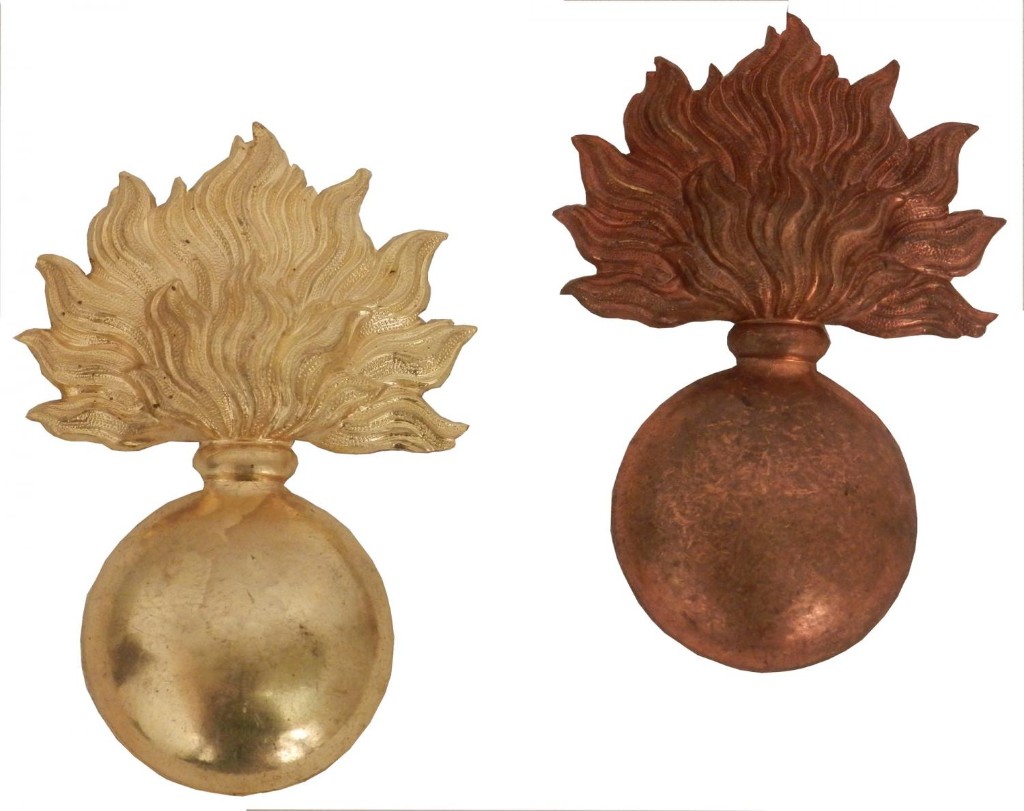
Flaming bomb on shako and colour: emblem of artillery, the Imperial Guard and the fighting elite.
Origins and precedents
The French flaming grenade — metal ball with stylised flames — is an old military emblem massively reused under the First Empire. It first designated grenadiers, elite troops for the hardest assaults and hand-grenade throwing, then artillery and Imperial Guard support units.
Its origin reaches the Ancien Régime: grenadier companies, placed on the battalion's right flank, were already distinguished by a flaming-ball insignia. Revolution kept and generalised this tradition; Consulate and Empire fixed regulatory models with new precision, engraved in uniform regulations of 1804 and beyond.
Birth of the imperial symbol
On shakos and head-plates the grenade visually distinguished grenadier companies from fusiliers or voltigeurs within the same line infantry regiment. Its presence on a colour signalled an elite regiment, honour company or Guard corps. The soldier who wore it knew superior bravery was expected — and that his silhouette was recognisable afar in battlefield smoke.
Artillery adopted the grenade as collective symbol from the late eighteenth century: it evoked explosive projectiles and the firepower deciding Napoleonic battles. Guard guns, massed on decisive positions at Wagram or Friedland, often bore ornaments where grenade met imperial eagle and crowned N on carriages and ammunition wagons.
Official uses
The Imperial Guard concentrated the symbol's most prestigious use: foot grenadiers, chasseurs, foot and horse artillery wore gilt or silvered brass models, sometimes topped with a crowned N. The grenade told the line private: these men were elite of the elite, the Emperor's last resort when battle wavered.
Regulations specified dimensions, metal and fixing mode by branch and rank. A grenadier officer might wear a larger, more lavishly chased grenade than the simple soldier. These minute distinctions structured the Grande Armée's visible hierarchy as much as stripes and epaulettes.
In the army and in battle
In battle the grenade was not mere ornament: it recalled grenadiers' tactical mission, sent forward to break enemy formations, force gates, storm redoubts. At Badajoz, Borodino, Lützen imperial grenadiers justified their insignia with often heavier losses than the rest of the battalion.
Raffet engravings, Detaille paintings and nineteenth-century figurines fixed in popular imagination the grenadier silhouette with dark shako and blazing grenade. This iconography survived the Empire: it fed romantic legend of the Napoleonic soldier, sometimes more immediate than the regimental eagle.
Propaganda and representation
Coalition armies knew this sign well: capturing a grenade shako meant striking elite foe. British, Austrian and Russian museums keep trophies where the flaming ball attests quality of French troops faced.
The grenade was not a wholly invented Napoleonic symbol: it inherited French traditions, but the Empire standardised its use and spread it across Grande Armée uniformology, including integrated contingents — Poles, Italians, Germans — often adopting French insignia beside their own distinctions.
Posterity and collections
After 1815 the grenade remained on French uniforms of restored monarchy then July Monarchy, proof of its force as military elite sign independent of political regime. Army conservatives refused to abandon an emblem speaking professional worth rather than dynastic legitimacy.
In the twentieth century the grenade still appeared on some infantry regimental insignia, Republican Guard headgear and Gendarmerie iconography. Each regulatory change was debated: the symbol became part of French military heritage far beyond its Napoleonic glory.
Memory and debate
Collectors distinguish models by period — Revolution, Consulate, Empire, Restoration — by maker and preservation state. An Old Guard shako grenade fetches considerable auction prices: proof the material object still carries prestige of the corps it represented.
For Empire Napoléon the French grenade embodies imperial army controlled violence: fire, explosion, assault — war's hardest part entrusted to men marked by the flaming ball.
Go further
Recommended books to dig deeper (affiliate links)

Napoleon — A magisterial biography
An exhaustive biography of the Emperor, the fruit of rigorous research.
≈ £14.99 Napoleon's Army
Organization, tactics and daily life of the Grande Armée soldiers.
≈ £18.00 Austerlitz 1805
The detailed account of the Battle of the Three Emperors.
≈ £12.99As an Amazon Associate, this site earns from qualifying purchases.
Support the encyclopedia
Napoleon Empire is an independent project. Your contribution helps grow the content and keep the site running.
Donate