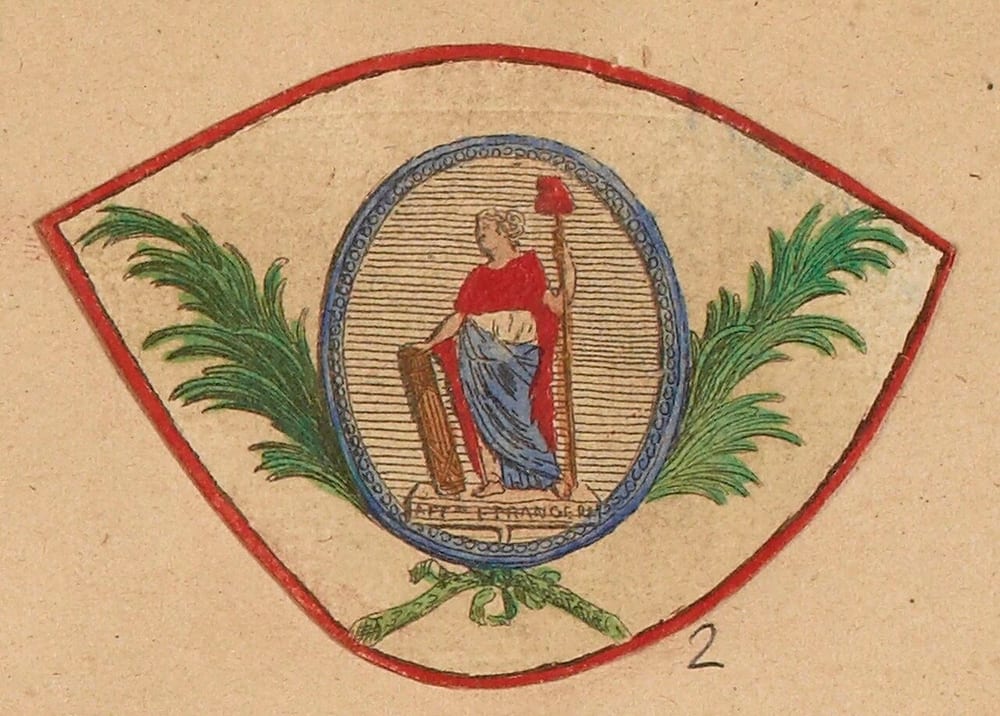
An ancient headdress turned emblem of liberty during the Revolution, the Phrygian cap crowned the pikes, seals and vignettes of the Republic. The Consulate and then the Empire preferred the laurel, the eagle and the bee: the story of an awkward inheritance.
Origins and precedents
A cone of red wool with its tip folded forward: the silhouette is so familiar that we forget how composite it is. The Phrygian cap runs through the imagery of the Revolution, crowns the Marianne of town halls and leaps from the prints of 1793 to the postage stamps of the twentieth century. Under the Consulate and the Empire, however, it almost entirely vanishes from official emblems.
Its name points to Phrygia, a region of Asia Minor, and Greek and Roman art lent it to figures from the East: the Trojan shepherd Paris, the Amazons, the Persians, the god Mithras. At the outset, the cap thus marks the foreigner, the barbarian seen from Athens or Rome, and by no means the free man.
Birth of the imperial symbol
Liberty comes from another cap, the pileus, a felt bonnet handed to a slave at the moment of manumission. Scholars of the classical age, and then the engravers of the eighteenth century, fused the two objects into one. The revolutionaries' “cap of liberty” is thus the fruit of a learned reading of Antiquity rather than of an unbroken tradition.
From 1790 the red cap reached the street and the clubs. It was planted atop liberty trees, brandished on the end of pikes, worn to assert one's patriotism. On 15 April 1792, the Festival of Liberty held in Paris for the Swiss soldiers of Châteauvieux, freed from the galleys after the Nancy mutiny, made it a true rallying sign.
Official uses
On 20 June 1792, demonstrators invaded the Tuileries and set a red cap on Louis XVI's head, where he kept it for some time. The famous scene shows how far the cap had become a political object: to accept it was to seem to yield to the people; to refuse it was to defy them.
Republican power then adopted it in its official images. Administrative vignettes, letterheads, cards and tokens show the Republic as a standing woman holding a pike topped with the cap and resting on a bundle of arms, as on the hand-coloured woodcut in the Musée Carnavalet reproduced on this page. The bundle, for its part, would outlive 1799: it reappears in the imperial universe.
In the army and in battle
The Terror loaded the red cap with a harsher meaning, that of the sans-culotte and the Jacobin militant. After Thermidor, in July 1794, everyday wearing of the cap gradually disappeared, while the emblem remained on official paper, softened, in the allegorical compositions of the Directory.
When Bonaparte took power in Brumaire of Year VIII, his undertaking was to close the Revolution without disowning its gains. The red cap, associated with the excesses of 1793, sat awkwardly with this regime of order and reconciliation. It is better to speak of fading than of a ban: the cap simply left the repertoire with which power wished to adorn itself.
Propaganda and representation
Other, more durable signs took its place. The victor's laurel crowns Napoleon's profile on the coins, the eagle of 1804 takes the place of the figure of Liberty, the bee and the N cover the palaces. Each of these emblems, presented in a neighbouring entry, says what the cap said in 1792 in another vocabulary: that of authority rather than insurrection.
Coinage offers a good marker of this transition. On pieces struck from 1804, the reverse still carries the legend “République française”; the formula “Empire français” replaces it only in 1809. The republican vocabulary thus outlived the coronation by five years, while the images had already changed sides.
Posterity and collections
The sister republics, from the Batavian to the Cisalpine, had taken up the same iconography: Liberty, pike and cap. When Italy became a kingdom in 1805 and Holland in 1806, the décor disappeared along with the institutions that carried it, replaced by the crowns and arms of the new sovereigns.
The Phrygian cap had its revenge after the Empire. In 1830 Eugène Delacroix set it on the Liberty who leads the people, shown at the Salon of 1831; under the Third Republic it became an almost obligatory attribute of Marianne, whose bust presided in town halls. The emblem Napoleon had set aside came back as the very face of the Republic.
Memory and debate
It also travelled far beyond France. The American cents of 1793 bear a Liberty with a cap on a pole, and several national coats of arms, those of Haiti, Argentina and Cuba among them, still display it. Everywhere it recalls the same idea, that of a liberty won, sometimes through violence.
For Empire Napoléon, the Phrygian cap is the necessary counterpoint to all the imperial emblems: without it, it is hard to grasp why the eagle, the laurel and the bee had to make so much noise to take hold. It recalls where the Empire came from, and what its symbols set out to replace.
Go further
Recommended books to dig deeper (affiliate links)
Napoleon the Great
Andrew Roberts · 2014
A monumental biography drawing on Napoleon’s 33,000 surviving letters, admiring but rigorous.
See on Amazon
Napoléon ou le mythe du sauveur
Jean Tulard · 1977
The book that reshaped how the man is read: how France gave itself a saviour, and what it cost.
See on Amazon
Nouvelle histoire du Premier Empire
Thierry Lentz · 2002-2010
Four reference volumes on institutions, diplomacy and collapse: the scholarly synthesis of the subject.
See on AmazonAs an Amazon Associate, this site earns from qualifying purchases.
Support the encyclopedia
Napoleon Empire is an independent project. Your contribution helps grow the content and keep the site running.
DonateSecure payment on the platform you choose.