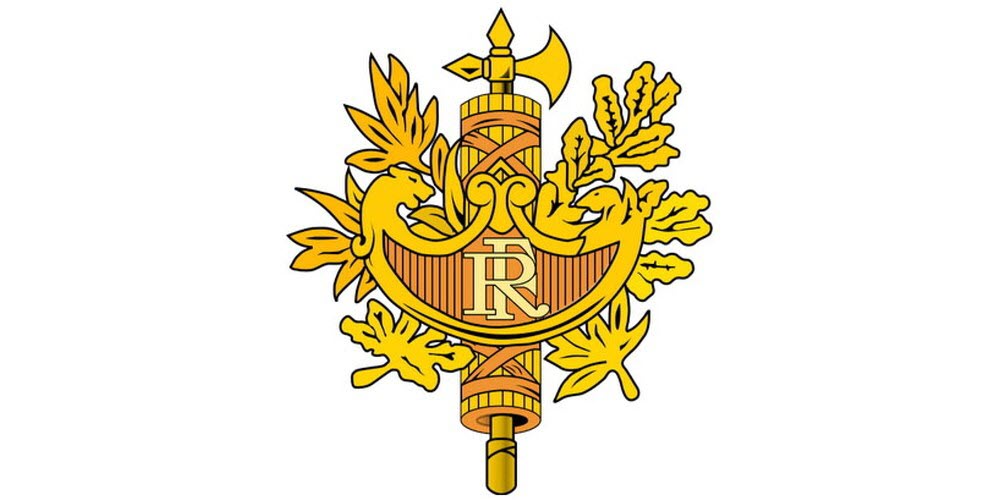
Axe and bundle of rods: Roman emblem of authority, reused on throne, seals and imperial architecture.
Origins and precedents
The lictor's fasces — birch rods bound around an axe — was the attribute of Roman lictors, minor magistrates who cleared the way for higher officials and carried out corporal sentences. In republican and imperial Rome the fasces signified imperium: the power to command, punish and enforce law in the name of the state.
The French Revolution reclaimed this symbol from 1789 onward: it appeared on assembly seals, assignat coinage and public monuments. Constituents saw in it the nation's indivisible unity — rods bound together — and the sovereign people's legitimate force. Robespierre and Convention leaders associated it with republican virtue; it adorned the pedestal of the Liberty statue raised in 1793 on the Place de la Révolution.
Birth of the imperial symbol
Napoleon Bonaparte, educated in the Enlightenment and obsessed with Roman antiquity, took up the fasces from the Consulate onward. He did not erase it: he reinterpreted it. Under the Empire the fasces ceased to be solely the people's emblem and became the attribute of imperial authority — that which the Emperor exercised as heir to consuls and Caesars.
The imperial eagle grips the fasces in its talons on standards, medals and pediments. The pairing was deliberate: Jupiter's bird stood for military power and glory; the fasces for justice and legal coercion. Together they declared French force framed by law that Napoleon embodied.
Official uses
On Napoleon's throne, designed by Jacob-Desmalter for the 1804 coronation, carved fasces adorned armrests and uprights. The message was explicit for ambassadors and princes entering Tuileries salons: they were not in a Versailles-type court but in a state claiming Rome's heritage.
Architects Charles Percier and Pierre Fontaine, masters of imperial aesthetics, placed fasces on palace doors, curule chairs in antechambers and ministerial panelling. The motif recurred with almost liturgical regularity: Louvre Carrousel columns, Fontainebleau décor, Council of State chamber furniture.
In the army and in battle
The Empire's great seal combined the fasces with the eagle and the Emperor's horse. Every letters patent, every treaty authenticated by this matrix thus bore, in red wax relief, the symbol of Roman authority. The fasces ran through legal ritual as much as military iconography.
On the battlefield the fasces did not serve as a regimental standard — unlike the eagle — but it saturated the mental world of soldiers raised under the Empire. Grande Armée bulletins, projected triumphal arches and Vendôme Column reliefs reused the motif to link military victory with civil order.
Propaganda and representation
Coalition powers and European liberals knew Napoleon's Roman rhetoric perfectly. When they denounced 'Caesarism' or 'enlightened despotism' they targeted precisely this appropriation of republican symbols for personal power. In English polemic the fasces became the emblem of tyranny draped in antiquity.
In Italy, Spain and annexed or allied German states the fasces sometimes accompanied local imperial arms. It signalled that Napoleonic law — Civil Code, granted constitutions — presented itself as heir to Roman law, the common tongue of European legal elites.
Posterity and collections
After the Empire's fall in 1814 the Bourbons erased part of this iconography without abolishing it entirely. Louis XVIII kept classical motifs on some monuments; but the fasces remained chiefly associated, in nineteenth-century memory, with the Consulate and First Empire.
In the United States the fasces had appeared on the Great Seal since 1782: the American Republic and French Empire thus shared a symbol without sharing a regime. That coexistence shows the antique motif's versatility — and why Napoleon could reuse it without seeming a plagiarist.
Memory and debate
Today the fasces survives on French republican iconography and early nineteenth-century neoclassical architecture. Restoring or contextualising it on any monument revives debate on continuity between Revolution, Empire and Republic.
For Empire Napoléon the lictor's fasces is the symbol of authority without sharing: state unity, punishment of traitors, continuity with antiquity — Roman law brandished behind the French eagle.
Go further
Recommended books to dig deeper (affiliate links)

Napoleon — A magisterial biography
An exhaustive biography of the Emperor, the fruit of rigorous research.
≈ £14.99 Napoleon's Army
Organization, tactics and daily life of the Grande Armée soldiers.
≈ £18.00 Austerlitz 1805
The detailed account of the Battle of the Three Emperors.
≈ £12.99As an Amazon Associate, this site earns from qualifying purchases.
Support the encyclopedia
Napoleon Empire is an independent project. Your contribution helps grow the content and keep the site running.
Donate