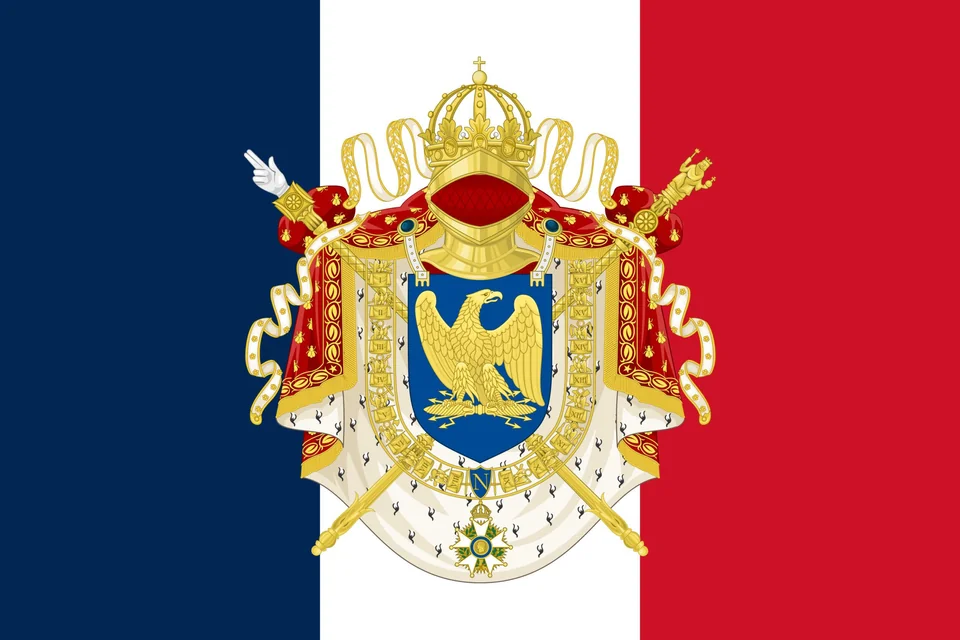
Blue, white, red: the revolutionary flag survives the Empire, enriched by the imperial eagle — emblem of a nation in arms and a conquering state.
Origins and precedents
The tricolour flag was born of Revolution: the blue-white-red cockade, merging Paris and royal colours, became the national emblem of republican then consular armies. Napoleon did not abolish this legacy: he absorbed and transformed it, proof the Empire claimed continuity with the victorious Republic as much as monarchical break.
The law of 27 Pluviôse Year II had already imposed the tricolour on Republic ships; land armies gradually adopted it replacing royal white flags or federalist banners. Under the Consulate regiments carried regulation models whose dimensions and inscriptions were fixed by ministerial decree.
Birth of the imperial symbol
From 1804 regimental colours kept three vertical bands — blue at the staff, white centre, red fly — but the canton or central field bore the imperial eagle on fasces and thunderbolt. The contrast is striking: colours of a people on the march, bird of the Roman emperor; national unity and imperial hierarchy on the same cloth.
Each regulation pattern specified dimensions, gold borders, inscriptions ("Imperial Guard", regiment name, number). Guard colours, more sumptuous, sometimes bore gold embroidery line regiments lacked. The navy adopted distinct tricolour ensigns with cockade and Empire symbols on yardarms.
Official uses
In battle the colour remained the battalion's moral anchor. The colour-bearer, often an NCO chosen for bravery, advanced in the front rank; grenadiers closed around him. Protecting the tricolour meant defending regimental honour and regime legitimacy.
Victory bulletins named colour-bearers killed or decorated as exemplary heroes. At Somosierra in November 1808 Guard tirailleurs scaled the Spanish gorge under fire; accounts stress those who fell still near the staff. The flag became a character in military narratives.
In the army and in battle
Coalition forces recognised the tricolour at distance: it signalled French presence across the continent from Madrid to Moscow. Its capture was a trophy; its destruction a tactical goal. Austrians and Prussians sometimes displayed captured flags in arsenals as proof of rare but precious victories.
In Spain and Russia guerrillas and Cossacks sometimes deliberately targeted colour-bearers to demoralise French columns. Losing the regimental colour, distinct from losing the eagle, was grave: it often required a replacement ceremony before assembled troops.
Propaganda and representation
Tricolour flags also figured in imperial diplomacy. When Napoleon entered allied or conquered capitals French standards paraded beside local flags — spectacle of domination as much as ceremony.
After 1814 the Bourbon white flag temporarily replaced the tricolour in the army and on public buildings. Grande Armée veterans sometimes secretly kept old colours; several survive in private and museum collections.
Posterity and collections
The 1830 Revolution brought blue-white-red back definitively: proof the Empire had not erased the revolutionary emblem. Louis-Philippe leaned on this continuity to legitimise the July Monarchy while republicans saw permanent legacy.
Nineteenth-century historians long debated whether Napoleon had "saved" or "betrayed" the revolutionary flag. The answer is likely both: he militarised and imperialised it, but also spread it from Warsaw to Cadiz.
Memory and debate
The imperial tricolour tells the Bonapartist synthesis: Revolution in colours, Empire in eagle; one standard to march millions in the name of France and Napoleon. A rare symbol outliving the man who transformed it.
For Empire Napoléon this flag remains the regime's most universal emblem: recognisable at distance, laden with honour on the battlefield, it unites 1789 ideals and the Emperor's glory on a single cloth.
Go further
Recommended books to dig deeper (affiliate links)

Napoleon — A magisterial biography
An exhaustive biography of the Emperor, the fruit of rigorous research.
≈ £14.99 Napoleon's Army
Organization, tactics and daily life of the Grande Armée soldiers.
≈ £18.00 Austerlitz 1805
The detailed account of the Battle of the Three Emperors.
≈ £12.99As an Amazon Associate, this site earns from qualifying purchases.
Support the encyclopedia
Napoleon Empire is an independent project. Your contribution helps grow the content and keep the site running.
Donate