The two ridges on which the armies clashed on 18 June 1815 are still there, south of Brussels. A cast-iron lion has watched over them since 1826, and a law of 1914 saved them from housing development.
Historical context
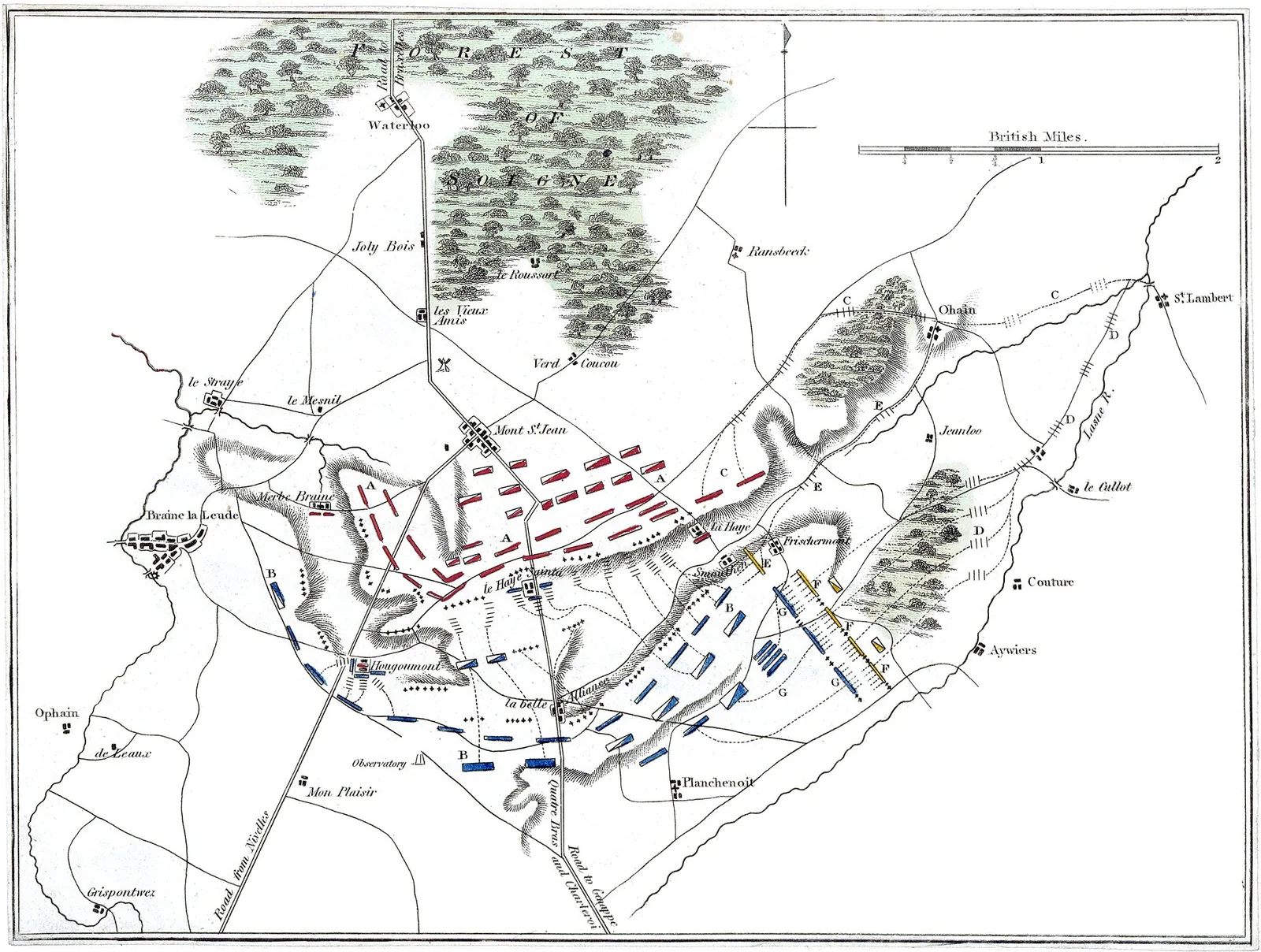
The battle bears the name of a village where no fighting took place. Waterloo, where Wellington had his headquarters and from which he dated his victory dispatch, lies a few kilometres to the north; the fighting of 18 June 1815 took place further south, on land now shared by four municipalities, Braine-l'Alleud, Lasne, Genappe and Waterloo itself. The ground can still be read without difficulty. Two low ridges face each other on either side of the Charleroi–Brussels highway, today's N5: that of Mont-Saint-Jean to the north, held by the allied army, and that of La Belle Alliance to the south, from which the French attacks were launched. The farms of 1815 are nearly all still standing: Mont-Saint-Jean, La Haye Sainte, La Belle Alliance, Papelotte, Hougoumont.
The landmark visible from everywhere is the Lion's Mound. King William I of the Netherlands had it raised on the presumed spot where his eldest son, the Prince of Orange, had been wounded in the shoulder at the end of the battle. The project was entrusted in 1820 to the architect Charles Vander Straeten; work began in 1824 and moved some 290,000 cubic metres of earth to build a cone 41 metres high, which visitors now climb by a flight of 226 steps. On top, a 28-tonne cast-iron lion, modelled by Jean-Louis Van Geel and cast in John Cockerill's works at Seraing, was hoisted onto its pedestal on 28 October 1826. Facing France, it rests a paw on a sphere.
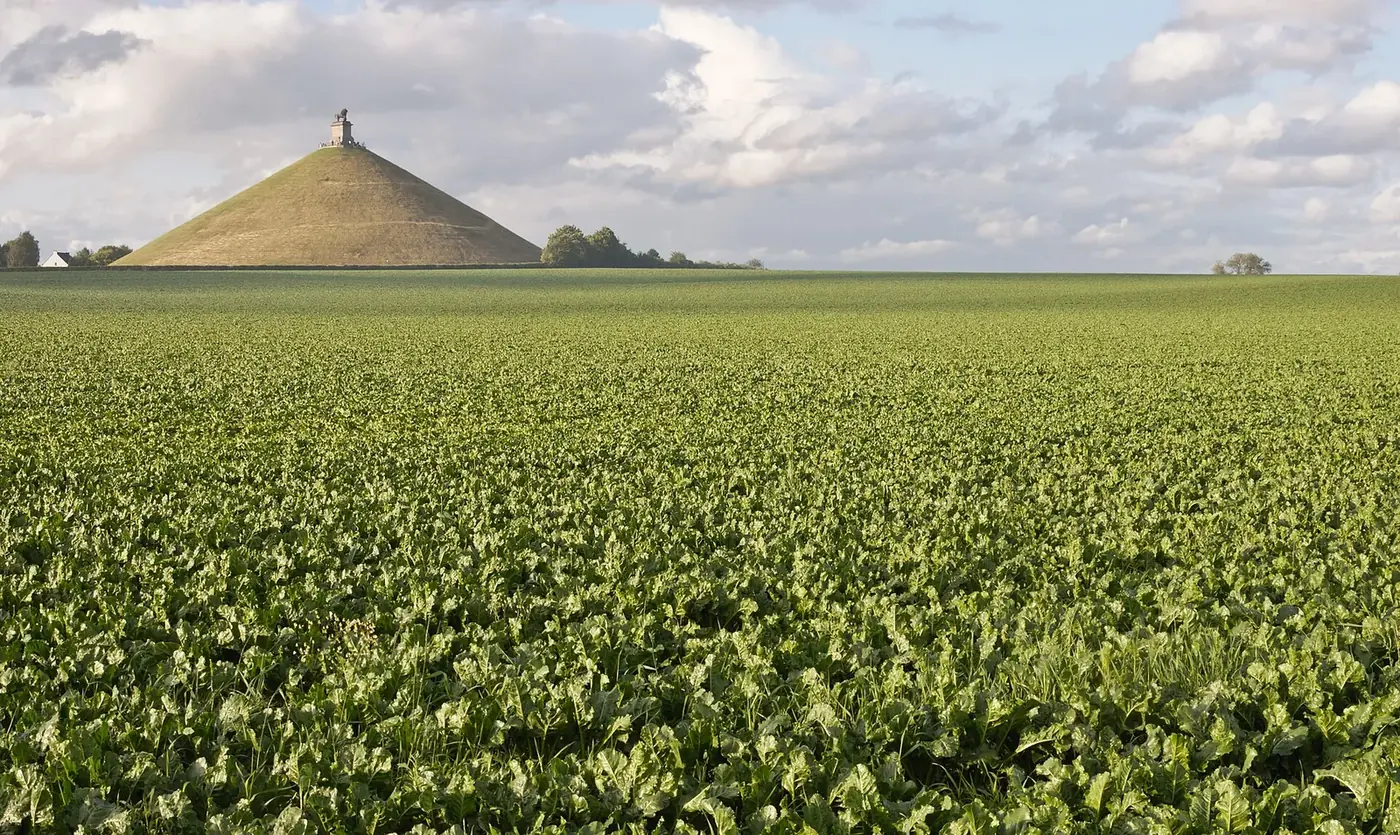
The monument cost the ground part of its truth. The earth was dug from the plateau itself, as far as the approaches to La Haye Sainte, and the ground level was lowered as a result: the Gordon monument, raised by his family in memory of Wellington's aide-de-camp, and the Hanoverian monument facing it across the highway now stand on knolls that mark the former height of the land. The sunken lane of Ohain, which tradition, and Victor Hugo after it, holds to have been the trap of the French cavalry, has lost its depth. Returning a few years later, Wellington is said to have remarked that they had spoiled his battlefield. The lion itself nearly did not survive: in 1832 soldiers of Marshal Gérard, on their way to the siege of the citadel of Antwerp, tried to pull it down and broke its tail.
At the foot of the mound, a neoclassical rotunda designed in 1911 by the architect Franz Van Ophem houses the Panorama of the battle. The circular canvas, painted in 1912 by Louis Dumoulin with the centenary in view, is 110 metres long and 12 high; in the foreground a false terrain scattered with real objects — fences, muskets, ploughs, fallen soldiers and horses — carries the illusion right up to the visitor's feet. It is one of the most important surviving witnesses to this mass spectacle born at the end of the eighteenth century; the rotunda and the canvas have been listed since 1998.
For the bicentenary, an underground museum was opened beside the mound on 21 May 2015. The Waterloo 1815 Memorial now brings together in a single visit this museum, the Panorama, the mound, which can only be climbed by passing through it, and the farm of Hougoumont, restored the same year.
If the landscape has changed so little, it is because it has been protected for more than a century. In the early twentieth century, the proximity of Brussels raised fears of building plots and speculation; a public subscription opened in Britain helped the Belgian state compensate the landowners, and on 26 March 1914 Parliament passed a law protecting the site, the first of its kind in Belgium. It has hardly been breached since — only a Dominican convent was built in 1929 at Fichermont, in the north-eastern part of the battlefield — and in 2015 the Walloon Region extended the protected area to 986 hectares.
More than a hundred and thirty-five monuments dot the site. At Plancenoit, the Prussian monument has recalled the soldiers of Bülow and Pirch since 1819. On the French side, the best known is the Wounded Eagle, a bronze by Jean-Léon Gérôme unveiled in 1904 beside the highway, two hundred metres south of La Belle Alliance, in memory of the "last square"; the sculptor had died a few months earlier. Almost opposite, a column raised in 1911–1912 recalls that Victor Hugo spent two months at Mont-Saint-Jean in 1861 and finished Les Misérables there.
Two houses frame the visit, at either end of the highway. To the north, in the town of Waterloo, opposite the church of Saint Joseph, the former Bodenghien inn, a coaching post since 1777, has become the Wellington Museum: the duke spent the nights of 17 and 18 June there and wrote his victory dispatch in it. To the south, at Vieux-Genappe, the farm of Le Caillou, where Napoleon spent the night before the battle and settled his dispositions for the next day, houses a museum that keeps his camp bed. Between these two houses lies the whole of 18 June: that is what makes Waterloo, already the most visited battlefield in Europe in the nineteenth century, a place people still come to in order to understand as much as to remember.
Go further
Recommended books to dig deeper (affiliate links)
Napoleon the Great
Andrew Roberts · 2014
A monumental biography drawing on Napoleon’s 33,000 surviving letters, admiring but rigorous.
See on Amazon
Napoléon ou le mythe du sauveur
Jean Tulard · 1977
The book that reshaped how the man is read: how France gave itself a saviour, and what it cost.
See on Amazon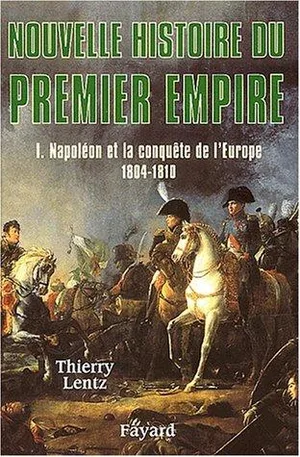
Nouvelle histoire du Premier Empire
Thierry Lentz · 2002-2010
Four reference volumes on institutions, diplomacy and collapse: the scholarly synthesis of the subject.
See on AmazonAs an Amazon Associate, this site earns from qualifying purchases.
Support the encyclopedia
Napoleon Empire is an independent project. Your contribution helps grow the content and keep the site running.
DonateSecure payment on the platform you choose.