A masterpiece of Savoyard baroque, the palazzina of Stupinigi became an imperial residence after the annexation of Piedmont. Napoleon stayed there in April 1805, on his way to be crowned King of Italy.
Historical context
The estate is an old one. The House of Savoy had held it since 1418; Amadeus VIII entrusted it in 1439 to the Marquis Pallavicino, and Emmanuel Philibert took it back in the sixteenth century before granting it in 1573 to the Order of Saints Maurice and Lazarus, which still owns it. Around an old fort that once guarded the territory of Moncalieri stretched a hunting reserve of almost 1,700 hectares, today divided between Nichelino, Orbassano and Candiolo, south of Turin.
In April 1729 Victor Amadeus II commissioned Filippo Juvarra to turn this lodge into a residence worthy of a king. The Sicilian architect devised a St Andrew's cross plan whose arms radiate from an oval central hall, capped by a dome topped with a bronze stag. It is not a castle but a machine for pleasure, designed for the court's stag hunts on the plain of the Po. The palazzina was inaugurated in November 1731, for the hunts of St Hubert. On 10 February of that year the king had entrusted the vault of the great hall to the brothers Giuseppe and Domenico Valeriani: their Triumph of Diana, painted between 1731 and 1733, sets the tone for a decoration devoted entirely to the chase.
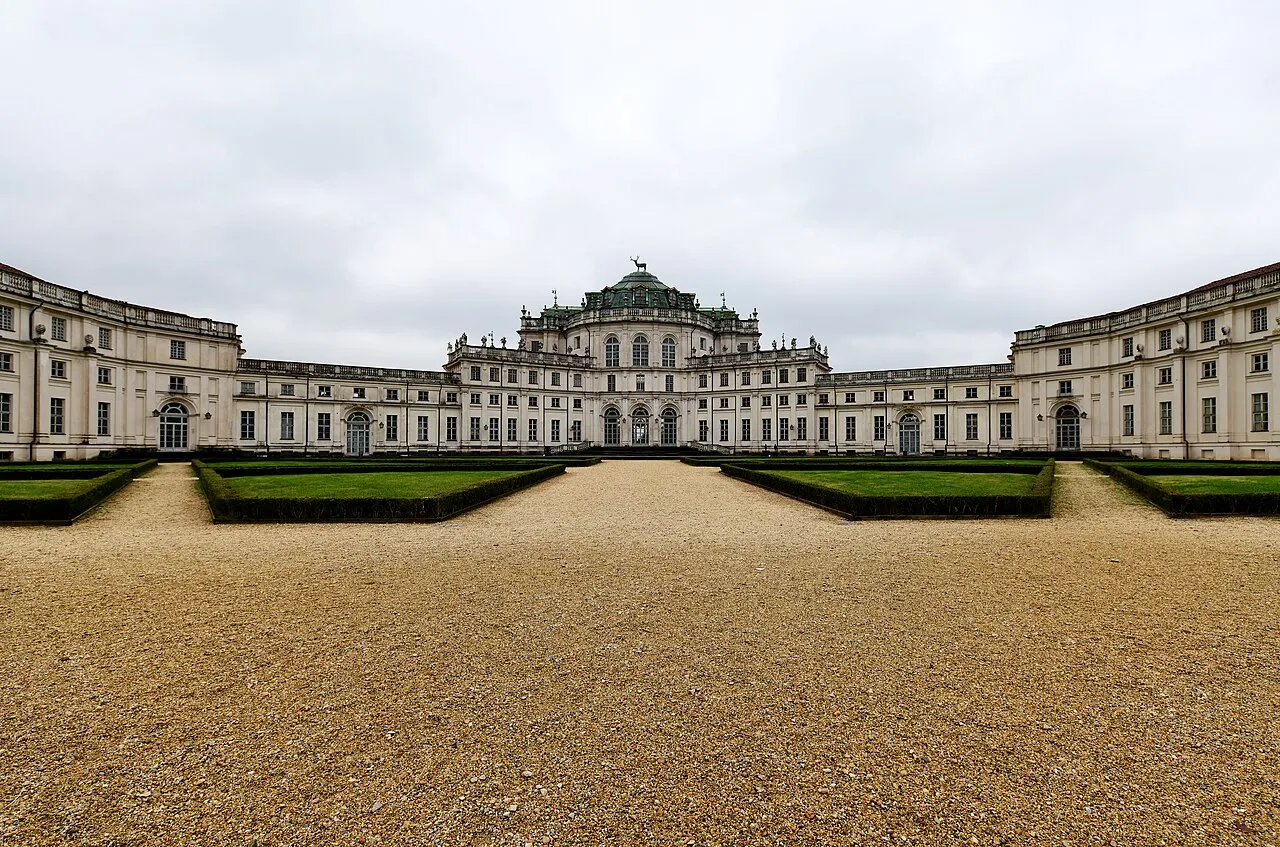
After Juvarra left for Madrid, Giovanni Tommaso Prunotto took over the works. From 1739 Benedetto Alfieri added two wings for the stables and outbuildings, and the French gardener Michel Bénard laid out the park in 1740. Under Charles Emmanuel III and Victor Amadeus III the complex kept growing; the stag crowning the dome was cast in 1766 by Francesco Ladatte. It was moved indoors for safekeeping in 1992 and replaced on the summit by a copy.
Piedmont was annexed to France in 1802 and divided into departments. The property of the House of Savoy passed to the imperial domain: Stupinigi, now styled the "Imperial Villa", became one of the Emperor's official residences in Italy, alongside the royal palace of Turin, renamed the imperial palace. Some of the furniture was renewed and a few apartments adapted to French taste.
Napoleon and Joséphine stayed there in April 1805, between the crossing of the Mont Cenis and their entry into Lombardy: the Emperor was on his way to take the iron crown in Milan on 26 May. The day-by-day chronology drawn up by the historian Alessandro Puato places the stay between 19 and 24 April. On the 19th, at five in the morning, Napoleon had the troops quartered at Stupinigi assembled in the rain and put through their manoeuvres; at seven, escorted by six mounted guards of honour, he set off for Moncalieri and climbed the hill of the Bert tower, from which Turin and its surroundings can be taken in at a glance. The view persuaded him that roads and bridges were urgently needed to shorten communications with France. On the 21st a hunt was held in the forest of Stupinigi; the same day the Emperor had seventeen relief models of Piedmontese fortresses requisitioned from the Turin Academy of Sciences.
On 24 April the imperial couple left the palazzina for Turin, where they remained until 29 April before travelling on through Asti, Alessandria and the battlefield of Marengo. Some accounts date the stay at Stupinigi to 5–16 May 1805: those dates fit neither the Emperor's itinerary, since he was then on the road to Milan, nor the Turin archives examined by Puato.
The visit of 1805 left a stubborn legend behind it. The Memoirs of Constant, published in Paris by Ladvocat in 1830 and actually written by Maxime de Villemarest from the valet's notes, claim that at Stupinigi the Emperor had a master key with which he slipped at night into the rooms of Joséphine's ladies-in-waiting. Puato judges the story entirely without foundation, which has not stopped it from passing into fiction: the Piedmontese novelist Edoardo Calandra used it in the episode "A Stupinigi" of I Lancia di Faliceto.
In 1808 Prince Camillo Borghese was appointed governor general of the departments beyond the Alps. With Pauline he made short stays at Stupinigi, and the eastern apartment still bears his name. The princess bore this gilded exile far from Paris badly and soon made her way back to France.
Returned to the Savoys in 1814, the palazzina changed its purpose. Victor Emmanuel I set up the court's first menagerie there; the animals were moved in 1826 to the building known as San Carlo. That same year Fritz arrived, an elephant given to Charles Felix by Muhammad Ali, which lived at Stupinigi until 1852. Back in the hands of the royal family around 1832, the residence hosted balls, concerts and receptions; in 1842 Victor Emmanuel II celebrated his wedding to Adelaide of Austria there. In 1910 Maria Pia of Savoy, Queen of Portugal, driven out by the proclamation of the republic, took refuge at Stupinigi and died there the following year.
The estate passed to the State in 1919, which installed the Museum of Art and Furnishing there, then returned in 1925 to the Mauritian Order. The palazzina escaped destruction and keeps its eighteenth-century decoration as well as furniture of the Napoleonic period. A long restoration, begun in 1988 under the direction of Roberto Gabetti and Maurizio Momo, has given back its splendour; the grounds became a nature park in 1992, and since 1997 the palazzina has been one of the residences of the Royal House of Savoy inscribed on UNESCO's World Heritage List.
Sources: Alessandro Puato, Napoleone a Torino. Le visite del 1797, 1800, 1805 e 1807, Turin, Mediares, 2015; Thierry Lentz, "Le couronnement de Napoléon roi d'Italie à Milan, 26 mai 1805", Revue du Souvenir napoléonien, no. 457, 2005, on napoleon.org.
Go further
Recommended books to dig deeper (affiliate links)

Napoleon the Great
Andrew Roberts · 2014
A monumental biography drawing on Napoleon’s 33,000 surviving letters, admiring but rigorous.
See on Amazon
Napoléon ou le mythe du sauveur
Jean Tulard · 1977
The book that reshaped how the man is read: how France gave itself a saviour, and what it cost.
See on Amazon
Nouvelle histoire du Premier Empire
Thierry Lentz · 2002-2010
Four reference volumes on institutions, diplomacy and collapse: the scholarly synthesis of the subject.
See on AmazonAs an Amazon Associate, this site earns from qualifying purchases.
Support the encyclopedia
Napoleon Empire is an independent project. Your contribution helps grow the content and keep the site running.
DonateSecure payment on the platform you choose.