The Battle of the Three Emperors took its name from a small Moravian town, but it was decided on the hills around it. Austerlitz is now called Slavkov, and its landscape, still farmed, has been protected since 1992.
Historical context
As at Waterloo, the name of the battle does not say where it was fought. Austerlitz is the German name of Slavkov u Brna, a small town in South Moravia some fifteen kilometres east of Brno; the fighting of 2 December 1805 took place a few kilometres further west, on the Pratzen plateau, around the villages of Sokolnitz and Telnitz and up to the heights overlooking the Olmütz road. The ground has not been built over. It now forms a heritage protection zone of about a hundred square kilometres across twenty-five municipalities in the districts of Vyškov and Brno-Country, and visitors follow the same fields, tracks and swells of ground that the staff officers once studied. The military account is found in the entry on the Battle of Austerlitz; this one describes what can be seen on the spot.
The town itself stayed at the edge of events until the battle was over, and then entered history through its castle. The building had belonged since the early sixteenth century to the Moravian Kaunitz family. Its present form goes back to a Baroque reconstruction begun in 1696 to designs by the Italian architect Domenico Martinelli, which Prince Wenzel Anton of Kaunitz-Rietberg, later Maria Theresa's chancellor, brought to completion more than half a century afterwards; a French-style garden inspired by Versailles was laid out there in 1774. In the oval state room known as the Historic Salon, Austria and France signed on 6 December 1805 the armistice that followed the battle and opened the way to the Peace of Pressburg. The castle now houses a small history museum and a multimedia presentation on the battle.
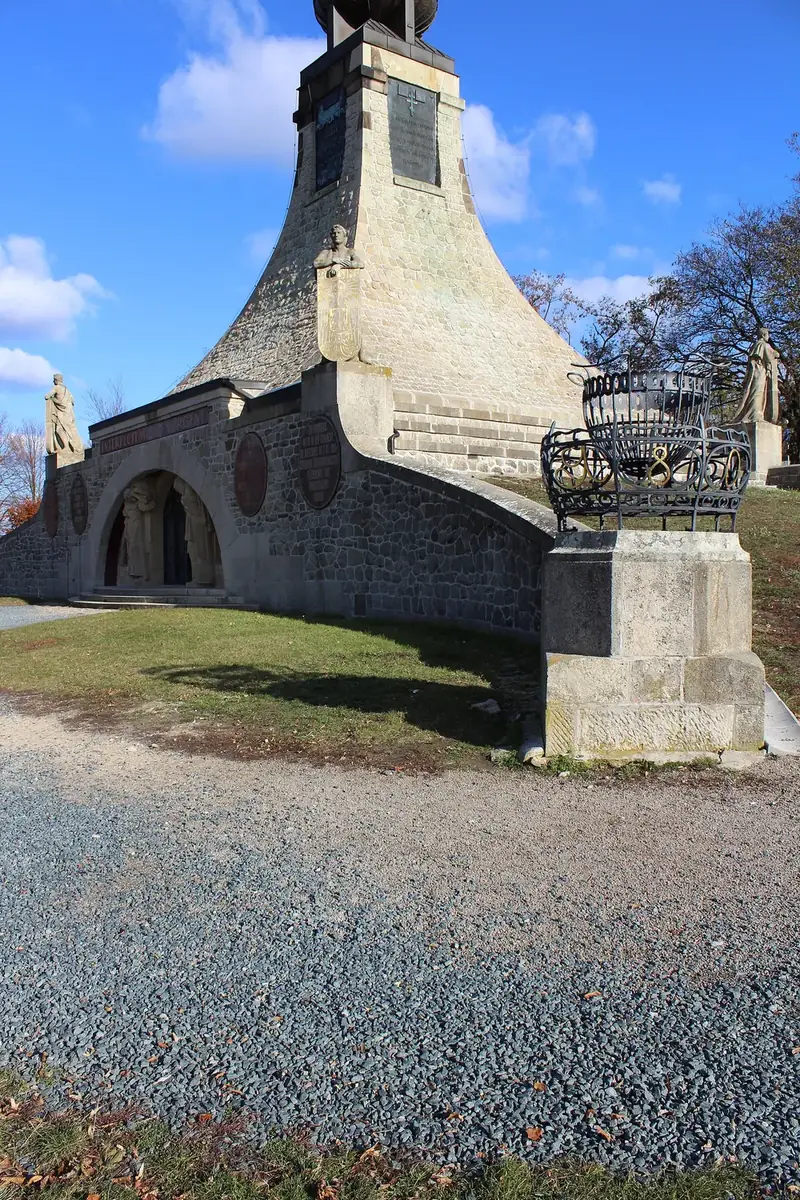
The landmark of the whole landscape is the Cairn of Peace, on the hill of Prace, about a kilometre south of the village and almost at the centre of the former battlefield. The idea came from a Brno priest and teacher, Alois Slovák, who wanted a memorial to the dead of 1805, whichever army they had served in. The project was entrusted to the architect Josef Fanta, who also designed Prague's main railway station. Work ran from 1910 to 1912 and was to end with an opening in 1914; the war postponed it, and the monument was opened and its chapel consecrated only in 1923. Fanta gave the work the outline of a Slavic burial mound, a truncated square pyramid of rubble stone more than twenty-six metres high, crowned by a copper cross about ten metres tall set on a globe. The sculptor Čeněk Vosmík placed four shield-bearers at its corners. The monument has been on the list of cultural monuments since 1964, and the South Moravian Region has owned it since 2003.
Beneath the cross, the square chapel, about ten metres on a side, contains a marble altar and a mosaic of adoring angels. An ossuary lies below it, where bones found in the fields of the battle have been placed. The vault has a quirk that guides rarely fail to demonstrate: a word whispered in one corner is heard clearly in the opposite one. It is a long way from the triumphal monument that the nineteenth century liked to raise to its victories; the Cairn is a place of remembrance, and that is how it was conceived.
At its foot, an exhibition by the Muzeum Brněnska, housed since the 1920s in a former guardhouse, tells the story of the battle; it was recast as a multimedia display before the bicentenary of 2005, and a sunken pavilion, "Fenomén Austerlitz", opened in 2010. A few quieter gestures complete the site: a monument unveiled in 1995 to the Austrian general František Jirčík, a brigade commander wounded in the battle who died three days later, and four trees planted between 2002 and 2005, a lime for Alois Slovák, a French oak, a Russian birch and an Austrian beech, recalling the three empires.
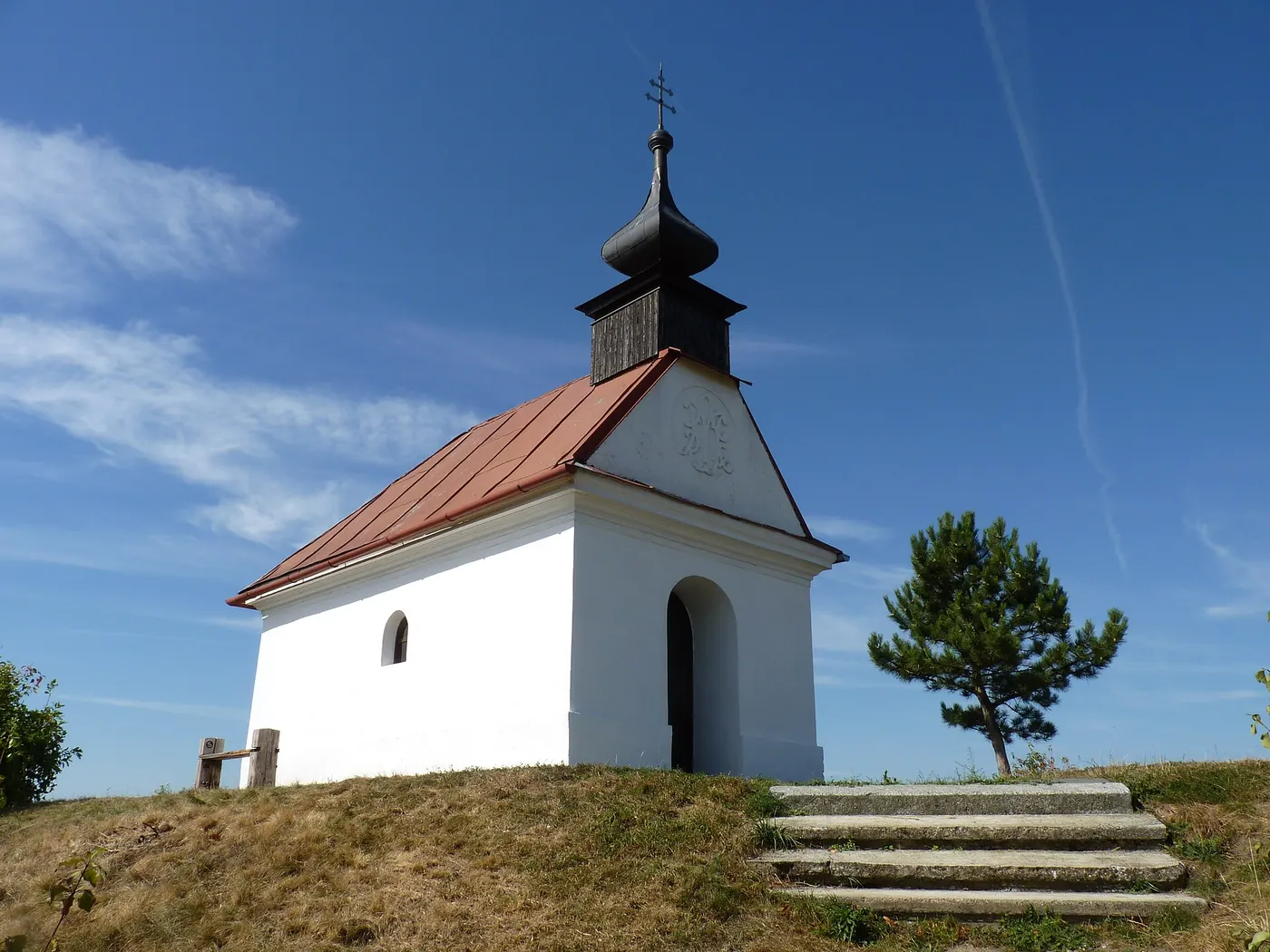
North of the battlefield, two heights can still be read as military positions. On the Žuráň, at Podolí, Napoleon set up his command post and followed the opening of the battle; a monument and an orientation table there now show the dispositions of that December morning. Further west, above Tvarožná, the Santon, which French veterans are said to have christened, carries a small white chapel on its summit. In 1805 the hill was fortified and defended by eighteen guns, and it held the French left facing the Olmütz road; the chapel is now the goal of a short walk, from which one takes in the terrain towards Brno.
The memory of the battle is not only in stone. Since the 1980s, historical reenactments have brought together enthusiasts from many countries on the weekend closest to 2 December, when the fog still settles in the hollows, as it did that day. They come in addition to the commemorations at the Cairn, where the dead are remembered first.
A visit to Austerlitz thus follows the thread of the day rather than a monumental route: the castle and its armistice salon for the end, the Žuráň for the beginning, the Pratzen plateau and its Cairn for the heart of the battle, the Santon for the left wing. None of these points lies more than a few kilometres from the others, which is why so vast a battlefield can be covered in a single day. For anyone who knows the story, the landscape makes the scale of Napoleon's manoeuvre easier to grasp than many maps.
Go further
Recommended books to dig deeper (affiliate links)

Napoleon the Great
Andrew Roberts · 2014
A monumental biography drawing on Napoleon’s 33,000 surviving letters, admiring but rigorous.
See on Amazon
Napoléon ou le mythe du sauveur
Jean Tulard · 1977
The book that reshaped how the man is read: how France gave itself a saviour, and what it cost.
See on Amazon
Nouvelle histoire du Premier Empire
Thierry Lentz · 2002-2010
Four reference volumes on institutions, diplomacy and collapse: the scholarly synthesis of the subject.
See on AmazonAs an Amazon Associate, this site earns from qualifying purchases.
Support the encyclopedia
Napoleon Empire is an independent project. Your contribution helps grow the content and keep the site running.
DonateSecure payment on the platform you choose.