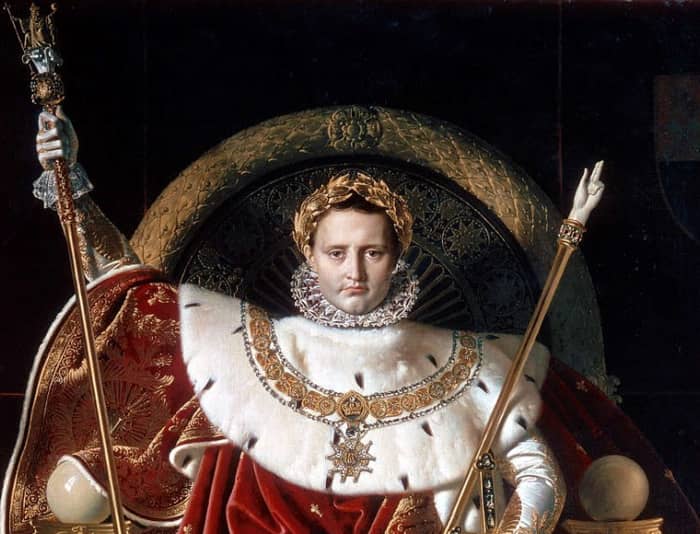
Regalia of the 1804 coronation: the imperial sceptre and hand of justice, emblems of temporal power and the sovereign's judicial authority.
Origins and precedents
The sceptre and hand of justice rank among the regalia made for Napoleon's coronation on 2 December 1804. They belong to the same set as Charlemagne's crown, the mantle and imperial globe: a casket of power designed to link the First Empire to Capetian and Carolingian tradition while asserting a new sovereignty.
The hand of justice — gloved in purple, holding a wand or short sceptre — is a direct inheritance from the kings of France. It recalls that the sovereign is source of law, guardian of statutes and final resort of justice. Under the Ancien Régime it accompanied the king at solemn ceremonies; Napoleon takes it up to legitimise his judicial authority before jurists and imperial courts.
Birth of the imperial symbol
The imperial sceptre, longer and more spectacular, embodies temporal command: war, administration, policing of the state. Studded with cameos, diamonds and antique symbols, it is raised at the coronation at Notre-Dame while Pope Pius VII presents the Emperor to the people. The gesture is calculated: left hand on justice, right hand on sceptre.
Goldsmiths Martin-Guillaume Biennais and the Odiot firm helped make these pieces, alongside Nitot for the crown. Garde-Meuble archives describe tight deadlines, shuttling with Denon and the arts committee, and a race against time before December 1804.
Official uses
The sceptre reuses classical motifs: eagle, palms, lion heads, sometimes Victory figures. It is not a medieval copy but a neoclassical recombination: Rome, French monarchy and Empire overlap in one object raised only once per reign — at coronation — then kept in the treasury.
The hand of justice, more discreet in popular iconography, nevertheless appears on official engravings, medals and certain state portraits. It tells the informed viewer Napoleon does not merely command armies: he settles disputes, signs codes, enforces sentences.
In the army and in battle
At the Milan coronation in 1805 adapted regalia serve the kingdom of Italy; the Paris model remains reference. Viceroys and princes do not bear the French imperial sceptre: it stays the exclusive apanage of Emperor of the French, reinforcing its singularity in the imperial system.
Under the Empire sceptre and hand of justice are kept at the Garde-Meuble, brought out for great ceremonies — coronation anniversaries, receptions of foreign sovereigns, Te Deum after victory. They are not everyday working attributes like the bicorne or snuffbox, but parade objects laden with civil sacrality.
Propaganda and representation
Civil and penal codes, senatus-consulta and imperial decrees give body to the promise symbolised by the hand of justice. The 1804 Civil Code in particular is presented as work of reason and stability: the legislating sovereign holds citizens' justice in hand as much as the sceptre of war.
After the 1814 abdication regalia are seized by the Bourbons then partly returned or copied according to political phases. Louis XVIII recovers part of the treasure; the Restoration reinvents its own symbols while letting memory of Napoleonic objects survive in display cases.
Posterity and collections
The Second Empire orders copies for its ceremonies; originals or what remains are studied by antiquarians and shown at the Louvre. The 1804 sceptre becomes museum piece as much as historical witness: one looks at it more than one carries it.
David, in his coronation painting at the Louvre, fixes for eternity the distribution of regalia: Joséphine kneeling, Napoleon standing or crowned, the pope witness. Sceptre and hand of justice, if not always centre of the composition, share the staging that shaped the world image of the coronation.
Memory and debate
Historians of law and monarchy see in this sceptre/justice pair the Bonapartist synthesis: a war leader become legislator, a general posing as successor to Most Christian kings without restoring theocracy. The hand of justice without the pope crowning alone speaks this founding ambiguity.
For Empire Napoléon the sceptre and hand of justice sum the dual face of imperial power: military thunder and scales of law, sword and code, victory on the battlefield and order in the courts.
Go further
Recommended books to dig deeper (affiliate links)

Napoleon — A magisterial biography
An exhaustive biography of the Emperor, the fruit of rigorous research.
≈ £14.99 Napoleon's Army
Organization, tactics and daily life of the Grande Armée soldiers.
≈ £18.00 Austerlitz 1805
The detailed account of the Battle of the Three Emperors.
≈ £12.99As an Amazon Associate, this site earns from qualifying purchases.
Support the encyclopedia
Napoleon Empire is an independent project. Your contribution helps grow the content and keep the site running.
Donate