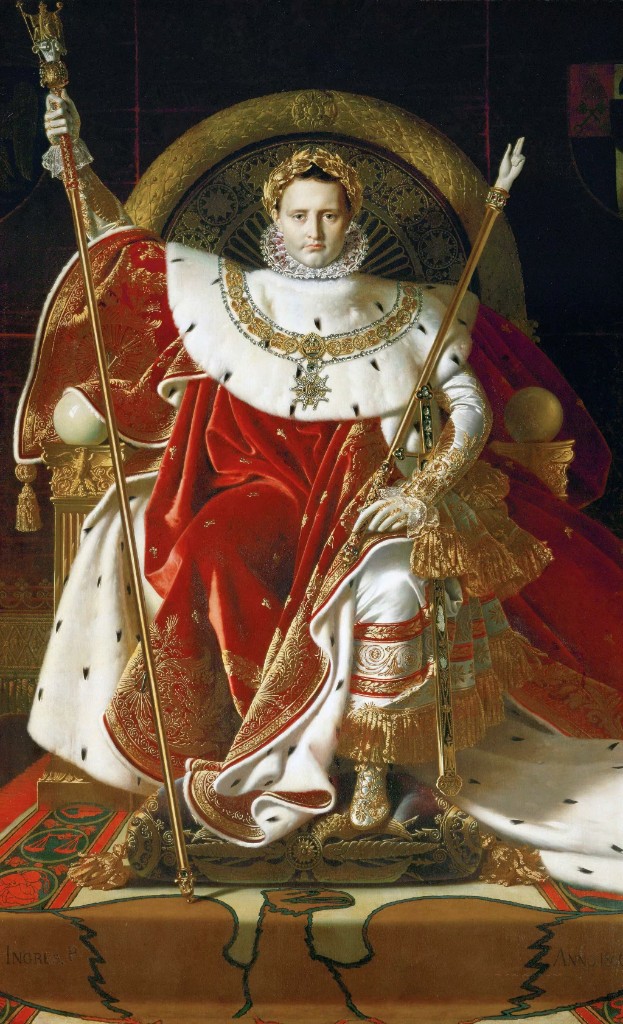
Ermine, golden bees and purple: the mantle of 2 December 1804, masterpiece of coronation symbolism.
Origins and precedents
The mantle worn by Napoleon at Notre-Dame coronation is among the imperial treasury's most sumptuous objects: long train of crimson velvet lined with ermine, strewn with golden bees and closed on the chest with chased clasps. It was not battle dress but sacred theatre costume, designed for a ceremony meant to strike all Europe.
Isabey, Lemot and court workshops coordinated its making with canopy ornaments, sword-bearers, pages and ladies-in-waiting. Months of embroidery, tailoring and fittings preceded 2 December; each detail obeyed an iconographic programme drawn by imperial ceremonial, in direct rivalry with memories of Reims coronations.
Birth of the imperial symbol
Ermine evoked French royalty and crowned kings' mantles; bees referred to Childeric's treasure exhumed at Tournai and Merovingian monarchy Napoleon claimed as ancestor; crimson spoke imperial dignity, colour of Roman generals and consular togas; embroidered gold recalled military glory and state wealth. The mantle transformed the revolutionary general into legitimate sovereign in cardinals' and ambassadors' eyes.
Its train, several metres long, required specially designated bearers: six or eight imperial pages supported it as Napoleon climbed Notre-Dame steps. Movement became procession: Paris crowds massed on quays and in tribunes saw purple pass before glimpsing the crown.
Official uses
David, in his coronation painting commissioned from 1805, froze the mantle in a composition where Napoleon visually dominates Pius VII, atop the steps, facing witness crowds. The work, shown at the Tuileries then Louvre, became iconographic reference: millions of prints spread it, fixing for history the ermine-and-bees silhouette more than the crown itself.
Josephine wore an analogous, shorter mantle for her coronation immediately after. The couple appeared as dual monarchy: two ermine trains on Notre-Dame steps, sign the Empire was dynasty as much as conquest. Chroniclers stressed public emotion before this conjugal appearance.
In the army and in battle
The Emperor's mantle weighed several kilos; cathedral heat, mass length and moment tension made the ceremony physically gruelling. Assistants' memoirs describe Napoleon mastering impatience, Pius VII slow and solemn — contrast between action-hardened general and rite-bound pontiff feeding legend.
After coronation the mantle was not hidden away: it featured at solemn audiences, royal entries and official portraits. Gérard showed it on the throne; Ingres suggested it in studies for grand costume portrait. Textile became permanent attribute of imperial majesty, like the sceptre.
Propaganda and representation
Mantle bees echoed those spreading across Tuileries furniture, Sèvres porcelain and Gobelins tapestries: coronation was not isolated event but launch of Empire style lasting until the regime's fall.
In 1805 at the Italian coronation in Milan Napoleon wore a different mantle adapted to Lombard rite; but the Paris image of 2 December remained reference. Every later European coronation attempt measured itself against this staging.
Posterity and collections
Preserved today at the Louvre with other regalia, the mantle is fragile; no longer worn but displayed in a climate-controlled room, sheltered from light. Its sight alone evokes coronation splendour and Napoleonic will to rival the most memorable medieval ceremonies.
Twentieth- and twenty-first-century restorers monitor velvet, ermine and gold thread condition; each intervention is documented. The object is both historical relic and conservation technical challenge, symbol of material fragility of an empire wanting to seem eternal.
Memory and debate
Modern re-enactments — films, historical reconstructions, immersive exhibitions — reproduce the mantle with varying fidelity; they prove contemporary public still identifies Napoleon emperor with this crimson train before the hand-in-waistcoat or campaign bicorne.
For Empire Napoléon the imperial coronation mantle is textile power symbol: it does not fight, it dazzles — and in dazzlement a general becomes hereditary emperor in the world's eyes.
Go further
Recommended books to dig deeper (affiliate links)

Napoleon — A magisterial biography
An exhaustive biography of the Emperor, the fruit of rigorous research.
≈ £14.99 Napoleon's Army
Organization, tactics and daily life of the Grande Armée soldiers.
≈ £18.00 Austerlitz 1805
The detailed account of the Battle of the Three Emperors.
≈ £12.99As an Amazon Associate, this site earns from qualifying purchases.
Support the encyclopedia
Napoleon Empire is an independent project. Your contribution helps grow the content and keep the site running.
Donate