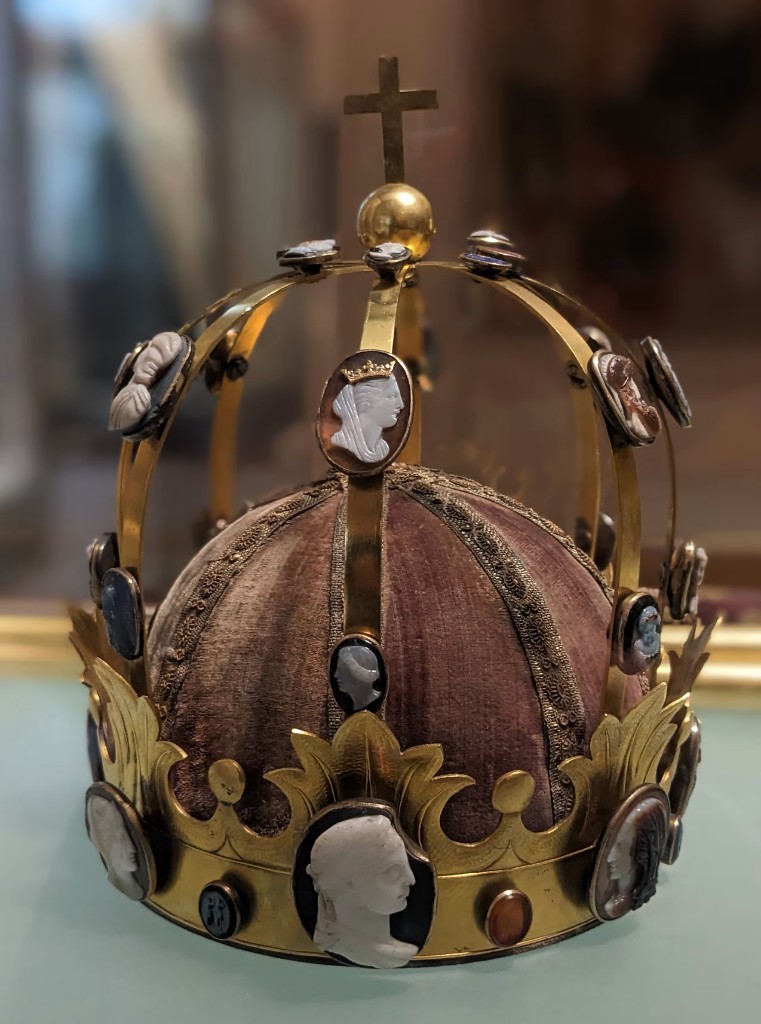
Crown of Charlemagne, gold and enamel: the insignia of the 1804 coronation and the staging of imperial power at Notre-Dame.
Origins and precedents
The imperial crown worn by Napoleon on 2 December 1804 was not created ex nihilo: it explicitly claimed Charlemagne's heritage. Martin-Guillaume Biennais, the Emperor's appointed goldsmith, designed with François-Regnault Nitot a cloisonné gold diadem set with antique cameos and gems from the national treasury, framed by eight arches forming a mitre — symbol of double dignity, royal and imperial.
The iconographic programme obeyed precise political logic: by presenting himself as successor to the Frankish king crowned by the pope in AD 800, Napoleon addressed the German princes of the future Rhine Confederation, Catholic opinion and European courts still fearful of Revolution. The French Empire was not Jacobin usurpation but revival of Latin Christendom unified under a military chief.
Birth of the imperial symbol
The coronation at Notre-Dame de Paris, in the presence of Pope Pius VII come from Rome despite diplomatic tension — the pontiff having first refused to crown an emperor who denied his temporal authority — was meticulously rehearsed staging. Napoleon wore the ermine mantle with bees, held Charlemagne's sceptre and the hand of justice; but at the decisive moment he took the crown from the altar and placed it on his own head.
David immortalised this gesture in his painting commissioned for the Tuileries: the Emperor did not passively receive dignity, he seized it under the pontiff's gaze. The image circulated in prints and engravings across Europe: it fixed for history the Bonapartist version of the coronation, where personal will trumped ecclesiastical rite.
Official uses
Beside the so-called Crown of Charlemagne stood the Crown of France, a closed fleur-de-lis gold crown Napoleon touched but did not wear: it embodied Capetian continuity the regime refused to erase while subordinating it to imperial dignity. The double use of insignia showed the coronation's legal sophistication: Emperor of the French and King of France in potency, without return to the Ancien Régime.
A second, lighter open crown served for Josephine's coronation immediately after. The imperial couple appeared as a founding dynasty before cardinals, senators and ambassadors; the gesture asserted shared sovereignty, even if the biological heir remained uncertain and the 1809 divorce would break this symbolic unity.
In the army and in battle
The crowns were not parade jewellery alone: they weighed on the wearer's head, physically reminding him of power's burden. Their making mobilised Paris's finest artisans for months; each antique cameo chosen by Denon pointed to Roman antiquity and Caesars' legitimacy.
After the ceremony the crowns joined the imperial treasury at the Tuileries, then the Louvre. Reproductions appeared on gold and silver coinage, commemorative medals, official portraits by Gérard, Ingres or Gros. A subject who never saw the coronation still recognised the eight-arched diadem silhouette.
Propaganda and representation
At solemn entries and diplomatic audiences lighter copies might be displayed; the original stayed at the treasury's heart. Coalition forces invading Paris in 1814 and 1815 did not destroy these objects: they understood their value as trophies of civilisation as much as war.
The restored Bourbons did not use imperial insignia for their own coronation: they invented a more modest rite, partly erasing memory of 2 December. Yet the crowns were neither melted nor sold; they joined the national heritage, material witnesses of a regime mastering legitimacy through objects.
Posterity and collections
In the nineteenth century Napoleonic cult multiplied bronze copies, costume jewellery and devotional images. Charlemagne's crown became the Empire's summary emblem: more immediate than mantle or sceptre, it fit in the palm on a medal.
Twentieth-century historians studied coronation inventories, Biennais's invoices, eyewitness accounts — Talleyrand, Cambacérès, Cardinal Fesch — to distinguish real liturgy from Davidian legend. The self-coronation gesture is attested; its interpretation — revolutionary boldness or Carolingian tradition — remains debated.
Memory and debate
Preserved today in the Louvre's decorative arts department, the imperial crowns rank among the most visited pieces of the Napoleonic trail. Their sight alone evokes coronation splendour, tension between Rome and Paris, and a general-turned-emperor's will to inscribe himself in French history's long duration.
For Empire Napoléon the imperial crown condenses the paradox of 2 December: religious ceremony and personal assertion; Charlemagne and Bonaparte; monarchical France and heir of Revolution — a golden circle holding an entire century's ambition in a few centimetres.
Go further
Recommended books to dig deeper (affiliate links)

Napoleon — A magisterial biography
An exhaustive biography of the Emperor, the fruit of rigorous research.
≈ £14.99 Napoleon's Army
Organization, tactics and daily life of the Grande Armée soldiers.
≈ £18.00 Austerlitz 1805
The detailed account of the Battle of the Three Emperors.
≈ £12.99As an Amazon Associate, this site earns from qualifying purchases.
Support the encyclopedia
Napoleon Empire is an independent project. Your contribution helps grow the content and keep the site running.
Donate