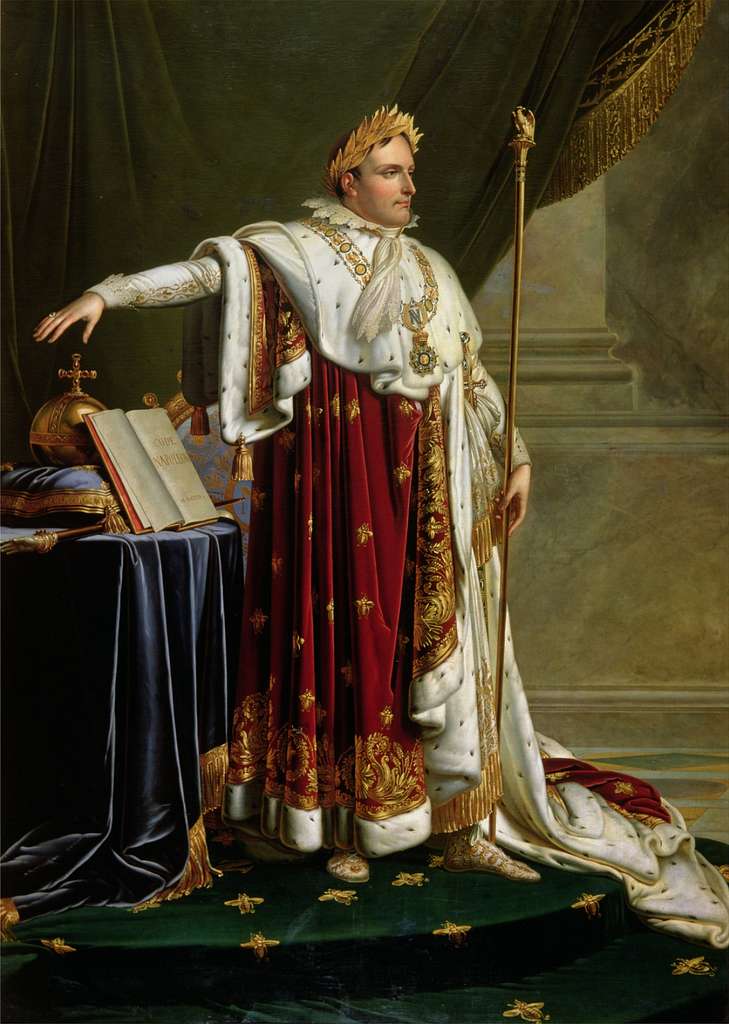
Globus cruciger of the coronation: gilded sphere and cross, emblem of Christian sovereignty over the world under the First Empire.
Origins and precedents
The imperial globe, or globus cruciger, is one of the regalia handed to Napoleon at his coronation at Notre-Dame on 2 December 1804. A gilded sphere topped by a cross, it expresses the medieval and baroque idea of a Christian sovereign holding the world under his protection — and, by extension, under his law.
Heir to the kings of France and emperors of the Holy Roman Empire, the globe belongs to a political vocabulary Napoleon reactivates without subordinating it to the pope: the cross crowns the sphere, but it is the Emperor who bears the object, not the Church alone that confers it.
Birth of the imperial symbol
Made by imperial goldsmiths — Nitot, Biennais, Odiot according to treasury pieces — the 1804 globe stands out for its rich mounting: blue enamel, gold filigree, sometimes doves or engraved palms. It is not a relic but a commissioned creation, meant for ceremony and posterity.
At the coronation the globe is presented with sceptre, hand of justice and crown. Official engravings and David's painting fix the arrangement: Napoleon receives the insignia, Joséphine will be crowned in turn, the pope attends without dominating the scene. The globe shares this staging balanced between sacred and imperial.
Official uses
Symbolically the sphere represents the political universe: provinces, peoples, seas and trade routes of the Empire. The cross recalls that the sovereign claims to guarantee moral order and divine law as interpreted by the state — a synthesis the Civil Code and concordats of the Napoleonic era translate in legal terms.
The globe is not a campaign object. It remains in the treasury, brought out for state ceremonies, official portraits and theatrical representations of power. On medals and tokens its miniature silhouette accompanies the Emperor's profile.
In the army and in battle
At Milan in 1805 an Italian regalia set reuses the globus cruciger model for Napoleon's kingdom. Visual coherence between Paris and Milan asserts unity of the imperial family under distinct crowns.
Napoleon's enemies sometimes caricature the globe: the Emperor holds a world too vast for his hands, or the cross tilts under ambition's weight. British press favours this image to suggest hubris — without stopping European courts from imitating regalia vocabulary.
Propaganda and representation
After 1814 the imperial globe joins royal or imperial collections according to regime. Restored, copied, sometimes confused with authentic Carolingian objects, it feeds scholars' debates on what of 1804 is historical reconstitution or political invention.
In the nineteenth century history painters and bourgeois salon decorators reproduce the globus cruciger on clocks, firedogs and tapestries. The motif becomes a decorative shorthand for Empire, like the eagle or crowned N.
Posterity and collections
Contemporary museums — Louvre, Les Invalides, Munich, Vienna — display imperial globes or Second Empire copies letting the public gauge goldsmith virtuosity and the object's symbolic charge.
Historically the imperial globe raises the question of continuity between traditional monarchy and modern state: Napoleon does not reign by grace of God alone, yet he uses the cross; he is not Holy Roman Emperor, yet he borrows its language.
Memory and debate
Art historians note that the Napoleonic globus cruciger influences nineteenth-century regalia in Latin and Germanic Europe: proof of the normative force of symbols created in Paris in 1804.
For Empire Napoléon the imperial globe is the world balanced on the sovereign's palm: a cross, a golden sphere, and the idea that Empire is understood on a global scale.
Go further
Recommended books to dig deeper (affiliate links)

Napoleon — A magisterial biography
An exhaustive biography of the Emperor, the fruit of rigorous research.
≈ £14.99 Napoleon's Army
Organization, tactics and daily life of the Grande Armée soldiers.
≈ £18.00 Austerlitz 1805
The detailed account of the Battle of the Three Emperors.
≈ £12.99As an Amazon Associate, this site earns from qualifying purchases.
Support the encyclopedia
Napoleon Empire is an independent project. Your contribution helps grow the content and keep the site running.
Donate