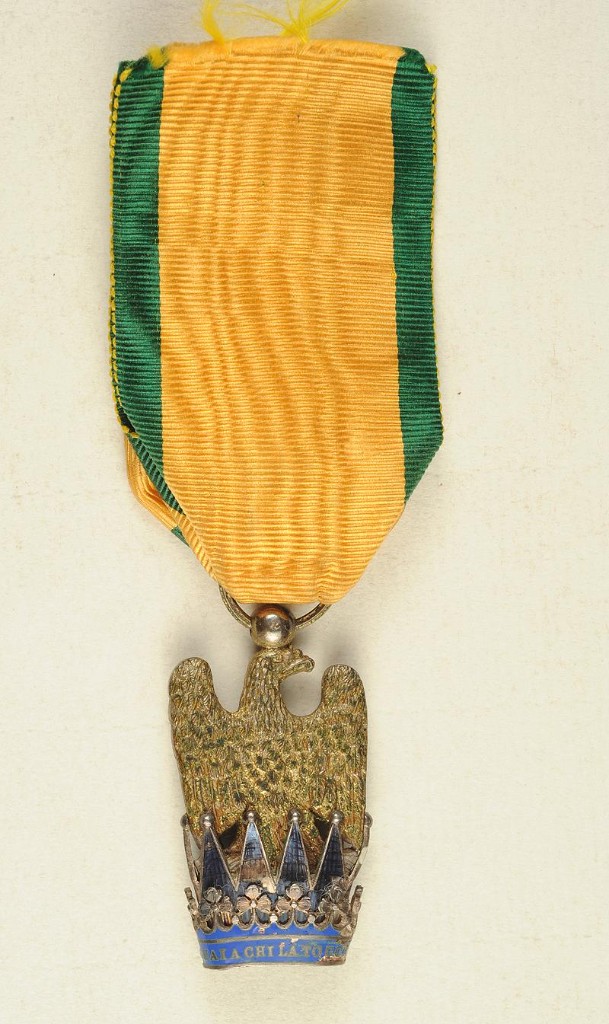
Kingdom of Italy, crown of Monza: the second great imperial order after the Legion of Honour.
Origins and precedents
The Order of the Iron Crown was instituted on 5 June 1805, weeks after Napoleon's coronation as King of Italy at Milan cathedral on 26 May. It formed the second great order of the imperial edifice, after the 1802 Legion of Honour, and the Italian counterpart to the French dignity system.
The decoration drew on the legendary relic kept at Monza: the Lombard kings' iron crown, whose inner ring was said forged from a nail of the Holy Cross. Napoleon had himself crowned with this medieval crown to link his reign to Lombard kingdom history and Latin Christendom.
Birth of the imperial symbol
The order jewel reproduced a green-enamelled gold crown bearing the inscription 'God gave it to me — beware who touches it', adapted from the French imperial coronation motto. A central medallion showed the Emperor-King's portrait; the reverse bore the imperial eagle and N monogram.
Bright orange ribbon immediately distinguished the Iron Crown from the Legion of Honour's red ribbon. In salons and on uniforms this colour identified the Italian title without confusion — deliberate aim of a hierarchical, readable honours system.
Official uses
Eugène de Beauharnais, Viceroy of the Kingdom of Italy, was named grand master of the order. He managed nominations, chapters and insignia distribution from Milan, placing the Italian crown at the heart of peninsular imperial administration.
Recipients mixed French marshals, Italian ministers, European princes, officers decorated for Austrian, Spanish or Russian campaigns, and Milan court loyalists. The order structured an Italian imperial nobility in Napoleon's and Eugène's service.
In the army and in battle
Militarily, wearing the Iron Crown on uniform beside the Legion of Honour marked double merit — French and Italian. Officer engravings and portraits often show both crosses side by side on the left breast, per precedence regulations.
The order had several classes, modelled on the Legion of Honour: grand cross, commander, officer and knight. This gradation allowed progressive reward for service without exhausting glory reserved for highest ranks.
Propaganda and representation
Milan ceremonies — chapter installations, solemn presentations — accompanied the kingdom's political calendar: coronation anniversaries, military victories, dynastic weddings. The order was instrument of loyalty as much as distinction.
The Kingdom of Italy was no mere annex: with Milan capital, Senate, national guard and order, it formed a satellite state with its own institutions. The Iron Crown was the visible sign for local elites.
Posterity and collections
Empire fall in 1814 abolished the order in Italy; the kingdom was dismantled at the Congress of Vienna. Insignia survive in private collections, portraits and military museums — witnesses to an attempt at Italian integration under French aegis.
In the nineteenth century memory of the Iron Crown fed Napoleonic myth in Italy as in France: Risorgimento patriots and Bonapartists appropriated fragments of this history for their national agendas.
Memory and debate
Historians of civil and military orders see in the Iron Crown the most accomplished example of Napoleonic honours politics at European scale — one title, one colour, one relic, one viceroy: a whole system condensed in one decoration.
For Empire Napoléon the Order of the Iron Crown symbolises Italy integrated into the Empire: a medieval crown, a sacred nail, a French Emperor — honours politics as cement of domination.
Go further
Recommended books to dig deeper (affiliate links)

Napoleon — A magisterial biography
An exhaustive biography of the Emperor, the fruit of rigorous research.
≈ £14.99 Napoleon's Army
Organization, tactics and daily life of the Grande Armée soldiers.
≈ £18.00 Austerlitz 1805
The detailed account of the Battle of the Three Emperors.
≈ £12.99As an Amazon Associate, this site earns from qualifying purchases.
Support the encyclopedia
Napoleon Empire is an independent project. Your contribution helps grow the content and keep the site running.
Donate