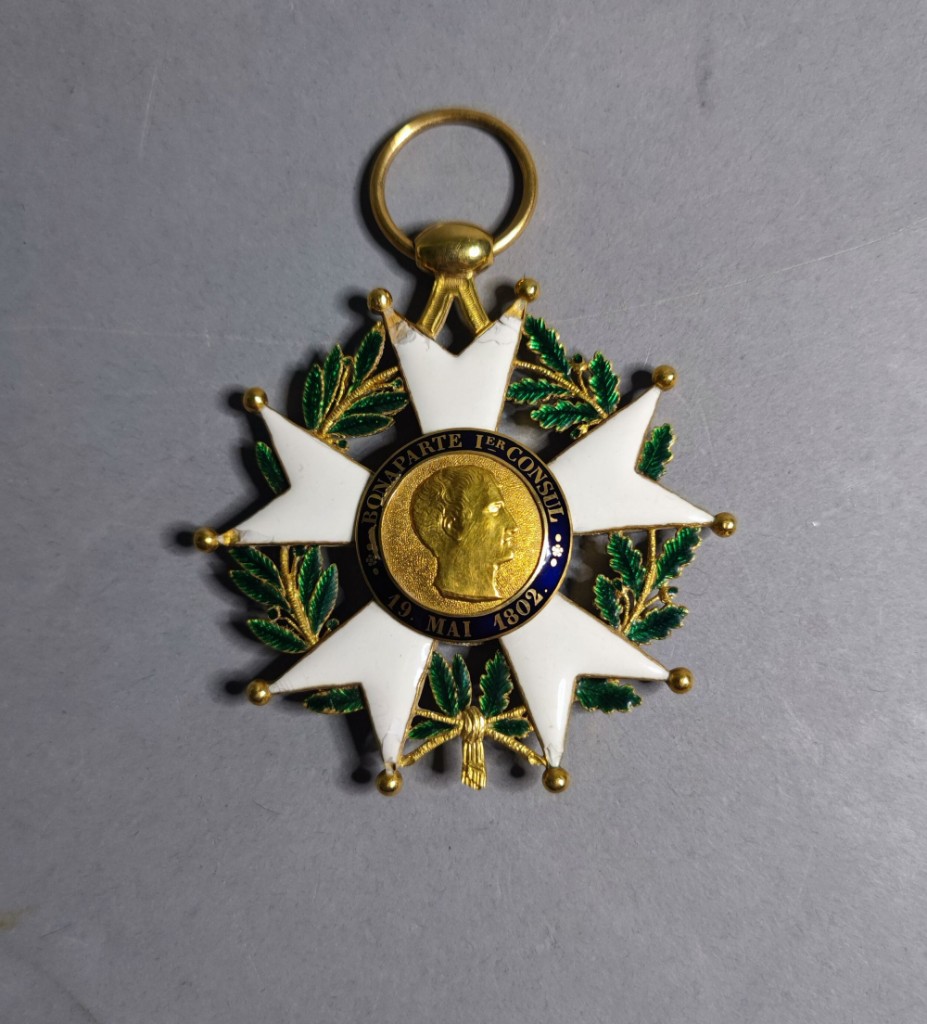
Instituted in 1802, the five-armed cross with white enamel and red ribbon rewards military and civil merit instead of birth.
Origins and precedents
The Legion of Honour cross is the central insignia of the order founded by the law of 29 Floréal Year X (19 May 1802). Napoleon, then First Consul, sought a national reward open to merit: soldiers decorated on the battlefield, magistrates, scholars, artists, exemplary craftsmen. Birth no longer sufficed; service to the fatherland became the criterion of distinction.
The chosen model is a five-armed cross pattée, inspired by chivalric orders but stripped of any exclusively noble character. White enamel on the arms evokes purity of devotion; at the centre the Emperor's profile — or the Consul's before 1804 — surrounded by the motto "Honour and Fatherland". The green oak and laurel wreath, symbol of civic strength and military victory, links the object to imperial iconography without confusing it with a dynastic decoration.
Birth of the imperial symbol
The red ribbon, an immediate distinctive mark, soon runs through imperial society. Worn on the reverse of uniform or civilian coat, at the left lapel according to regulations, it signals to the informed eye a man recognised by the state. British caricatures mock it; foreign courts imitate it.
The first great public distribution took place on 15 July 1804 at Les Invalides, in the presence of the newly crowned Emperor. Four thousand officers and soldiers received the cross; the ceremony mixed civil religiosity, military music and imperial speech. Napoleon proclaimed that France honours those who serve it, not those who possess it by inheritance.
Official uses
The order is both military and civil. Grades — legionnaire, officer, commander, grand officer, grand eagle — structure a hierarchy of merit crossing professions. A schoolteacher, a campaign surgeon or a mayor may appear on the honour roll alongside a cuirassier colonel.
Paris workshops produce crosses in series: gold, silver, enamel, manufacture sometimes entrusted to the Mint or approved goldsmiths. Models evolve slightly across periods — Consulate, Empire, Restoration — but the five-armed silhouette remains instantly recognisable.
In the army and in battle
On the battlefield the cross is sometimes awarded on the spot, on the divisional general's report. The soldier who receives it before his comrades acquires a new aura; Grande Armée veterans proudly wear the red ribbon under the coat collar, sometimes for life.
Napoleon uses the order as a political instrument: he adorns allies, senators, Concordat bishops, Institute scholars. Each distribution is a message: the Empire rewards loyalty as much as bravery.
Propaganda and representation
After 1814 Louis XVIII officially abolished the order then reinstated it in monarchical form. The Napoleonic cross survived in veterans' drawers; the Second Empire would largely resume the 1802 model. Today the French Republic still keeps the Legion of Honour as its highest national distinction.
History painters — Gros, Gérard, Scheffer — depict legionnaires receiving the cross or wearing it in battle. The motif enters collective imagination: the red ribbon becomes synonymous with imperial republican glory.
Posterity and collections
Historians stress Bonapartist originality: creating a universal order in a Europe still dominated by orders of birth. The cross says a country may found its nobility on service rendered.
Military collections — Les Invalides, provincial museums, private holdings — preserve crosses from Consulate and Empire, sometimes engraved on the reverse with the recipient's name. These pieces tell individual destinies: grognards, Trafalgar sailors, prefecture officials.
Memory and debate
Symbolically the cross sums the regime's social promise: advancement through merit, state recognition, bond between sovereign and citizen-soldiers. It complements the regimental eagle: one speaks to the corps, the other to the person.
For Empire Napoléon the Legion of Honour cross remains the most enduring emblem of Consulate and First Empire: five arms of white enamel, a red ribbon, and the idea that France rewards those who serve it.
Go further
Recommended books to dig deeper (affiliate links)

Napoleon — A magisterial biography
An exhaustive biography of the Emperor, the fruit of rigorous research.
≈ £14.99 Napoleon's Army
Organization, tactics and daily life of the Grande Armée soldiers.
≈ £18.00 Austerlitz 1805
The detailed account of the Battle of the Three Emperors.
≈ £12.99As an Amazon Associate, this site earns from qualifying purchases.
Support the encyclopedia
Napoleon Empire is an independent project. Your contribution helps grow the content and keep the site running.
Donate