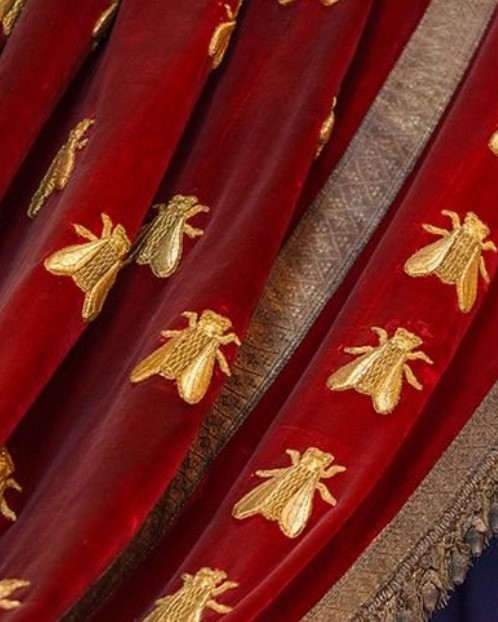
Cicadas or golden bees: the motif adorning the imperial mantle and so many palace objects, between French royal tradition and classical reference.
Origins and precedents
The "bees" covering Napoleon's coronation mantle belong to a long French story. In 1653 Merovingian goldsmith pieces, long called bees, were exhumed from Childeric I's tomb at Tournai. Louis XIV, then the Revolution and finally the Empire reclaimed this treasure as proof of a French monarchy predating the Capetians.
Historians still debate: bees, cicadas or a hybrid heraldic figure? Modern archaeology leans toward stylised cicadas, sacred insects in antiquity. Power cared little: Napoleon and his designers — Isabey, Percier, Fontaine — chose the motif for the mantle of 2 December 1804.
Birth of the imperial symbol
The imperial mantle, embroidered with golden bees on ermine, is one of the coronation's most famous pieces. Designed by Jean-Baptiste Isabey and executed by Lyon embroiderers, it weighs several dozen kilos. Napoleon wore it at Notre-Dame under Pius VII's gaze, surrounded by marshals and dignitaries whose costumes repeated the same motifs.
The mantle was not isolated: bees spread across Tuileries and Fontainebleau furniture, Sèvres porcelain, Gobelins tapestries, court insignia. They were not a coat of arms in the strict medieval sense but an instantly recognizable imperial ornament, like the crowned N cipher.
Official uses
Their juxtaposition with the Roman eagle created a dual visual grammar. The eagle spoke to military glory and Roman heritage; the bee to deep France, royal hive labour, reinvented dynastic continuity. Napoleon, child of Revolution become hereditary emperor, needed both registers to legitimise rupture and permanence.
Bees also appear on the Emperor's throne, on armrests alternating N ciphers and palms. Charlemagne's throne at Aachen inspired this furniture: every detail asserted the new sovereign stood in a line of founding kings, far beyond a mere military coronation.
In the army and in battle
On Gobelins tapestries bees woven into borders recalled seventeenth-century royal hangings. Percier and Fontaine did not copy Versailles: they took its magnificence while stripping Bourbon heraldry, replaced by coherent Bonapartist iconography.
The Sèvres factory reproduced the motif on vases, plates and diplomatic services given to allied sovereigns. A gift adorned with golden bees signalled the recipient's entry into the imperial circle: the King of Bavaria, Grand Duke of Berg and Prince Borghese received several.
Propaganda and representation
Bees also appear on insignia of chamberlains, pages and ladies-in-waiting. Their repetition on costumes created striking visual unity at ceremonies: imperial weddings, baptisms, solemn audiences at the Tuileries.
In contemporary literature bees sometimes served metaphor for French industry and imperial social order: each in place in the hive under the sovereign's direction. This reading, more moral than military, complemented the eagle without contradicting it.
Posterity and collections
After 1815 bees survived in decorative memory. Louis XVIII and Charles X partly erased them from palaces, but nineteenth-century restorations and Napoleonic cult reintroduced them on commemorative objects, clocks, snuffboxes and medals.
The Second Empire would reuse them widely, sometimes confused in popular imagination with First Empire symbols. Even today a golden bee instantly evokes 1804-1815, far more than Childeric or the Merovingians.
Memory and debate
Bees embody Bonapartist symbolic sophistication: archaeological borrowing, dynastic cunning and ornamental beauty in service of a regime wanting to seem both ancient and new. They show how Napoleon built legitimacy through image as much as victory.
For Empire Napoléon golden bees remain among the First Empire's most elegant motifs: discreet on coronation ermine, omnipresent in palaces, they tell of a monarchy invented in haste yet destined to mark the centuries.
Go further
Recommended books to dig deeper (affiliate links)
Napoleon the Great
Andrew Roberts · 2014
A monumental biography drawing on Napoleon’s 33,000 surviving letters, admiring but rigorous.
See on Amazon
Napoléon ou le mythe du sauveur
Jean Tulard · 1977
The book that reshaped how the man is read: how France gave itself a saviour, and what it cost.
See on Amazon
Nouvelle histoire du Premier Empire
Thierry Lentz · 2002-2010
Four reference volumes on institutions, diplomacy and collapse: the scholarly synthesis of the subject.
See on AmazonAs an Amazon Associate, this site earns from qualifying purchases.
Support the encyclopedia
Napoleon Empire is an independent project. Your contribution helps grow the content and keep the site running.
DonateSecure payment on the platform you choose.